

General Chemistry 2
Date:08/26/25
CHAPTER 11: Liquids
Recap
Intramolecular Forces
Bonding
Covalent-sharing electrons
Ionic-electrostatic attraction
Metallic
Intermolecular Forces
Forces inside in the element
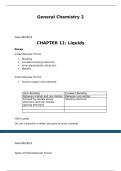
Ionic Bonding Covalent Bonding
Between metals and non metals Between non-metals
Formed by metals losing Sharing electrons
electrons and non metals
gaining electrons
H20 is polar
Oil can’t dissolve in water because its pure covalent
Date:08/28/25
Types of Intermolecular Forces
, 1. Ion-dipole
-between ionic and polar
compounds
2. Dipole-dipole
-between polar covalent
compounds
3.Dipole induced dipole (Debye-Forces)
-between polar and non-polar covalent
compounds
Polarisation is the distortion of a negatively charged ion's electron cloud
by a positively charged ion.
4.Induced Dipole-Dipole (London Dispersion)
-between nonpolar covalent compounds
Ice is less dense because has empty space in between
Increasing molar mass increase boiling point
High boiling point= very strong
What types of IMFs between the following
a.CH4
LDF
b.Water + CH3OH
LDF and HB
, c. Br2 + Water
LDF and dipole induced dipole
.
Liquids
Vaporisation: liquid to gas
Enthalpy of vaporisation-amount of heat to vaporise
Endothermic
Vapor pressure:
Condensation: gas to liquid
Enthalpy of condensation-amount to of heat to condense
Exothermic
Date:09/02/25
Surface Tension
-intermolecular forces between the molecules of water makes the surface
very stretchy so nothing can penetrate
-acts like skin
Capillary Action
-movement of liquid through very thin capillary tubes
-liquid moves through thin tubes because of capillary
action
- A convex meniscus forms when the cohesive forces within the liquid are
stronger than the adhesive forces to the container, causing the liquid to
pull away from the walls, resulting in an upward-curving surface
C>A
Date:08/26/25
CHAPTER 11: Liquids
Recap
Intramolecular Forces
Bonding
Covalent-sharing electrons
Ionic-electrostatic attraction
Metallic
Intermolecular Forces
Forces inside in the element
Ionic Bonding Covalent Bonding
Between metals and non metals Between non-metals
Formed by metals losing Sharing electrons
electrons and non metals
gaining electrons
H20 is polar
Oil can’t dissolve in water because its pure covalent
Date:08/28/25
Types of Intermolecular Forces
, 1. Ion-dipole
-between ionic and polar
compounds
2. Dipole-dipole
-between polar covalent
compounds
3.Dipole induced dipole (Debye-Forces)
-between polar and non-polar covalent
compounds
Polarisation is the distortion of a negatively charged ion's electron cloud
by a positively charged ion.
4.Induced Dipole-Dipole (London Dispersion)
-between nonpolar covalent compounds
Ice is less dense because has empty space in between
Increasing molar mass increase boiling point
High boiling point= very strong
What types of IMFs between the following
a.CH4
LDF
b.Water + CH3OH
LDF and HB
, c. Br2 + Water
LDF and dipole induced dipole
.
Liquids
Vaporisation: liquid to gas
Enthalpy of vaporisation-amount of heat to vaporise
Endothermic
Vapor pressure:
Condensation: gas to liquid
Enthalpy of condensation-amount to of heat to condense
Exothermic
Date:09/02/25
Surface Tension
-intermolecular forces between the molecules of water makes the surface
very stretchy so nothing can penetrate
-acts like skin
Capillary Action
-movement of liquid through very thin capillary tubes
-liquid moves through thin tubes because of capillary
action
- A convex meniscus forms when the cohesive forces within the liquid are
stronger than the adhesive forces to the container, causing the liquid to
pull away from the walls, resulting in an upward-curving surface
C>A


