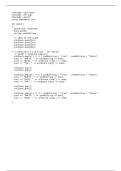
Tinahuynh On this page, you find all documents, package deals, and flashcards offered by seller tinahuynh. 68 Documents 0 Flashcards 0 Package deal Community 0 Followers 0 Following 48 items Everything Documents Flashcards Package deal Best sold Newest Rating Working with Data Structures: Queues (0) $12.99 0x sold A queue in data structures is a collection of elements that follows the First-In-First-Out (FIFO) principle, meaning that the first element added to the queue will be the first one to be removed. In C++, a queue can be implemented using the Standard Template Library (STL) with the `std::queue` class. 
 
Key operations associated with a queue include: 
 
1. **Enqueue**: Adding an element to the back of the queue. 
2. **Dequeue**: Removing an element from the front of the queue. 
3. **Peek/Front*... i x Other • 1 pages • by tinahuynh • uploaded 2025 Quick View i x Santiago Canyon College • CMPR 131 Working with Data Structures: Stacks (0) $9.99 0x sold A stack is a linear data structure that follows the Last In, First Out (LIFO) principle, meaning the last element added is the first one to be removed. In C++, a stack can be implemented using arrays or linked lists. The main operations associated with a stack are: 
 
1. **Push**: Adding an element to the top of the stack. 
2. **Pop**: Removing the element from the top of the stack. 
3. **Peek/Top**: Retrieving (but not removing) the top element of the stack. 
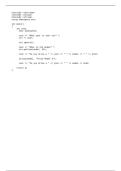
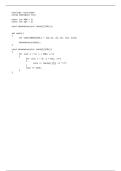
4. **Empty**: Checking if the stack... i x Other • 1 pages • by tinahuynh • uploaded 2025 Quick View i x Santiago Canyon College • CMPR 131 Using cin.ignore(), cin.getline(), and strcpy() (0) $8.49 0x sold The provided C++ program prompts the user to enter the year and model of their car. It then displays the information back to the user. After that, the program changes the model of the car to "Tesla Model S" and outputs the updated information. i x Other • 1 pages • by tinahuynh • uploaded 2025 Quick View i x Santiago Canyon College • CMPR 131 Using 2D Arrays (0) $8.49 0x sold The provided C++ code defines a program that initializes a 2D array (a table) with 3 rows and 2 columns containing integers. The `main` function initializes this array with specific values and then calls the `showValues` function to display the elements of the array. 
 
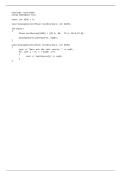
The `showValues` function takes a 2D array as an argument and uses nested loops to iterate through each element of the array, printing each value followed by a tab. After printing each row, it outputs a newline to separate the ro... i x Other • 1 pages • by tinahuynh • uploaded 2025 Quick View i x Santiago Canyon College • CMPR 131 Main file for Test Scores (0) $9.99 0x sold The provided code defines a program that initializes an array of test scores and displays them. It includes the necessary libraries and specifies a constant size for the array. The `main` function creates an array of five float values representing test scores, and then it calls the `displayScores` function to print these scores. The `displayScores` function takes the array and its size as parameters and iterates through the array, outputting each score to the console. i x Other • 1 pages • by tinahuynh • uploaded 2025 Quick View i x Santiago Canyon College • CMPR 131 student.h file Student Records (0) $8.49 0x sold The provided code snippet defines a structure named `Student` in C++. This structure contains three members: an integer `id`, a string `name`, and a pointer `next` that points to another `Student` struct. This setup suggests that `Student` could be used to create a linked list of student records, where each student node contains personal information and a reference to the next student in the list. i x Other • 1 pages • by tinahuynh • uploaded 2025 Quick View i x Santiago Canyon College • CMPR 131 main.h Student (0) $20.99 0x sold The provided code defines a simple linked list structure for managing student records. Its main functionalities include: 
 
1. **Inserting a Student**: The `insertStudent` function allows users to add a new student by capturing their ID and name, creating a new node, and inserting it at the head of the list. 
 
2. **Deleting a Student**: The `deleteStudent` function enables the removal of a student based on their ID. It traverses the list to find the specified ID, updates the pointers to maintai... i x Other • 2 pages • by tinahuynh • uploaded 2025 Quick View i x Santiago Canyon College • CMPR 131 Working with Accessing Deques (0) $8.49 0x sold The provided code snippet demonstrates the use of a `deque` (double-ended queue) in C++. Let's break down the functionality step by step: 
 
1. **Include Directives and Namespace**: 
 ```cpp 
 #include <iostream> 
 #include <deque> 
 using namespace std; 
 ``` 
 The code starts by including the necessary headers for input/output streaming (`<iostream>`) and for using the deque container (`<deque>`). The `using namespace std;` statement allows us to use standa... i x Book Other • 1 pages • by tinahuynh • uploaded 2025 Quick View i x Santiago Canyon College • CMPR 131 Starting Out with C++ from Control Structures to Objects • Tony Gaddis• ISBN 9780134498379 Working with Deque Indexes (0) $9.99 0x sold The provided C++ code uses the Standard Template Library (STL) `deque` (double-ended queue) to collect positive numbers from the user until the user inputs -1, which signals they want to quit. 
 
Here's a breakdown of the code: 
 
1. **Imports**: It includes the `<iostream>` header for input and output and `<deque>` for using the `deque` container. 
 
2. **Main Function**: The `main()` function starts execution. 
 
3. **Deque Initialization**: A `deque` named `numbers` is initiali... i x Book Other • 1 pages • by tinahuynh • uploaded 2025 Quick View i x Santiago Canyon College • CMPR 131 Starting Out with C++ from Control Structures to Objects • Tony Gaddis• ISBN 9780134498379 Working with deque (0) $12.99 0x sold This C++ file utilizes the Standard Template Library (STL) to work with a `deque`, which stands for double-ended queue. Here's a breakdown of what the code does: 
 
1. **Includes Required Headers**: It includes `<iostream>` for input and output operations and `<deque>` for using the `deque` container. 
 
2. **Main Function**: The program starts execution in the `main` function. 
 
3. **Deque Initialization**: A `deque` named `numbers` is created with an initial size of 5, which mean... i x Book Other • 1 pages • by tinahuynh • uploaded 2025 Quick View i x Santiago Canyon College • CMPR 131 Starting Out with C++ from Control Structures to Objects • Tony Gaddis• ISBN 9780134498379 1 2 3 4 5