

Learners Guide International
Are you striving for academic excellence and top grades? Look no further! At Learners Guide International we provide premium study materials purposely crafted to help you excel in your exams and achieve your academic goals.
- 77
- 0
- 3
Community
- Followers
- Following
80 items
Hesi A2 Vocabulary
Hesi A2 Vocabulary Proscribe - Forbid Holistic - Concerned with whole Repugnant - Offensive; to morals Exiguous - inadequency; lacking Untenable - No support; ground Clement - favorable Adversity - a state of burden or hardship Anecdote - a short story or account of an event Assiduous - diligent; hard-working Benevolent - showing sympathy, understanding, and generosity Boisterous - rough; rowdy; unruly Brazen - bold or unrestrained by normal standards Brusque - attitude of shortness...
- Summary
- • 7 pages •
Hesi A2 Vocabulary Proscribe - Forbid Holistic - Concerned with whole Repugnant - Offensive; to morals Exiguous - inadequency; lacking Untenable - No support; ground Clement - favorable Adversity - a state of burden or hardship Anecdote - a short story or account of an event Assiduous - diligent; hard-working Benevolent - showing sympathy, understanding, and generosity Boisterous - rough; rowdy; unruly Brazen - bold or unrestrained by normal standards Brusque - attitude of shortness...
PEDIATRIC HESI Questions and Correct Answers 2024 - 2025
PEDIATRIC HESI Questions and Correct Answers A 6-month-old infant with congestive heart failure (CHF) is receiving digoxin elixir. Which observation by the nurse warrants immediate intervention? Apical heart rate of 60. Sweating across the forehead. Doesn't suck well.s Respiratory rate of 30 breaths per minute. Apical heart rate of 60. A heart rate of 60 (A) is much lower than normal for a 6-month-old and warrants immediate intervention. The normal heart rate for a 6-month-old is 80 ...
- Exam (elaborations)
- • 92 pages •
PEDIATRIC HESI Questions and Correct Answers A 6-month-old infant with congestive heart failure (CHF) is receiving digoxin elixir. Which observation by the nurse warrants immediate intervention? Apical heart rate of 60. Sweating across the forehead. Doesn't suck well.s Respiratory rate of 30 breaths per minute. Apical heart rate of 60. A heart rate of 60 (A) is much lower than normal for a 6-month-old and warrants immediate intervention. The normal heart rate for a 6-month-old is 80 ...
Introduction to Nervous system and ICP
1. The human nervous system is capable of a wide range of functions. What is the basic unit of the nervous system? A. Glial cell B. Meninges C. Neuron D. Cerebrospinal fluid 2. The neuron cell is made up of which of the following parts? A. Axon B. Dendrite C. Nucleus D. All of the Above 3. Neurons come in which different type(s)? A. Sensory B. Motor C. Skeletal D. A and B Questions 4. How do neurons communicate with one another? A. Electrically B. Chemically C. Through weak, r...
- Exam (elaborations)
- • 15 pages •
1. The human nervous system is capable of a wide range of functions. What is the basic unit of the nervous system? A. Glial cell B. Meninges C. Neuron D. Cerebrospinal fluid 2. The neuron cell is made up of which of the following parts? A. Axon B. Dendrite C. Nucleus D. All of the Above 3. Neurons come in which different type(s)? A. Sensory B. Motor C. Skeletal D. A and B Questions 4. How do neurons communicate with one another? A. Electrically B. Chemically C. Through weak, r...

Brain Tumor and head injury
Q1// The nurse is performing a neurologic assessment of a patient whose injuries have rendered her unable to follow verbal commands. How should the nurse proceed with assessing the patients level of consciousness (LOC)? • A) Assess the patients vital signs and correlate these with the patients baselines. • B) Assess the patients eye opening and response to stimuli. • C) Document that the patient currently lacks a level of consciousness • D) Facilitate diagnostic testing in an eff...
- Exam (elaborations)
- • 13 pages •
Q1// The nurse is performing a neurologic assessment of a patient whose injuries have rendered her unable to follow verbal commands. How should the nurse proceed with assessing the patients level of consciousness (LOC)? • A) Assess the patients vital signs and correlate these with the patients baselines. • B) Assess the patients eye opening and response to stimuli. • C) Document that the patient currently lacks a level of consciousness • D) Facilitate diagnostic testing in an eff...
Nursing Management of Patients with Renal Disorders
Nursing Management of Patients with Renal Disorders Anatomic and Physiologic of Urinary System: The urinary system consist of (2) kidneys, (2) ureters, (1) bladder, and (1) urethra. Kidneys: - Located (behind and outside the peritoneal cavity) on the posterior wall of the abdomen from the 12th thoracic vertebra to the 3rd lumbar vertebra in the adult. - Adult kidney weighs 120 to 170 g, and is 12 cm (about 4.5 inches) long, 6 cm wide and 2.5 cm thick. - Each kidney contains about 1 mil...
- Summary
- • 13 pages •
Nursing Management of Patients with Renal Disorders Anatomic and Physiologic of Urinary System: The urinary system consist of (2) kidneys, (2) ureters, (1) bladder, and (1) urethra. Kidneys: - Located (behind and outside the peritoneal cavity) on the posterior wall of the abdomen from the 12th thoracic vertebra to the 3rd lumbar vertebra in the adult. - Adult kidney weighs 120 to 170 g, and is 12 cm (about 4.5 inches) long, 6 cm wide and 2.5 cm thick. - Each kidney contains about 1 mil...
Drugs Administration and Routines
Absorption and Drug Action • The function of the gastrointestinal tract is different in very young and the elderly. • Infants and the very elderly tend to be the most sensitive to the effects of the drugs. • Common problem is the slowed peristalsis and the gastric emptying time. • Activity and concentrations of digestive secretions are lower in new
- Package deal
- • 4 items •
- Drugs used in Cardiovascular system • Summary
- Drugs Acting on the Respiratory System • Summary
- ROUTES OF DRUG ADMINISTRATION • Summary
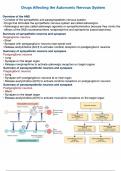
- Drugs Affecting the Autonomic Nervous System • Summary
Absorption and Drug Action • The function of the gastrointestinal tract is different in very young and the elderly. • Infants and the very elderly tend to be the most sensitive to the effects of the drugs. • Common problem is the slowed peristalsis and the gastric emptying time. • Activity and concentrations of digestive secretions are lower in new
Drugs Therapy across the Lifespan
Absorption and Drug Action • The function of the gastrointestinal tract is different in very young and the elderly. • Infants and the very elderly tend to be the most sensitive to the effects of the drugs. • Common problem is the slowed peristalsis and the gastric emptying time. • Activity and concentrations of digestive secretions are lower in newborns. • Infants and elderly require special considerations for medication administration. An example can be: absorption of medic...
- Summary
- • 38 pages •
Absorption and Drug Action • The function of the gastrointestinal tract is different in very young and the elderly. • Infants and the very elderly tend to be the most sensitive to the effects of the drugs. • Common problem is the slowed peristalsis and the gastric emptying time. • Activity and concentrations of digestive secretions are lower in newborns. • Infants and elderly require special considerations for medication administration. An example can be: absorption of medic...
Drugs Affecting the Autonomic Nervous System
Drugs Affecting the Autonomic Nervous System Overview of the ANS • Consists of the sympathetic and parasympathetic nervous system. • Drugs that stimulate the sympathetic nervous system are called adrenergics. • Adrenergics are also called adrenergic agonists or sympathomimetics because they mimic the effects of the SNS neurotransmitters norepinephrine and epinephrine (catecholamines). Summary of sympathetic neurons and synapses Preganglionic neurons • Short • Synapse with post...
- Package deal
- Summary
- • 4 pages •
Drugs Affecting the Autonomic Nervous System Overview of the ANS • Consists of the sympathetic and parasympathetic nervous system. • Drugs that stimulate the sympathetic nervous system are called adrenergics. • Adrenergics are also called adrenergic agonists or sympathomimetics because they mimic the effects of the SNS neurotransmitters norepinephrine and epinephrine (catecholamines). Summary of sympathetic neurons and synapses Preganglionic neurons • Short • Synapse with post...
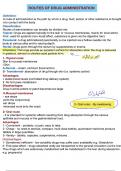
ROUTES OF DRUG ADMINISTRATION
Definition: A route of administration is the path by which a drug, fluid, poison or other substance is brought into contact with the body Classification Routes of administration can broadly be divided into: Topical: Drugs are applied topically to the skin or mucous membranes, mainly for local action. Oral: used for systemic (non-local) effect, substance is given via the digestive tract. Parenteral: A drug administered parenterally is one injected via a hollow needle into the body at vari...
- Package deal
- Summary
- • 4 pages •
Definition: A route of administration is the path by which a drug, fluid, poison or other substance is brought into contact with the body Classification Routes of administration can broadly be divided into: Topical: Drugs are applied topically to the skin or mucous membranes, mainly for local action. Oral: used for systemic (non-local) effect, substance is given via the digestive tract. Parenteral: A drug administered parenterally is one injected via a hollow needle into the body at vari...
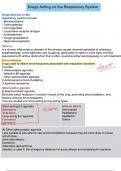
Drugs Acting on the Respiratory System
Drugs Acting on the Respiratory System Drugs that act on the respiratory system include • Bronchodilators • Corticosteroids • Cromoglycates • Leukotriene receptor antagon • Antihistamines • Cough preparations • Nasal decongestants Asthma is a chronic inflammatory disorder of the airways causes recurrent episodes of wheezing, breathlessness, chest tightness, and coughing, particularly at night or in the early morning associated with airflow obstruction that is often rev...
- Package deal
- Summary
- • 6 pages •
Drugs Acting on the Respiratory System Drugs that act on the respiratory system include • Bronchodilators • Corticosteroids • Cromoglycates • Leukotriene receptor antagon • Antihistamines • Cough preparations • Nasal decongestants Asthma is a chronic inflammatory disorder of the airways causes recurrent episodes of wheezing, breathlessness, chest tightness, and coughing, particularly at night or in the early morning associated with airflow obstruction that is often rev...