Summary ROUTES OF DRUG ADMINISTRATION
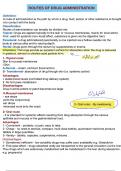
Definition: A route of administration is the path by which a drug, fluid, poison or other substance is brought into contact with the body Classification Routes of administration can broadly be divided into: Topical: Drugs are applied topically to the skin or mucous membranes, mainly for local action. Oral: used for systemic (non-local) effect, substance is given via the digestive tract. Parenteral: A drug administered parenterally is one injected via a hollow needle into the body at various sites and to varying depth. Rectal: Drugs given through the rectum by suppositories or enema. Inhalation: The lungs provide an excellent surface for absorption when the drug is delivered in gaseous, aerosol or ultrafine solid particle form. 1- Topical route: Skin & mucosal membranes I Skin A-Dermal – cream, ointment (local action) B- Transdermal- absorption of drug through skin (i.e. systemic action) Advantages: I. stable blood levels (controlled drug delivery system) II. No first pass metabolism Disadvantages: Drug must be potent or patch becomes too large II Mucosal membranes • eye drops (onto the conjunctiva) ear drops intranasal route (into the nose) 2- Oral route: - By swallowing. 2- Oral route: - It is intended for systemic effects resulting from drug absorption through the various epithelia and mucosa of the gastrointestinal tract.
Written for
- Institution
- Drugs
- Course
- Drugs
Document information
- Uploaded on
- October 6, 2024
- Number of pages
- 4
- Written in
- 2024/2025
- Type
- Summary
Subjects
- parenteral a drug admini
-
routes of drug administration
-
definition a route of administration is the path
-
topical drugs are applied topically to the skin o
-
oral used for systemic non local effect substa

Also available in package deal