Nataliedillon
On this page, you find all documents, package deals, and flashcards offered by seller nataliedillon.
- 67
- 0
- 1
Community
- Followers
- Following

68 items
Chapter 5: Cell membrane and transport
Topics: 
Components of the plasma membrane 
	Transport across membranes 
	Bulk transport mechanisms 
 
Learning Objectives: 
•	Calculate osmolarity and concentration gradients to classify transport processes as active or passive. 
•	Predict which regions of transmembrane proteins will be hydrophobic and hydrophilic. 
•	Identify the type of transport required for common molecules and substances.
- Class notes
- • 17 pages •
Topics: 
Components of the plasma membrane 
	Transport across membranes 
	Bulk transport mechanisms 
 
Learning Objectives: 
•	Calculate osmolarity and concentration gradients to classify transport processes as active or passive. 
•	Predict which regions of transmembrane proteins will be hydrophobic and hydrophilic. 
•	Identify the type of transport required for common molecules and substances.
Chapter8: Photosynthesis
Topics: 
Plants are autotrophs 
Chloroplast structure 
Light-dependent reactions 
Light-independent reactions 
 
Learning Objectives: 
•	Summarize the light-independent and light-dependent reactions of photosynthesis. 
•	Relate the mechanism and yields of photosynthesis to that of aerobic respiration. How are these two unique reactions similar and different?
- Class notes
- • 8 pages •
Topics: 
Plants are autotrophs 
Chloroplast structure 
Light-dependent reactions 
Light-independent reactions 
 
Learning Objectives: 
•	Summarize the light-independent and light-dependent reactions of photosynthesis. 
•	Relate the mechanism and yields of photosynthesis to that of aerobic respiration. How are these two unique reactions similar and different?
Microscopy Lab
you will be working with a partner to make slides of various plant materials to observe and document under the microscope. You will also test for the presence of starch by staining your samples with iodine solution.
- Class notes
- • 4 pages •
you will be working with a partner to make slides of various plant materials to observe and document under the microscope. You will also test for the presence of starch by staining your samples with iodine solution.
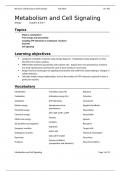
Chapter 6&9: metabolism & cell signaling
Topics: 
What is metabolism? 
Free energy and spontaneity 
Coupling ATP hydrolysis to endergonic reactions 
Enzymes 
Cell signaling 
 
Learning Objectives: 
•	Categorize metabolic reactions using energy diagrams. Manipulate energy diagrams to show the effect of enzyme catalysis. 
•	Differentiate between spontaneity and reaction rate. Explain how non-spontaneous reactions are made spontaneous and how the rate of slow reactions is increased. 
•	Assign chemical messengers to signaling mech...
- Class notes
- • 12 pages •
Topics: 
What is metabolism? 
Free energy and spontaneity 
Coupling ATP hydrolysis to endergonic reactions 
Enzymes 
Cell signaling 
 
Learning Objectives: 
•	Categorize metabolic reactions using energy diagrams. Manipulate energy diagrams to show the effect of enzyme catalysis. 
•	Differentiate between spontaneity and reaction rate. Explain how non-spontaneous reactions are made spontaneous and how the rate of slow reactions is increased. 
•	Assign chemical messengers to signaling mech...
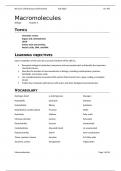
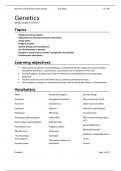
Chapter 3: Macromolecules
Topics: 
Chemistry review 
	Sugars and carbohydrates 
	Lipids 
	Amino acids and proteins 
	Nucleic acids, DNA, and RNA 
 
Learning Objectives: 
•	Recognize biological molecules (monomers and macromolecules) and identify the important chemical features. 
•	Describe the function of macromolecules in biology, including carbohydrates, proteins, fats/lipids, and nucleic acids. 
•	Use complementarity to produce RNA and/or DNA strands from a given coding or template strand. 
•	Predict how molec...
- Class notes
- • 26 pages •
Topics: 
Chemistry review 
	Sugars and carbohydrates 
	Lipids 
	Amino acids and proteins 
	Nucleic acids, DNA, and RNA 
 
Learning Objectives: 
•	Recognize biological molecules (monomers and macromolecules) and identify the important chemical features. 
•	Describe the function of macromolecules in biology, including carbohydrates, proteins, fats/lipids, and nucleic acids. 
•	Use complementarity to produce RNA and/or DNA strands from a given coding or template strand. 
•	Predict how molec...
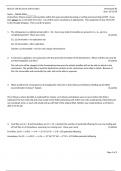
Genetics problems
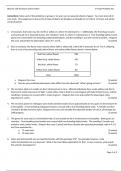
1.	In pea plants, round pea shape (R) is dominant to wrinkled pea shape (r) and green pod color (G) is dominant to yellow pod color (g). True-breeding wrinkled, green pod plants are bred to true-breeding round, yellow pod plants, yielding F1. The F1 plants are interbred to yield F2. 
 
2.	In garden tomatoes, round fruit (R) is dominant to oval fruit (r). Yellow fruit color (CY) is co-dominant with red fruit color (CR), such that the heterozygote CYCR has fruit with red and yellow splotches. ...
- Class notes
- • 7 pages •
1.	In pea plants, round pea shape (R) is dominant to wrinkled pea shape (r) and green pod color (G) is dominant to yellow pod color (g). True-breeding wrinkled, green pod plants are bred to true-breeding round, yellow pod plants, yielding F1. The F1 plants are interbred to yield F2. 
 
2.	In garden tomatoes, round fruit (R) is dominant to oval fruit (r). Yellow fruit color (CY) is co-dominant with red fruit color (CR), such that the heterozygote CYCR has fruit with red and yellow splotches. ...
Mitosis and Meiosis Problems
7 word problems about mitosis and meiosis, answers included
- Class notes
- • 3 pages •
7 word problems about mitosis and meiosis, answers included
Photosynthesis Problems
6 word problems about photosynthesis, answers included
- Class notes
- • 2 pages •
6 word problems about photosynthesis, answers included
Cellular Respiration Problems
3 word problems about cellular respiration, answers included
- Class notes
- • 1 pages •
3 word problems about cellular respiration, answers included
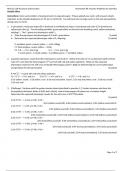
Cellular Transport Problems
6 problems about cellular transport, answers included
- Class notes
- • 3 pages •
6 problems about cellular transport, answers included