

Joselyngonzlezgarca
On this page, you find all documents, package deals, and flashcards offered by seller joselyngonzlezgarca.
- 4
- 0
- 0
Community
- Followers
- Following
4 items
Ratification of the US Constitution
These notes outline the key debates, compromises, and political conflicts involved in the creation and ratification of the U.S. Constitution. They cover the major plans proposed at the Constitutional Convention, the compromises that shaped the structure of the new government, the arguments between Federalists and Anti-Federalists, and the main features of each article of the Constitution, including how the government is organized and how amendments are added.
- Class notes
- • 4 pages •
These notes outline the key debates, compromises, and political conflicts involved in the creation and ratification of the U.S. Constitution. They cover the major plans proposed at the Constitutional Convention, the compromises that shaped the structure of the new government, the arguments between Federalists and Anti-Federalists, and the main features of each article of the Constitution, including how the government is organized and how amendments are added.
Challenges of The Articles of Constitution
The Articles of Confederation formed a very weak federal government where states held most of the power. Congress couldn’t tax, regulate commerce, or enforce laws, which led to financial problems, interstate conflicts, and an inability to respond to crises showing the need for a stronger Constitution.
- Class notes
- • 2 pages •
The Articles of Confederation formed a very weak federal government where states held most of the power. Congress couldn’t tax, regulate commerce, or enforce laws, which led to financial problems, interstate conflicts, and an inability to respond to crises showing the need for a stronger Constitution.
Types of Democracy
This study document breaks down the Types of Democracy required for AP Government and Politics, including participatory, pluralist, and elite models. Each section includes definitions, key characteristics, comparisons, and examples to strengthen understanding and support high-scoring FRQs and multiple-choice questions.
- Class notes
- • 3 pages •
This study document breaks down the Types of Democracy required for AP Government and Politics, including participatory, pluralist, and elite models. Each section includes definitions, key characteristics, comparisons, and examples to strengthen understanding and support high-scoring FRQs and multiple-choice questions.
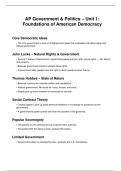
AP Government & Politics – Unit 1 Study Guide (Foundations of American Democracy)
AP Government & Politics – Unit 1 Complete Notes (Foundations of American Democracy) This study guide provides a clear, organized, and easy-to-understand overview of Unit 1. Includes detailed explanations of Enlightenment thinkers (Locke, Hobbes, Rousseau, Montesquieu), natural rights, social contract theory, popular sovereignty, limited government, separation of powers, federalism, and the origins of the U.S. Constitution. Formatted with clean bullet points, headings, and simplified definit...
- Class notes
- • 2 pages •
AP Government & Politics – Unit 1 Complete Notes (Foundations of American Democracy) This study guide provides a clear, organized, and easy-to-understand overview of Unit 1. Includes detailed explanations of Enlightenment thinkers (Locke, Hobbes, Rousseau, Montesquieu), natural rights, social contract theory, popular sovereignty, limited government, separation of powers, federalism, and the origins of the U.S. Constitution. Formatted with clean bullet points, headings, and simplified definit...