Dhanu93448
On this page, you find all documents, package deals, and flashcards offered by seller dhanu93448.
- 10
- 0
- 0
Community
- Followers
- Following
10 items
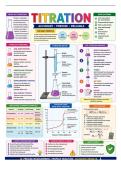
Titration experiment
A solution of known concentration (titrant) is slowly added to a solution of unknown concentration (analyte) until the reaction is complete. The point at which the reaction is complete is called the end point.
- Presentation
- • 1 pages •
-
• SCIENCE
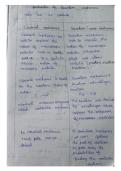
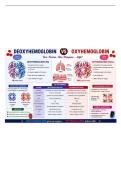
Oxyhaemoglobin and Deoxyhemoglobin Differentiate
Oxyhemoglobin and Deoxyhemoglobin are two functional forms of hemoglobin involved in oxygen transport in the blood. Oxyhemoglobin (HbO₂) is formed when hemoglobin binds oxygen in the lungs and carries it to body tissues. Deoxyhemoglobin (Hb) is hemoglobin without bound oxygen and is responsible for transporting carbon dioxide and returning to the lungs for reoxygenation. These two forms play a vital role in respiration, gas exchange, and maintaining life processes.
- Presentation
- • 1 pages •
-
• Science
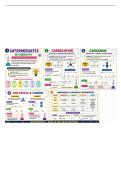
Intermediates
Reaction intermediates are highly reactive, short-lived chemical species formed during a multi-step reaction mechanism. They are produced in one step and consumed in the next, so they do not appear in the final balanced equation. Common intermediates include carbocations, carbanions, free radicals, carbenes, nitrenes, and benzyne. Understanding these intermediates helps explain reaction pathways, mechanisms, product formation, and reaction rates.
- Presentation
- • 1 pages •
-
• Science
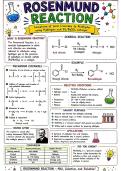
Reaction Mechanism
Rosenmund Reaction (Rosenmund Reduction) is an important organic name reaction in which an acid chloride (R–COCl) is selectively reduced to an aldehyde (R–CHO) using hydrogen gas (H₂) in the presence of a poisoned catalyst Pd/BaSO₄ (Palladium on Barium Sulfate). The poisoned catalyst prevents further reduction of the aldehyde into alcohol. This reaction was discovered by Karl Wilhelm Rosenmund in 1918 and is widely used in the preparation of aldehydes in organic synthesis, perfumes, phar...
- Presentation
- • 1 pages •
-
• Science
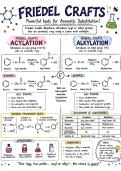
Naming reaction
Friedel–Crafts Reaction is an important organic reaction used to introduce an alkyl group (–R) or acyl group (–COR) into an aromatic ring like benzene in the presence of a Lewis acid catalyst such as anhydrous AlCl₃. It is a type of electrophilic aromatic substitution reaction. There are two types: Friedel–Crafts Alkylation and Friedel–Crafts Acylation. This reaction was discovered by Charles Friedel and James Crafts in 1877. It is widely used in the preparation of dyes, perfumes, ph...
- Presentation
- • 1 pages •
-
• Science
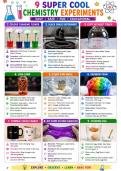
Scientific Fun
“Scientific Fun” is a colorful and interactive chemistry experiment project designed for Grade 6th to 10th students. It helps students understand science concepts through easy, safe, and exciting experiments with simple explanations, creative visuals, and real-life applications. This project makes learning chemistry fun, innovative, and engaging for young learners.
- Presentation
- • 1 pages •
-
• Science
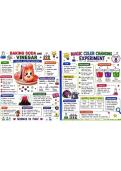
Science Fun experiment
These colorful Grade 8 science experiment posters explain simple and fun chemistry activities in an easy-to-understand way. The first poster shows the Baking Soda and Vinegar Chemical Reaction Experiment, where mixing baking soda and vinegar produces carbon dioxide gas, bubbles, and foam like a mini volcano. It includes the aim, materials, procedure, observations, chemical equation, explanation, uses, and safety precautions. The second poster explains the Magic Color Changing Experiment using r...
- Presentation
- • 1 pages •
-
• Science