

Chariotte
Sur cette page, vous trouverez tous les documents, offres groupées et cartes mémoire flash proposés par le vendeur CharIotte.
- 152
- 0
- 0
Community
- Abonnés
- Abbonements
11 Avis reçus
152 éléments
TEST BANK FOR HUMAN PHYSIOLOGY, 13TH EDITION: FOX
1 Student: ___________________________________________________________________________ 1. Physiology A. emphasizes cause-and-effect mechanisms. B. includes the fields of chemistry and psychology. C. ignores the scientific method. D. ultimately strives to understand the structures of individual cells. 2. The study of how disease or injury alters physiological processes is termed A. comparative physiology. B. the scientific method. C. pathophysiology. D. anatomy. 3. The study of diseas...
- Book
- Examen
- • 32 pages •
1 Student: ___________________________________________________________________________ 1. Physiology A. emphasizes cause-and-effect mechanisms. B. includes the fields of chemistry and psychology. C. ignores the scientific method. D. ultimately strives to understand the structures of individual cells. 2. The study of how disease or injury alters physiological processes is termed A. comparative physiology. B. the scientific method. C. pathophysiology. D. anatomy. 3. The study of diseas...
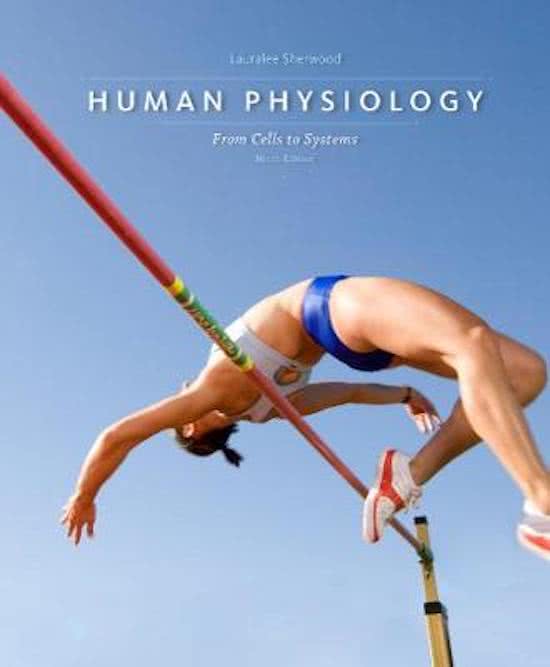
TEST BANK FOR HUMAN PHYSIOLOGY FROM CELLS TO SYSTEMS SHERWOOD 9TH EDITION
2 Chapter 1—Introduction to Physiology and Homeostasis MULTIPLE CHOICE 1. Select the incorrect association. a. anatomy/heart structure b. human body/multicellularity c. oxygen/cellular waste d. physiology/stomach function e. unicellularity/amoeba ANS: C PTS: 1 DIF: Comprehension 2. Which of the following is a mechanistic explanation of a physiological phenomenon? a. You breathe to obtain oxygen. b. You sweat to cool off. c. Your stomach secretes digestive juices when stimulated by...
- Book
- Examen
- • 16 pages •
2 Chapter 1—Introduction to Physiology and Homeostasis MULTIPLE CHOICE 1. Select the incorrect association. a. anatomy/heart structure b. human body/multicellularity c. oxygen/cellular waste d. physiology/stomach function e. unicellularity/amoeba ANS: C PTS: 1 DIF: Comprehension 2. Which of the following is a mechanistic explanation of a physiological phenomenon? a. You breathe to obtain oxygen. b. You sweat to cool off. c. Your stomach secretes digestive juices when stimulated by...
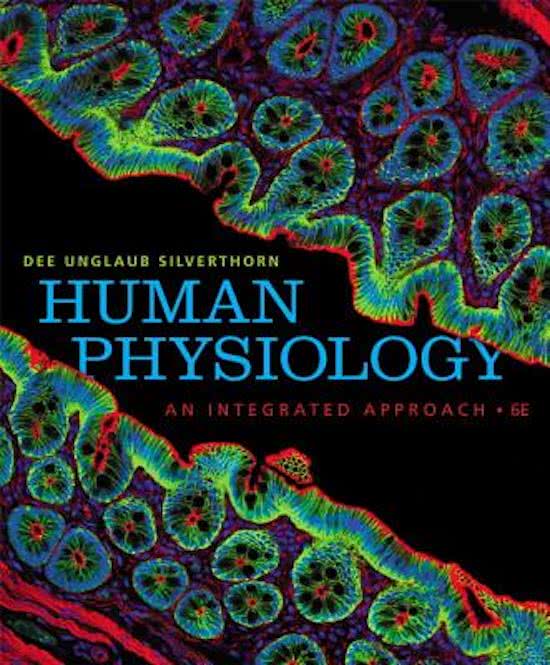
Test Bank for Human Physiology, 6th Edition: Dee Silverthorn
Human Physiology: An Integrated Approach, 6e (Silverthorn) Chapter 1 Introduction to Physiology 1) Physiology is the study of A) the structure of the body. B) the tissues and organs of the body at the microscopic level. C) growth and reproduction. D) the normal functions of the organ systems. E) the facial features as an indication of personality. Answer: D Section Title: The Science of Physiology Learning Outcome: 1.5 Skill: Level I: Reviewing Facts and Terms (Bloom's Taxonomy: Knowl...
- Book
- Examen
- • 22 pages •
Human Physiology: An Integrated Approach, 6e (Silverthorn) Chapter 1 Introduction to Physiology 1) Physiology is the study of A) the structure of the body. B) the tissues and organs of the body at the microscopic level. C) growth and reproduction. D) the normal functions of the organ systems. E) the facial features as an indication of personality. Answer: D Section Title: The Science of Physiology Learning Outcome: 1.5 Skill: Level I: Reviewing Facts and Terms (Bloom's Taxonomy: Knowl...
TEST BANK FOR INTRODUCTION TO GENETIC ANALYSIS, BY GRIFFITHS WESSLER 9TH EDITION
Multiple Choice 0 points Question A sample of normal double-stranded DNA was found to have a guanine content of 18%. What is the expected proportion of adenine? Answer 9% 32% 36% 68% 82% Multiple Choice 0 points Question In one strand of DNA the nucleotide sequence is 5'-ATGC-3'. The complementary sequence in the other strand must be Answer 3'-ATGC-5'. 3'-TACG-5'. 5'-ATCG-3'. 5'-CGTA-3'. 5'-TACG-3'. Multiple Choice 0 points Question How many different DNA molecule...
- Examen
- • 6 pages •
Multiple Choice 0 points Question A sample of normal double-stranded DNA was found to have a guanine content of 18%. What is the expected proportion of adenine? Answer 9% 32% 36% 68% 82% Multiple Choice 0 points Question In one strand of DNA the nucleotide sequence is 5'-ATGC-3'. The complementary sequence in the other strand must be Answer 3'-ATGC-5'. 3'-TACG-5'. 5'-ATCG-3'. 5'-CGTA-3'. 5'-TACG-3'. Multiple Choice 0 points Question How many different DNA molecule...
TEST BANK FOR MARIEB ESSENTIALS HUMAN ANATOMY PHYSIOLOGY REVISED EDITION 11TH EDITION
Essentials of Human Anatomy and Physiology, 11e, (Marieb) Chapter 1 The Human Body: An Orientation 1.1 Multiple Choice Part I Questions Using Figure 1.1, identify the following: 1) Identify the cavity that houses the spinal cord. A) Label A B) Label B C) Label C D) Label D E) Label E F) Label F Answer: B Page Ref: 43 Bloom's: 1) Knowledge 2) Label A points to the ________ cavity. A) thoracic B) pelvic C) cranial D) abdominal Answer: C Page Ref: 43 Bloom's: 1) KnowledgE
- Book
- Examen
- • 11 pages •
Essentials of Human Anatomy and Physiology, 11e, (Marieb) Chapter 1 The Human Body: An Orientation 1.1 Multiple Choice Part I Questions Using Figure 1.1, identify the following: 1) Identify the cavity that houses the spinal cord. A) Label A B) Label B C) Label C D) Label D E) Label E F) Label F Answer: B Page Ref: 43 Bloom's: 1) Knowledge 2) Label A points to the ________ cavity. A) thoracic B) pelvic C) cranial D) abdominal Answer: C Page Ref: 43 Bloom's: 1) KnowledgE
TEST BANK FOR PRINCIPLES OF ANATOMY AND PHYSIOLOGY TORTORA 14TH EDITION
Package Title: Testbank Course Title: PAP14 Chapter Number: 01 Question type: Multiple Choice 1) This is the study of the functions of body structures. a) anatomy b) physiology c) endocrinology d) histology e) immunology Answer: b Difficulty: Easy Learning Objective 1: LO 1.1 Define anatomy and physiology, and name several subspecialties of these sciences. Section Reference 1: 1.1 Anatomy and Physiology Defined 2) This is defined as a group of cells that work together to perform a...
- Book
- Examen
- • 11 pages •
Package Title: Testbank Course Title: PAP14 Chapter Number: 01 Question type: Multiple Choice 1) This is the study of the functions of body structures. a) anatomy b) physiology c) endocrinology d) histology e) immunology Answer: b Difficulty: Easy Learning Objective 1: LO 1.1 Define anatomy and physiology, and name several subspecialties of these sciences. Section Reference 1: 1.1 Anatomy and Physiology Defined 2) This is defined as a group of cells that work together to perform a...
TEST BANK FOR PRINCIPLES OF ANIMAL PHYSIOLOGY, 2ND EDITION: CHRISTOPHER D. MOYES
2 Chapter 1 Introduction to Physiological Principles Principles of Animal Physiology, 2e (Moyes/Schulte) 1) An explosion in physiological research occurred in the 1960s because A) there was an increase in the number of physiologists. B) physiologists in one specialty worked only with each other, concentrating their knowledge. C) physiologists began focusing on local species, rather than trying to study organisms from many areas. D) all of the above Answer: D Page Ref: 2 2) The Alpha ...
- Book
- Examen
- • 12 pages •
2 Chapter 1 Introduction to Physiological Principles Principles of Animal Physiology, 2e (Moyes/Schulte) 1) An explosion in physiological research occurred in the 1960s because A) there was an increase in the number of physiologists. B) physiologists in one specialty worked only with each other, concentrating their knowledge. C) physiologists began focusing on local species, rather than trying to study organisms from many areas. D) all of the above Answer: D Page Ref: 2 2) The Alpha ...
Test Bank for Principles of Human Physiology, 5th Edition: Cindy L. Stanfield
Chapter 1 1) The smallest living units capable of carrying out their own basic life functions are called A) cells. B) organelles. C) organs. D) organ systems. E) tissues. Answer: A 2) Cells are classified into which of the following four broad categories? A) squamous, cubodial, columnar, and basement membranes B) endocrine, nervous, integumentary, and reproductive C) atoms, tissues, organs, and organ systems D) neurons, muscle, epithelial, and connective tissue E) skeletal, cardiac,...
- Book
- Examen
- • 19 pages •
Chapter 1 1) The smallest living units capable of carrying out their own basic life functions are called A) cells. B) organelles. C) organs. D) organ systems. E) tissues. Answer: A 2) Cells are classified into which of the following four broad categories? A) squamous, cubodial, columnar, and basement membranes B) endocrine, nervous, integumentary, and reproductive C) atoms, tissues, organs, and organ systems D) neurons, muscle, epithelial, and connective tissue E) skeletal, cardiac,...
TEST BANK FOR SECTIONAL ANATOMY FOR IMAGING PROFESSIONALS, 3RD EDITION : KELLEY
Kelley: Sectional Anatomy for Imaging Professionals, 3rd Edition Chapter 1: Introduction to Sectional Anatomy Test Bank MULTIPLE CHOICE 1. A vertical plane that passes through the body, dividing it into anterior and posterior portions, is the plane. a. sagittal b. coronal c. axial d. oblique ANS: B REF: page 2 OBJ: Define the four anatomic planes. 2. The directional term contralateral refers to which of the following? a. On the same side b. On the opposite side c. Toward the midsag...
- Book
- Examen
- • 12 pages •
Kelley: Sectional Anatomy for Imaging Professionals, 3rd Edition Chapter 1: Introduction to Sectional Anatomy Test Bank MULTIPLE CHOICE 1. A vertical plane that passes through the body, dividing it into anterior and posterior portions, is the plane. a. sagittal b. coronal c. axial d. oblique ANS: B REF: page 2 OBJ: Define the four anatomic planes. 2. The directional term contralateral refers to which of the following? a. On the same side b. On the opposite side c. Toward the midsag...
Test Bank for Vander’s Human Physiology, 12th Edition: Eric Widmaier
Chapter 01 - Homeostasis: A Framework for Human Physiology Chapter 01 Homeostasis: A Framework for Human Physiology Multiple Choice Questions 1. The four broad categories of cells include those specialized for each of the following functions except A. Movement B. Synthesis of complex molecules C. Secretion D. Support E. Conduction of electrical impulses Bloom's Level: 1. Remember Section 1.02 Topic: Cells 2. Physiology is the study of A. How two organisms interact B. How organis...
- Book
- Examen
- • 21 pages •
Chapter 01 - Homeostasis: A Framework for Human Physiology Chapter 01 Homeostasis: A Framework for Human Physiology Multiple Choice Questions 1. The four broad categories of cells include those specialized for each of the following functions except A. Movement B. Synthesis of complex molecules C. Secretion D. Support E. Conduction of electrical impulses Bloom's Level: 1. Remember Section 1.02 Topic: Cells 2. Physiology is the study of A. How two organisms interact B. How organis...
Test Bank for Fundamentals of Anatomy and Physiology, 3rd Edition: Donald C. Rizzo
TEST BANK FOR DIAGNOSTIC MICROBIOLOGY, 4TH EDITION: MAHON
TEST BANK FOR HUMAN ANATOMY & PHYSIOLOGY LABORATORY MANUAL, CAT VERSION, 11 EDITION: ELAINE N. MARIEB
TEST BANK FOR CAMPBELL BIOLOGY CONCEPTS CONNECTIONS 8TH EDITION BY REECE
Not related to the book
TEST BANK FOR RAVEN BIOLOGY OF PLANTS, 8TH EDITION BY RAY F. EVERT