
Advance Pathophysiology (NSG 5003)
South University
Here are the best resources to pass Advance Pathophysiology (NSG 5003). Find Advance Pathophysiology (NSG 5003) study guides, notes, assignments, and much more.
Exam (elaborations)
Test Bank Pathophysiology The Biologic Basis For Disease In Adults And Children 8Th Edition, A Guide.
Test Bank - Pathophysiology: The Biologic Basis for Disease in Adults and Children (8th) Chapter 01: Cellular Biology Chapter 02: Altered Cellular and Tissue Biology: Environmental Agents Chapter 03: The Cellular Environment: Fluids and Electrolytes, Acids and Bases Chapter 04: Genes and Genetic Diseases Chapter 05: Genes, Environment-Lifestyle, and Common Diseases Chapter 06: Epigenetics and Disease Chapter 07: Innate Immunity: Inflammation and Wound Healing Chapter 08: Adaptive ImmunityChapter...
 reviewnurse
Exam (elaborations)
NSG5003 Week 5 |NSG 5003 Module 5 knowledge check – Advanced Pathophysiology – South University (A grade)
PopularNSG5003 Week 5 knowledge check – Advanced Pathophysiology – South University (A grade) Question 1 (1 point) 5 out of 5 correct Saved Which statement best describes the major characteristic of bronchiolitis? Question 1 options: Destruction of lung parenchyma and collapse of distal airways Obstruction by eosinophilic mucous plugs in the upper airway
 Bestanalytic

Exam (elaborations)
Gould’s Pathophysiology For The Health Professions,5th Edition_TEST BANK | 28 Chapters
Gould’s Pathophysiology For The Health Professions, 5thEdition TEST BANK 01: Introduction to Pathophysiology Chapter 01: Introduction to Pathophysiology Test Bank MULTIPLE CHOICE 1. Which of the following would be the most likely cause of an iatrogenic disease? a. An inherited disorder b. A combination of specific etiological factors c. An unwanted effect of a prescribed drug d. Prolonged exposure to toxic chemicals in the environment ANS: C REF: 6 2. The manifesta...
 Academiks
Exam (elaborations)
The Biologic Basis For Disease In Adults And Children, 5th Edition | Pathophysiology TEST BANK - _Huether & McCance
Pathophysiology The Biologic Basis For Disease In Adults And Children, 5th Edition Test Bank Chapter 01: Cellular Biology Huether and McCance: Understanding Pathophysiology, 5th Edition Chapter 01: Cellular Biology Test Bank MULTIPLE CHOICE 1. A student is observing a cell under the microscope. It is observed to have supercoiled DNA with histones. Which of the following would also be observed by the student? a. A single circular chromosome b. A nucleus c. Free-floating nucl...
Academiks
Exam (elaborations)
NSG 5003 / NSG5003 Pathophysiology Review Questions 6 (latest) – South University (A grade)
NSG 5003 Pathophysiology Review Questions 6 (latest) – South University (A grade) Pathophysiology Review Questions 6 A heat stroke is characterized by: a. Core temperatures usually reaching approximately 39.9° C (103.9° F) b. Sweat production on the face occurring even during dehydration c. A rapidly decreasing core temperature as heat loss from the evaporation of sweat ceases d. Symptoms caused by the loss of sodium and prolonged sweating Which medication is used to reverse th...
Bestanalytic
Exam (elaborations)
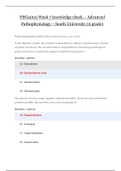
NSG5003 Week 7 | NSG 5003 Module 7 knowledge check – Advanced Pathophysiology – South University (A grade)
NSG5003 Week 7 knowledge check – Advanced Pathophysiology – South University (A grade) Whats highlighted in RED is the correct answer- 5/5- 100% In the digestive system, the stomach is stimulated by eating to produce large volumes of gastric secretions. The secretion that is responsible for converting pepsinogen to pepsin and acts as a bactericide against swallowed organisms is:
Bestanalytic
Exam (elaborations)
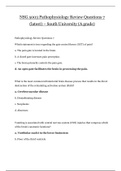
NSG 5003 / NSG5003 Pathophysiology Review Questions 7 (latest) – South University (A grade)
NSG 5003 Pathophysiology Review Questions 7 (latest) – South University (A grade) Pathophysiology Review Questions 7 Which statement is true regarding the gate control theory (GCT) of pain? a. The pain gate is located in the brain. b. A closed gate increases pain perception. c. The brain primarily controls the pain gate.
Bestanalytic
Exam (elaborations)
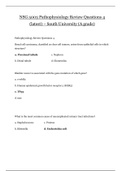
NSG 5003 / NSG5003 Pathophysiology Review Questions 4 (latest) – South University (A grade)
NSG 5003 Pathophysiology Review Questions 4 (latest) – South University (A grade) Pathophysiology Review Questions 4 Renal cell carcinoma, classified as clear cell tumors, arises from epithelial cells in which structure? a. Proximal tubule c. Nephron b. Distal tubule d. Glomerulus Bladder cancer is associated with the gene mutation of which gene? a. c-erbB2 b. Human epidermal growth factor receptor 2 (HER2) c. TP53 d. myc
Bestanalytic
Exam (elaborations)
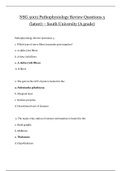
NSG 5003 / NSG5003 Pathophysiology Review Questions 5 (latest) – South University (A grade)
NSG 5003 Pathophysiology Review Questions 5 (latest) – South University (A grade) Pathophysiology Review Questions 5 1. Which type of nerve fibers transmits pain impulses? a. A-alpha (Aa) fibers b. A-beta (Ab) fibers c. A-delta (Ad) fibers d. B fibers 2. The gate in the GCT of pain is located in the: a. Substantia gelatinosa b. Marginal layer c. Nucleus proprius d. Dorsolateral tract of Lissauer 3. The major relay station of sensory information is located in the: a. Bas...
Bestanalytic
Exam (elaborations)
NSG5003 Week 6 |NSG 5003 Module 6 knowledge check – Advanced Pathophysiology – South University (A grade)
NSG5003 Week 6 knowledge check – Advanced Pathophysiology – South University (A grade) Week 6 Quiz 100% all answers are in BOLD Question 1 (1 point) Question 1 Saved Both iron and folate are vital to meet both the woman’s needs and those of the developing baby. They play an active role in the development of: A) Erythrocytes B) Leukocytes C) Neutrophils D) Platelets Question 2 (1 point) Question 2 Saved Within the first year of life, it is normal for a childs: A) Reticulocyte c...
Bestanalytic
Package deal
CP02 Advance Pathophysiology Week 1 Case Study & Discussion_Neurological – South University
CP02 Advance Pathophysiology case Study 1 _Neurological – South University CP02 Advance Pathophysiology Week 1 discussion – South University
Academiks
Essay
CP02 Advance Pathophysiology Week 5 discussion breath of fresh air – South University | Advance Pathophysiology Week 5 discussion breath of fresh air
Academiks
Other
CP02 Advance Pathophysiology Week 1 discussion – South University | CP02 Advance Pathophysiology Week 1 discussion
CP02 Advance Pathophysiology Week 1 discussion – South University Risk factors for myocardial infarction are age, sex, education, hypertension, diabetes, cholesterol, smoking, sedate lifestyle (Kiani, 2015). The study read it reports that education was a non-changeable factor; however, this student feels the education of all people can change. However, age and sex are non-changeable even in society today, the older a person is increasing the risk as well as the birth sex of a person, ...
Academiks
Case
CP02 Advance Pathophysiology case Study 1 _Neurological – South University | Advance Pathophysiology Case Study 1 _Neurological System
CP02 Advance Pathophysiology case Study 1 _Neurological – South University Neurological Neurological System Case Study - #1 Mrs. Smith is an 85-year female with a history of Hypertension, diabetes and osteoarthritis. Her daughter who cares for her reports that she became suddenly confused beginning last night. She recognizes her daughter but has been unable to remember her grandchildren’s names. She continuously asks her daughter “What are those kids doing in our house?” Her moth...
Academiks