
Biology
Bloomsburg University Of Pennsylvania
Here are the best resources to pass Biology. Find Biology study guides, notes, assignments, and much more.
Exam (elaborations)
Test Bank For Biology: Life On Earth With Physiology,10/E 10Th Edition Gerald Audesirk, Teresa Audesirk, Bruce E. Byers
Biology: Life on Earth with Physiology, 10e (Audesirk) Chapter 2 Atoms, Molecules, and Life 2.1 Multiple Choice Questions 1) A substance with specific properties that cannot be broken down or converted into another substance is called a(n) A) element. B) molecule. C) ion. D) compound. E) mixture. Answer: A Diff: 1 Section: 2.1 Skill: Knowledge/Comprehension 2) If you examined the human body, which of the following combinations of elements would be most common? A) C, O, P, S B) C...
 LoIa
LoIa
Exam (elaborations)
Test Bank For Biology: Science For Life With Physiology, 5Th Edition By Colleen M. Belk, Virginia Borden Maier
2 Biology: Science for Life with Physiology, 5e (Belk) Chapter 2 Science Fiction, Bad Science, and Pseudoscience: Water, Biochemistry, and Cells 1) Which feature is present in all known living things? A) genes made from proteins B) growth from inorganic materials C) absorption of sunlight for energy D) metabolic reactions Answer: D Section: 2.1 Skill: Knowledge/Comprehension (Remember/Understand) Learning Outcome: 2.1 2) Which term best describes the water in a sugarwater solution? ...
LoIa
Exam (elaborations)
Test Bank For Biology, 8Th Edition By Campbell
Chapter 1 Introduction: Themes in the Study of Life The introduction to the study of biology in Chapter 1 highlights seven book -wide themes, with special emphasis on the core theme of evolution. How scientists use inductive reasoning to draw general conclusions and deductive reasoning to test hypotheses is emphasized. Questions in this chapter are designed to help assess a student’s understanding of the content of Chapter 1 based on the three key concepts. Multiple-Choice Questions 1) ...
LoIa
Exam (elaborations)
Test Bank For Biology, 11Th Edition By Mader
ch2 Student: ___________________________________________________________________________ 1. Which of the following elements would be more reactive with other elements? A. boron, #5 B. neon, #10 C. argon, #18 D. helium, #2 2. Which of the following would be a proposed mechanism by which stomach antacids work? A. Antacids dilute the solution, therefore lowering the pH. B. Antacids are bases and by definition can absorb H+ out of a solution. C. Antacids are bases and by definition can abs...
LoIa
Exam (elaborations)
Test Bank For Brock Biology Of Microorganisms Madigan 13Th Edition
Exam Name___________________________________ MULTIPLE CHOICE. Choose the one alternative that best completes the statement or answers the question. 1) Which statement is generally NOT true? A) Microbial cells exist as single cells. B) Microbial cells exclude the cells of plants and animals. C) Microbial cells include both bacteria and viruses. D) Microbial cells carry out their life processes of growth independently. 1) 2) Basic microbiology can be used to A) model our understanding of...
LoIa
Exam (elaborations)
Test Bank For Burtons Microbiology For The Health Sciences 9 North Americanth Edition Paul G Engelkirk
1. Which of the following individuals is considered to be the “Father of Microbiology” ? A) Anton van Leeuwenhoek B) Louis Pasteur C) Robert Koch D) Rudolf Virchow 2. The microorganisms that usually live on or within a person are collectively referred to as A) germs. B) indigenous microflora. C) nonpathogens. D) opportunistic pathogens. 3. Microorganisms that live on dead and decaying organic material are known as A) indigenous microflora. B) parasites. C) pathogens. D) saprop...
LoIa
Exam (elaborations)
Test Bank For 2014 Foundations In Microbiology, 9Th Edition
Chapter 03 Tools of the Laboratory: Methods of Studying Microorganisms Multiple Choice Questions 1. The Six I's of studying microorganisms include all of the following except A. inoculation. B. incubation. C. infection. D. isolation. E. identification. ASM Objective: 07.01b Ability to apply the process of science: Analyze and interpret results from a variety of microbiological methods and apply these methods to analogous situations. ASM Topic: Module 07 Scientific Thinking Learning ...
LoIa
Exam (elaborations)
Test Bank For Campbell Biology 10Th Edition By Reece
Campbell Biology, 10e (Reece) Chapter 1 Evolution, the Themes of biology, and Scientific Inquiry 1) Cells are _____. A) only found in pairs, because single cells cannot exist independently B) limited in size to 200 and 500 micrometers in diameter C) characteristic of eukaryotic but not prokaryotic organisms D) characteristic of prokaryotic and eukaryotic organisms Answer: D Bloom's Taxonomy: Knowledge/Comprehension Section: 1.1 2) In comparison to eukaryotes, prokaryotes _____. A) ar...
LoIa
Exam (elaborations)
Test Bank For Campbell Biology Concepts And Connections, 7Th Edition: Reece
TABLE OF CONTENTS 1. Biology: Exploring Life I. THE LIFE OF THE CELL 2. The Chemical Basis of Life 3. The Molecules of Cells 4. A Tour of the Cell 5. The Working Cell 6. How Cells Harvest Chemical Energy 7. Photosynthesis: Using Light to Make Food II. CELLULAR REPRODUCTION AND GENETICS 8. The Cellular Basis of Reproduction and Inheritance 9. Patterns of Inheritance 10. Molecular Biology of the Gene 11. How Genes Are Controlled 12. DNA Technology and Genomics III. CONCEPTS OF EVOLU...
LoIa
Exam (elaborations)
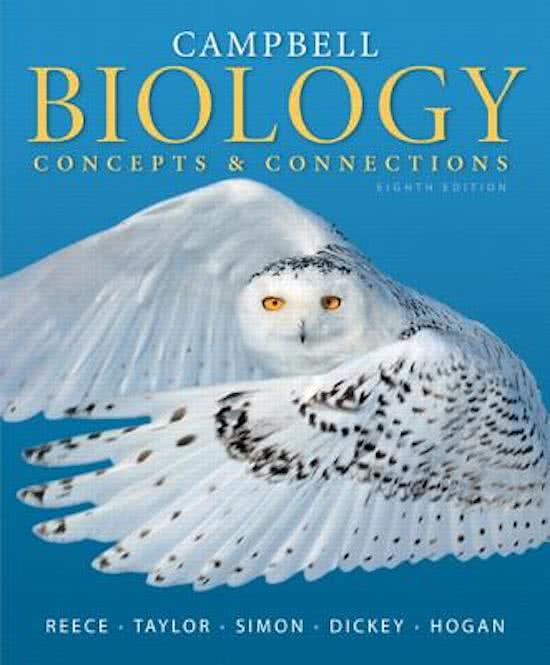
Test Bank For Campbell Biology Concepts Connections 8Th Edition By Reece
Test Bank for Campbell Biology Concepts Connections 8th Edition by Reece Campbell Biology: Concepts and Connections, 8e Chapter 2 The Chemical Basis of Life 2.1 Multiple-Choice Questions 1) The four most common elements in living organisms are A) C, H, O, Fe. B) C, H, O, Na. C) C, H, O, N. D) C, N, O, Na. Answer: C Topic: 2.1 Skill: Knowledge/Comprehension Learning Outcome: 2.1 2) Which of the following is a trace element in the human body? A) nitrogen B) zinc C) oxygen D) hydr...
LoIa
Exam (elaborations)
Test Bank For Campbell Biology In Focus, 1St Edition : Urry
Campbell Biology in Focus (Urry) Chapter 1 Introduction: Evolution and the Foundations of Biology 1.1 Multiple-Choice Questions 1) A localized group of organisms that belong to the same species is called a A) biosystem. B) community. C) population. D) ecosystem. E) family. Answer: C Topic: Concept 1.1 Skill: Knowledge/Comprehension Learning Outcome: 1.1 2) Organisms interact with their environments, exchanging matter and energy. For example, plant chloroplasts convert the energy of...
LoIa
Exam (elaborations)
Test Bank For Campbell Essential Biology, 5Th Edition: Simon
Campbell Essential Biology, 5e (Simon/Yeh) Chapter 1 Introduction: Biology Today Multiple-Choice Questions 1) In what way(s) is the science of biology influencing and changing our culture? A) by helping us understand the relevance of evolution to human health B) by revealing how mutations in genes can lead to disease C) by providing new tools for forensic investigations D) all of the above Answer: D Topic: 1.1 The Scope of Life Skill: Knowledge/Comprehension 2) What is biology? A) th...
LoIa
Exam (elaborations)
Test Bank For Clinical Immunology And Serology A Laboratory Perspective, 3Rd Edition: Stevens
1. Eosinophils are involved in the immune response against: A) viruses B) intracellular bacteria C) multicellular parasites D) extracellular bacteria 2. Which of the following are considered to be an acute phase protein? A) serum amyloid A B) streptolysin O C) cardiolipin D) reagin 3. A patient is tested for the presence of C-reactive protein and is found to have an elevated level. What does this indicate is taking place in the patient? A) inflammation B) nothing, the patient is nor...
LoIa
Exam (elaborations)
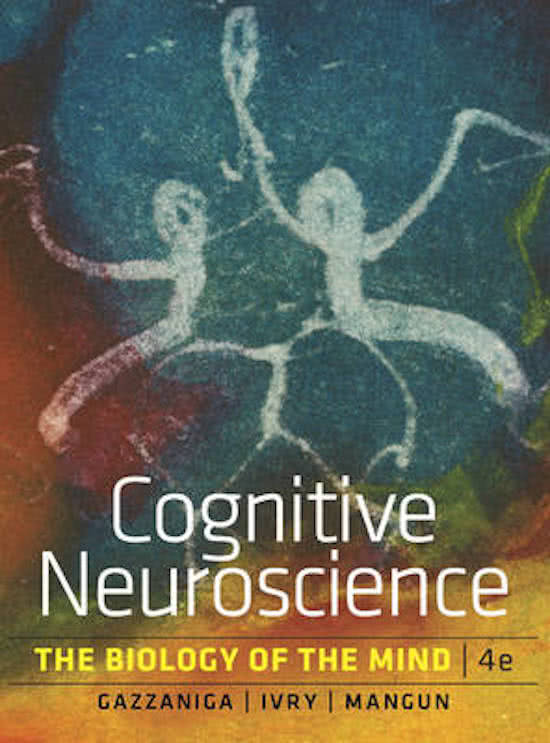
Test Bank For Cognitive Neuroscience The Biology Of The Mind 4Th Edition By Michael S Gazzaniga
LoIa
Exam (elaborations)
Test Bank For Concepts Of Biology, 2Nd Edition By Sylvia Mader
Chapter 01 Biology, the Study of Life Multiple Choice Questions 1. The main purpose of the queen fire ant is to A. find food. B. defend the eggs. C. produce food. D. produce eggs. E. defend food. The primary purpose of the queen fire ant is to produce thousands of eggs. Bloom's Level: 1. Remember Topic: Animals True / False Questions 2. The main reason why worker fire ants defend their nest and sting aggressors is to protect their food supply. FALSE The workers sting mainly to d...
LoIa
Exam (elaborations)
Test Bank For Diagnostic Microbiology, 4Th Edition: Mahon
TABLE OF CONTENTS PART I INTRODUCTION TO CLINICAL MICROBIOLOGY 1. Bacterial Cell Structure, Physiology, Metabolism, and Genetics 2. Host-Parasite Interaction 3. Laboratory Role in Infection Control 4. Control of Microorganisms 5. Performance Improvement in the Microbiology Laboratory 6. Specimen Collection and Processing 7. Microscopic Examination of Infected Materials 8. Use of Colonial Morphology for the Presumptive Identification of Microorganisms 9. Biochemical Identification of Gr...
LoIa
Exam (elaborations)
Test Bank For Essentials Of The Living World 4Th Edition George Johnson
Chapter 01 Test Bank Student: ___________________________________________________________________________ 1. Which group includes the simplest of organisms that do not have a nucleus? A. Plantae B. Eukaryotes C. Protista D. Fungi E. Archaea and Bacteria 2. Supernatural and ____________ hypotheses cannot be measured and tested and so are beyond the realm of scientific analyses. A. behavioral B. religious C. genetic D. fossils 3. Supernatural and ____________ hypotheses cannot be mea...
LoIa
Exam (elaborations)
Test Bank For Foundations In Microbiology, 8Th Edition: Kathleen P. Talaro
Chapter 01 Testbank Student: ___________________________________________________________________________ 1. Disease-causing microorganisms are called A. decomposers. B. procaryotes. C. pathogens. D. eucaryotes. E. fermenters. 2. The microorganisms that recycle nutrients by breaking down dead matter and wastes are called A. decomposers. B. prokaryotes. C. pathogens. D. eukaryotes. E. fermenters. 3. The microorganisms that do not have a nucleus in their cells are called A. decompose...
LoIa
Exam (elaborations)
Test Bank For Fundamentals Of Biochemistry: Life At The Molecular Level 5Th Edition Donald Voet Judith G. Voet Charlotte W. Pratt Isbn: 9781118918463
TABLE OF CONTENTS Part I Introduction 1 Introduction to the Chemistry of Life 2 Water Part II Biomolecules 3 Nucleotides, Nucleic Acids, and Genetic Information 4 Amino Acids 5 Proteins: Primary Structure 6 Proteins: Three-Dimensional Structure 7 Protein Function: Myoglobin and Hemoglobin, Muscle Contraction, and Antibodies 8 Carbohydrates 9 Lipids and Biological Membranes 10 Membrane Transport Part III Enzymes 11 Enzymatic Catalysis 12 Enzyme Kinetics, Inhibition, and Control 13...
LoIa
Exam (elaborations)
Test Bank For Genetics And Genomics For Nursing, 1St Edition: Carole A. Kenner
Kenner Genetics and Genomics for Nursing, 1/E Chapter 1 Question 1 Type: MCSA A client states, “My wife has been reading about the human genome project. Do you think that may help with my cancer treatment?” Which nursing response is most appropriate? 1. “While that work is interesting, it isn’t very far along.” 2. “In the future there may be some changes because of this project.” 3. “Some of the work of this project is changing the way we treat different diseases.” 4. ...
LoIa