

Firelands Regional Medical Center School Of Nursing
Meest recente samenvattingen op de Firelands Regional Medical Center School Of Nursing. Op zoek naar een samenvatting op de Firelands Regional Medical Center School Of Nursing? Wij hebben diverse samenvattingen voor jouw school of universiteit.
-
90
- 0
-
20
All courses for Firelands Regional Medical Center School Of Nursing
Laatste content Firelands Regional Medical Center School Of Nursing
1.A patient who is 32 weeks pregnant arrives with a three-day history of headache and notable swelling in her face and lower limbs. Her vital signs are as follows: BP: 160/90, HR: 105/min, RR: 19/min, SpO2: 94% on room air, Temp: 97.3°F. What medication should be administered first? A. Furosemide (Lasix) B. Magnesium Sulfate C. Labetalol (Trandate) D. Acetaminophen (Tylenol) Answer: B. Magnesium Sulfate 2. A patient with a history of alcohol use and seizures suddenly becomes diaphoreti...
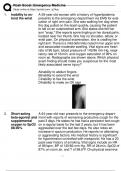
Rosh Boost: Emergency Medicine
Relias: Nursing Care of the Patient with Obstetric and Postpartum Hemorrhage Assessment During a cesarean, the provider communicates that the drapes have been suctioned out prior to the delivery of the placenta. The nurse notes the suction canister has 350 mL of blood-tinged fluid in it. The nurse quickly switches to a new suction canister prior to the delivery of the placenta. As the fascia is closed, the provider again suctions the drape, and the nurse notes 600 mL of blood in the new cani...

Relias ED RN A, Complete Test Fall 2023 What is the current recommended dose of intravenous or intraosseous epinephrine in adult patients with cardiac arrest? 10 mg every 10 minutes 1 mg every 3-5 minutes 1 mg every 7 minutes 0.1 mg every 2 minutes A patient with a traumatic brain injury (TBI) is MOST likely to suffer from what condition? Diabetes mellitus Cerebral palsy Diabetes Insipidus Myxedema coma A patient presents after sustaining a roll-over motor vehicle accident. They are complaining ...

Relias ED RN A, Complete Test Fall 2023 What is the current recommended dose of intravenous or intraosseous epinephrine in adult patients with cardiac arrest? 10 mg every 10 minutes 1 mg every 3-5 minutes 1 mg every 7 minutes 0.1 mg every 2 minutes A patient with a traumatic brain injury (TBI) is MOST likely to suffer from what condition? Diabetes mellitus Cerebral palsy Diabetes Insipidus Myxedema coma A patient presents after sustaining a roll-over motor vehicle accident. They are complaining ...

Relias ED RN A, Complete Test Fall 2023 What is the current recommended dose of intravenous or intraosseous epinephrine in adult patients with cardiac arrest? 10 mg every 10 minutes 1 mg every 3-5 minutes 1 mg every 7 minutes 0.1 mg every 2 minutes A patient with a traumatic brain injury (TBI) is MOST likely to suffer from what condition? Diabetes mellitus Cerebral palsy Diabetes Insipidus Myxedema coma A patient presents after sustaining a roll-over motor vehicle accident. They are complaining ...

Relias ED RN A, Complete Test Fall 2023 What is the current recommended dose of intravenous or intraosseous epinephrine in adult patients with cardiac arrest? 10 mg every 10 minutes 1 mg every 3-5 minutes 1 mg every 7 minutes 0.1 mg every 2 minutes A patient with a traumatic brain injury (TBI) is MOST likely to suffer from what condition? Diabetes mellitus Cerebral palsy Diabetes Insipidus Myxedema coma A patient presents after sustaining a roll-over motor vehicle accident. They are complaining ...

Relias ED RN A, Complete Test Fall 2023 What is the current recommended dose of intravenous or intraosseous epinephrine in adult patients with cardiac arrest? 10 mg every 10 minutes 1 mg every 3-5 minutes 1 mg every 7 minutes 0.1 mg every 2 minutes A patient with a traumatic brain injury (TBI) is MOST likely to suffer from what condition? Diabetes mellitus Cerebral palsy Diabetes Insipidus Myxedema coma A patient presents after sustaining a roll-over motor vehicle accident. They are complaining ...

Relias ED RN A, Complete Test Fall 2023 What is the current recommended dose of intravenous or intraosseous epinephrine in adult patients with cardiac arrest? 10 mg every 10 minutes 1 mg every 3-5 minutes 1 mg every 7 minutes 0.1 mg every 2 minutes A patient with a traumatic brain injury (TBI) is MOST likely to suffer from what condition? Diabetes mellitus Cerebral palsy Diabetes Insipidus Myxedema coma A patient presents after sustaining a roll-over motor vehicle accident. They are complaining ...
Relias ED RN A, Complete Test Fall 2023 What is the current recommended dose of intravenous or intraosseous epinephrine in adult patients with cardiac arrest? 10 mg every 10 minutes 1 mg every 3-5 minutes 1 mg every 7 minutes 0.1 mg every 2 minutes A patient with a traumatic brain injury (TBI) is MOST likely to suffer from what condition? Diabetes mellitus Cerebral palsy Diabetes Insipidus Myxedema coma A patient presents after sustaining a roll-over motor vehicle accident. They are complaining ...