
BIOD 151 A&P 1 (BIOD151AP)
Portage Learning
Here are the best resources to pass BIOD 151 A&P 1 (BIOD151AP). Find BIOD 151 A&P 1 (BIOD151AP) study guides, notes, assignments, and much more.
Exam (elaborations)
Portage Learning BIOD 151 A&P 1 Module 4:OCTOBER 2022
Portage Learning BIOD 151 A&P 1 Module 4:OCTOBER 2022
 AutoPass
Exam (elaborations)
Portage Learning BIOD 151 A&P 1 Module 6:OCTOBER 2022
PopularPortage Learning BIOD 151 A&P 1 Module 6:OCTOBER 2022
AutoPass
Exam (elaborations)
BIOD 151 A&P 1 Exam 4 (100 out of 100) Questions and Verified Answers (New Update) Guaranteed Pass
BIOD 151 A&P 1 Exam 4 (100 out of 100) Questions and Verified Answers (New Update) Guaranteed Pass
 ScholarVaultPRO
Exam (elaborations)
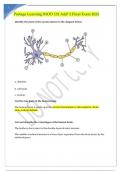
Portage Learning BIOD 152 A&P 2 Final Exam 2024
Portage Learning BIOD 152 A&P 2 Final Exam 2024
 TutorExpert
Exam (elaborations)
PORTAGE LEARNING BIOD 151 A&P 1 MODULE 4 Exam 202 Questions and Answers (2023 / 2024) (Verified Answers)
PORTAGE LEARNING BIOD 151 A&P 1 MODULE 4 Exam 202 Questions and Answers (2023 / 2024) (Verified Answers)
 NurseFerian
Exam (elaborations)
Portage Learning BIOD 151 FINAL EXAM A&P 1 Completed with Accurate Answers
Portage Learning BIOD 151 FINAL EXAM A&P 1 Portage Learning BIOD 151 FINAL EXAM A&P 1 Completed with Accurate Answers Question 2 5 / 5 pts Portage Learning BIOD 151 FINAL EXAM A&P 1 List two organs contained in the abdominal cavity. Your Answer: small intestine and large intestine The abdominal cavity contains the stomach, intestines, spleen and liver True or False? a. The purpose of cellular respiration is to produce ADP. (T or F) b. Peripheral proteins are found on the outer surfa...
 grade_bender
Exam (elaborations)
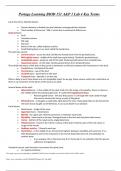
Portage Learning BIOD 151 A&P 1 Lab 6Key Terms A & P 1 - Lab 6 Key Terms. Portage Learning BIOD 151 A&P 1 Lab 6Key Terms A & P 1 - Lab 6 Key Terms Muscular System: Appendicular Muscles Any muscle that acts on our arms, legs, shoulder blade, pectoral an
grade_bender
Exam (elaborations)
portage Learning BIOD 151 A&P 1 Lab 4 Key Terms Lab 4 Key Terms: Skeletal System
portage Learning BIOD 151 A&P 1 Lab 4 Key Terms Lab 4 Key Terms: Skeletal System portage Learning BIOD 151 A&P 1 Lab 4 Key Terms Lab 4 Key Terms: Skeletal System portage Learning BIOD 151 A&P 1 Lab 4 Key Terms Lab 4 Key Terms: Skeletal System
grade_bender
Exam (elaborations)
Portage Learning BIOD 151 A&P 1 Module 4 completed with Answers.
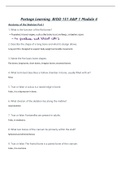
Portage Learning BIOD 151 A&P 1 Module 4 completed with Answers. Portage Learning BIOD 151 A&P 1 Module 4 Anatomy of the Skeleton Part I 1. What is the function of the flat bones? 2. Describe the shape of a long bone and what its design allows. Long and thin. Designed to support body weight and enable movement. 3. Name the five basic bone shapes. Flat bones, long bones, short bones, irregular bones, sesamoid bones. 4. What term best describes a hollow chamber in bone, usually filled wi...
grade_bender
Exam (elaborations)
Portage Learning Biod 151 A&P 1 Module 5 Exam
PORTAGE LEARNING BIOD 151 A&P 1 MODULE 5 Exam Note: Essay answers must clearly be in your own words. All multiple-choice questions have one answer unless otherwise specified. Choose the best response with the information provided. Answer the following five true or false questions: 1. There are five types of muscle tissue found in the body. False, only 3 2. Cardiac and smooth muscle tissue are both under involuntary control. True 3. The musculocutaneous nerve is part of the central nervous system...
PhysioTherapist
Exam (elaborations)
Portage Learning Biod 151 A&P 1 Module 5 Exam
PORTAGE LEARNING BIOD 151 A&P 1 MODULE 5 Exam Note: Essay answers must clearly be in your own words. All multiple-choice questions have one answer unless otherwise specified. Choose the best response with the information provided. Answer the following five true or false questions: 1. There are five types of muscle tissue found in the body. False, only 3 2. Cardiac and smooth muscle tissue are both under involuntary control. True 3. The musculocutaneous nerve is part of the central nervous system...
 Pharmacia
Exam (elaborations)
Portage Learning Biod 151 A&P 1 Module 5 Exam
PORTAGE LEARNING BIOD 151 A&P 1 MODULE 5 Exam Note: Essay answers must clearly be in your own words. All multiple-choice questions have one answer unless otherwise specified. Choose the best response with the information provided. Answer the following five true or false questions: 1. There are five types of muscle tissue found in the body. False, only 3 2. Cardiac and smooth muscle tissue are both under involuntary control. True 3. The musculocutaneous nerve is part of the central nervous system...
 earlystudy
Exam (elaborations)
Portage Learning Biod 151 A&P 1 Module 3 Exam
PORTAGE LEARNING BIOD 151 A&P 1 MODULE 3 Exam Note: Essay answers must clearly be in your own words. All multiple choice questions haveone answer unless otherwise specified. Choose the best response with the information provided. Answer the following two questions: 1. Explain why a patient with liver disease would have intolerance to fatty foods. The liver produces bile which breaks down fats. If it is not producing bile (or less bile), fats willnot be broken down effectively. 2. Explain in deta...
PhysioTherapist
Exam (elaborations)
Portage Learning Biod 151 A&P 1 Module 3 Exam
PORTAGE LEARNING BIOD 151 A&P 1 MODULE 3 Exam Note: Essay answers must clearly be in your own words. All multiple choice questions haveone answer unless otherwise specified. Choose the best response with the information provided. Answer the following two questions: 1. Explain why a patient with liver disease would have intolerance to fatty foods. The liver produces bile which breaks down fats. If it is not producing bile (or less bile), fats willnot be broken down effectively. 2. Explain in deta...
Pharmacia
Exam (elaborations)
Portage Learning Biod 151 A&P 1 Module 3 Exam
PORTAGE LEARNING BIOD 151 A&P 1 MODULE 3 Exam Note: Essay answers must clearly be in your own words. All multiple choice questions haveone answer unless otherwise specified. Choose the best response with the information provided. Answer the following two questions: 1. Explain why a patient with liver disease would have intolerance to fatty foods. The liver produces bile which breaks down fats. If it is not producing bile (or less bile), fats willnot be broken down effectively. 2. Explain in deta...
earlystudy
Exam (elaborations)
Portage Learning BIOD 151 A&P 1 Lab 1 Exam
Portage Learning BIOD 151 A&P 1 Lab 1 Exam Course BIOD 151 Institution Portage Learning Susan Smith is a participant in an Anatomy and Physiology lab class. Susan walked into lab today carrying a bagged lunch that she brought to eat following class. She has long blonde hair that is not pulled back. Today in class, you are reviewing basic microscopy and you notice that Susan’s microscope is partially hanging off the edge of her lab bench. Given what you learned from the lab video, list two lab ...
PhysioTherapist
Exam (elaborations)
Portage Learning BIOD 151 A&P 1 Lab 1 Exam
Portage Learning BIOD 151 A&P 1 Lab 1 Exam Course BIOD 151 Institution Portage Learning Susan Smith is a participant in an Anatomy and Physiology lab class. Susan walked into lab today carrying a bagged lunch that she brought to eat following class. She has long blonde hair that is not pulled back. Today in class, you are reviewing basic microscopy and you notice that Susan’s microscope is partially hanging off the edge of her lab bench. Given what you learned from the lab video, list two lab ...
Pharmacia
Exam (elaborations)
Portage Learning BIOD 151 A&P 1 Lab 1
Portage Learning BIOD 151 A&P 1 Lab 1 Exam Course BIOD 151 Institution Portage Learning Susan Smith is a participant in an Anatomy and Physiology lab class. Susan walked into lab today carrying a bagged lunch that she brought to eat following class. She has long blonde hair that is not pulled back. Today in class, you are reviewing basic microscopy and you notice that Susan’s microscope is partially hanging off the edge of her lab bench. Given what you learned from the lab video, list two lab ...
earlystudy
Exam (elaborations)
Portage Learning BIOD 151 A&P 1 Lab 7 Exam
Question 1 2.5 / 2.5 pts Give the definition of what a tissue is. Your Answer: A tissue is a grouping of similar cells that work together to perform a specific function. Question 2 2.5 / 2.5 pts Which of the following statements is FALSE regarding the four primary classes of tissue in the body? Epithelial tissue functions in secretion and protection. Connective tissue functions in absorption. The correct answer is that connective tissue functions to bind tissues and anchor organs. Nervous tissue...
PhysioTherapist
Exam (elaborations)
Portage Learning BIOD 151 A&P 1 Lab 7 Exam
Question 1 2.5 / 2.5 pts Give the definition of what a tissue is. Your Answer: A tissue is a grouping of similar cells that work together to perform a specific function. Question 2 2.5 / 2.5 pts Which of the following statements is FALSE regarding the four primary classes of tissue in the body? Epithelial tissue functions in secretion and protection. Connective tissue functions in absorption. The correct answer is that connective tissue functions to bind tissues and anchor organs. Nervous tissue...
Pharmacia
Exam (elaborations)
Portage Learning BIOD 151 A&P 1 Lab 7 Exam
Question 1 2.5 / 2.5 pts Give the definition of what a tissue is. Your Answer: A tissue is a grouping of similar cells that work together to perform a specific function. Question 2 2.5 / 2.5 pts Which of the following statements is FALSE regarding the four primary classes of tissue in the body? Epithelial tissue functions in secretion and protection. Connective tissue functions in absorption. The correct answer is that connective tissue functions to bind tissues and anchor organs. Nervous tissue...
earlystudy
Exam (elaborations)
Portage Learning BIOD 151 A&P 1 Lab 5 Exam
A specialist in the field of myology would study : muscles bones mental functions hormones Discuss how muscles help in the function of communication: Your Answer: The muscles that we have responsible for: • movement around the mouth and neck that help with speech • non-verbal expressions (facial) • swallowing Muscles contract to allow us to speak; both verbal and nonverbal communication (facial expressions)
PhysioTherapist