

NSG5003 (NSG5003)
Chamberlain College Of Nursing
Here are the best resources to pass NSG5003 (NSG5003). Find NSG5003 (NSG5003) study guides, notes, assignments, and much more.
Exam (elaborations)
NSG5003 Week 2 Study Guide Chapters 7 – 11 (Questions With Answers Rated A+)
NSG5003 Week 2 Study Guide Chapters 7 – 11 (Questions With Answers Rated A+) This is an all-inclusive guide to NSG5003 Week 2 Study Guide Chapters 7 – 11. Which action is a purpose of the inflammatory process? a. To provide specific responses toward antigens b. To lyse cell membranes of microorganisms c. To prevent infection of the injured tissue d. To create immunity against subsequent tissue injury 2. How do surfactant proteins A through D provide innate resistance? a. Initiate the...
 DRBRIGHT2026
Exam (elaborations)
NSG 5003 MIDTERM EXAM LATEST 2023 SPRING SUMMER SESSION In examination of the nose, the clinician observes gray, pale mucous membranes with clear, serous discharge. This is most likely indicative of: Allergic rhinitis Your patient complains of a feeli
PopularNSG 5003 MIDTERM EXAM LATEST 2023 SPRING SUMMER SESSION In examination of the nose, the clinician observes gray, pale mucous membranes with clear, serous discharge. This is most likely indicative of: Allergic rhinitis Your patient complains of a feeling of heaviness in the lower legs daily. You note varicosities, edema, and dusky color of both ankles and feet. Which of the following is the most likely cause for these signs? Venous insufficiency Which of the following is the most i...
 TOPNURS
Package deal
pathophysiology exam bundle questions and answers
pathophysiology exam bundle questions and answers
 PASSINGMASTER01
Exam (elaborations)
NSG_5003__Advanced_Pathophysiology_Exam_3_Practice_Questions With 100% Correct & Verified Answers
NSG 5003 | NSG5003- Advanced Pathophysiology Exam 3 practice questions The primary characteristic that differentiates the immune response from other protective mechanisms is that the immune response is: specific to the antigen that initiates it. B lymphocytes mature and undergo changes that commit them to becoming B cells in the: bone marrow. What is the term for the process in which lymphoid stem cells migrate from the bone marrow to the central lymphoid organs (the thymus or bone marro...
 Splendid
Exam (elaborations)
ADVANCED PATHOPHYSIOLOGY
. It is important to not dilate the eye if is suspected. Cataract Macular degeneration Acute closed-angle glaucoma Chronic open-angle glaucoma Question 2. 2. An 18-year-old female patient presents with repeated urinary tract infections. She has no risk factors in her history, and her physical examination is unremarkable. She also has a normal pelvic exam. Which of the following should be obtained if anatomic abnormalities are suspected? Ultrasound of the kidneys Intravenous pyelog...
ALAINE88
Exam (elaborations)
NSG5003 Week 9 QUESTIONS AND CORRECT ANSWERS 2023
NSG5003 Week 9 QUESTIONS AND CORRECT ANSWERS 2023 Cheyne–Stokes respirations are described as a: Question 1 options: Sustained, deep, rapid but regular pattern of breathing Crescendo-decrescendo pattern of breathing, followed by a period of apnea Prolonged inspiratory period, gradually followed by a short expiratory period Completely irregular breathing pattern with random, shallow, deep breaths and irregular pauses Question 2 (1 point) Vomiting is associated with CNS injuries that ...
 onlinetutor2025
Exam (elaborations)
Week 2 Dialong Case Study: Janet, a 20 year-old college student, is experiencing a five-week history of itchy eyes and nasal congestion with watery nasal discharge. She also complains of a “tickling” cough, especially at night, and she has had episodes
Week 2 Dialong Case Study: Janet, a 20 year-old college student, is experiencing a five-week history of itchy eyes and nasal congestion with watery nasal discharge. She also complains of a “tickling” cough, especially at night, and she has had episodes of repetitive sneezing. Janet gets frequent “colds” every spring and fall. Physical Examination Vital Signs: Temp, 98.8; BP 110/68; Pulse 72; Respirations 18 Skin: Flaking erythematous rash on the flexor surfaces of both arms ...
TOPNURS
Exam (elaborations)
NSG 5003 Advanced Pathophysiology Final Exam Questions and Answers (Graded A).
NSG 5003 Advanced Pathophysiology Final Exam Questions and Answers (Graded A). 1. It is important to not dilate the eye if ____ is suspected. Question 2. 2. An 18-year-old female patient presents with repeated urinary tract infections. She has no risk factors in her history, and her physical examination is unremarkable. She also has a normal pelvic exam. Which of the following should be obtained if anatomic abnormalities are suspected? Question 4. 4. Which of the following is the most imp...
 RNMaria
Exam (elaborations)
NSG 5003 Week 3 Quiz Advanced Patho, LATEST- 2020) ADVANCED PATHOPHYSIOLOGY SOUTH UNIVERSITY, Complete Solution guide. Quiz Week 3 - Answers in Bold - 100% Correct Question 1 (0.5 points) Question 1 Saved Oncogenes are genes that are capable of: Question
NSG 5003 Week 3 Quiz Advanced Patho, LATEST- 2020) ADVANCED PATHOPHYSIOLOGY SOUTH UNIVERSITY, Complete Solution guide. Quiz Week 3 - Answers in Bold - 100% Correct Question 1 (0.5 points) Question 1 Saved Oncogenes are genes that are capable of: Question 1 options: a) Undergoing mutation that directs the synthesis of proteins to accelerate the rate of tissue proliferation b) Directing synthesis of proteins to regulate growth and to provide necessary replacement of tissue c) Encoding proteins th...
 LectJordan
Exam (elaborations)
NSG5003 Week 9 Neuro Quiz 2022
NSG5003 Week 9 Neuro Quiz Cheyne–Stokes respirations are described as a: Question 1 options: Sustained, deep, rapid but regular pattern of breathing Crescendo-decrescendo pattern of breathing, followed by a period of apnea Prolonged inspiratory period, gradually followed by a short expiratory period Completely irregular breathing pattern with random, shallow, deep breaths and irregular pauses Question 2 (1 point) Vomiting is associated with CNS injuries that compress which of the bra...
 lectdenis
Exam (elaborations)
NSG5003 Week 2 Patho Quiz
NSG5003 Week 2 Patho Quiz 1. Question : During a stress response, the Th1 response is suppressed by which hormone? Student Answer: Adrenocorticotropic hormone (ACTH) Cortisol Prolactin Growth hormone Instructor Explanation: Stress can activate an excessive immune response and, through cortisol and catecholamines, suppress the Th1 response, causing a Th2 shift. This response is not active by any of the other options. Points Received: 0.5 of 0.5 Comments: Question 2. Question : Th...
lectdenis
Exam (elaborations)
NSG5003 Week 2 Patho Quiz
NSG5003 Week 2 Patho Quiz 1. Question : During a stress response, the Th1 response is suppressed by which hormone? Student Answer: Adrenocorticotropic hormone (ACTH) Cortisol Prolactin Growth hormone Instructor Explanation: Stress can activate an excessive immune response and, through cortisol and catecholamines, suppress the Th1 response, causing a Th2 shift. This response is not active by any of the other options. Points Received: 0.5 of 0.5 Comments: Question 2. Question : Th...
lectdenis
Package deal
NSG 5003 Quiz 1 | NSG5003 Week 2 Patho Quiz | NSG 5003 Midterm Exam | NSG 5003 Week 5 Midterm Questions & Answers & NSG 5003 Week 9 Neuro Quiz.
NSG 5003 Quiz 1 | NSG5003 Week 2 Patho Quiz | NSG 5003 Midterm Exam | NSG 5003 Week 5 Midterm Questions & Answers & NSG 5003 Week 9 Neuro Quiz.
DRBRIGHT2026
Exam (elaborations)
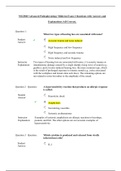
NSG5003 Advanced Pathophysiology Midterm Exam 2 Questions with Answers and Explanations (All Correct).
NSG5003 Advanced Pathophysiology Midterm Exam 2 Questions with Answers and Explanations (All Correct).
CollegeProfessor
Exam (elaborations)
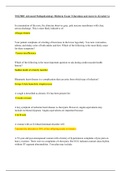
NSG5003 Advanced Pathophysiology Midterm Exam 3 Questions and Answers (Graded A)
NSG5003 Advanced Pathophysiology Midterm Exam 3 Questions and Answers (Graded A)
CollegeProfessor