Tutorial 1
Orbital: a specific area that contains electrons with a certain energy.
s, p, d orbitals.
1. There’s only 1 type of s-orbital.
2. There are 3 types of p orbitals: px, py, Pz.
P orbitals have perpendicular position.
3. There are 5 types of d orbitals.
Covalent bond: an overlap of partially filled atomic orbitals (AO).
Formation: 2 atoms approach each other closely. The singly occupied orbital
on atom A overlaps with the singly occupied orbital on atom B.
Molecular orbital (MO): a set of interacting atomic orbitals.
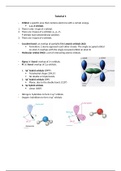
Sigma (σ ) bond: overlap of 2 s-orbitals.
Pi (π) bond: overlap of 2 p-orbitals.
1. Sp3 hybrid orbitals (SPPP)
Tetrahedral shape (109,5o)
No double or triple bonds.
2. Sp2 hybrid orbitals (SPP)
Planar, due to the double bond, (120o)
3. Sp hybrid orbitals
Linear (180o)
Nitrogen: hybridizes to form 4 sp3 orbitals.
Oxygen: hybridizes to form 4 sp3 orbitals.
, Tutorial 2
Ionic bond: held together by electrostatic attractions between unlike charges ( + and
– charge)
Nonpolar covalent bond: 2 electrons are share equally by the 2 bonding atoms (C-C).
Polar covalent bond: the electron distribution between 2 atoms is unequal.
Due to a difference in electronegativity.
Electronegativity (EN) generally increases from left to
right and from bottom to top.
Electron rich: δ -
Electron poor: δ +
The lone-pair electrons on oxygen and nitrogen stick
out into space away from the positively charged nuclei.
Resonance form: an intermediate structure of the same molecule, but with a certain
charge on a different position.
A resonance form is only imaginary and thus not an official structure!
Resonance hybrid: a ‘’summary’’ of the resonance structures.
Resonance forms only differ in the placement of their π-electrons.
Brønsted-Lowry acid: can donate a H+ ion to a base
Brønsted-Lowry base: can accept a H+ ion from an acid.
Lewis acid: can accept an electron pair from a base.
All electrophiles are Lewis acids (BF3, AlCl3)
Lewis base: can donate an electron pair to an acid.
All nucleophiles are Lewis bases.
Non-covalent interactions are also called Vander Waals forces.
1. Dipole-dipole.
2. Dispersion forces.
Between all neighboring molecules)
3. Hydrogen bonds
Between O and H & N and H.
Tutorial 3
Orbital: a specific area that contains electrons with a certain energy.
s, p, d orbitals.
1. There’s only 1 type of s-orbital.
2. There are 3 types of p orbitals: px, py, Pz.
P orbitals have perpendicular position.
3. There are 5 types of d orbitals.
Covalent bond: an overlap of partially filled atomic orbitals (AO).
Formation: 2 atoms approach each other closely. The singly occupied orbital
on atom A overlaps with the singly occupied orbital on atom B.
Molecular orbital (MO): a set of interacting atomic orbitals.
Sigma (σ ) bond: overlap of 2 s-orbitals.
Pi (π) bond: overlap of 2 p-orbitals.
1. Sp3 hybrid orbitals (SPPP)
Tetrahedral shape (109,5o)
No double or triple bonds.
2. Sp2 hybrid orbitals (SPP)
Planar, due to the double bond, (120o)
3. Sp hybrid orbitals
Linear (180o)
Nitrogen: hybridizes to form 4 sp3 orbitals.
Oxygen: hybridizes to form 4 sp3 orbitals.
, Tutorial 2
Ionic bond: held together by electrostatic attractions between unlike charges ( + and
– charge)
Nonpolar covalent bond: 2 electrons are share equally by the 2 bonding atoms (C-C).
Polar covalent bond: the electron distribution between 2 atoms is unequal.
Due to a difference in electronegativity.
Electronegativity (EN) generally increases from left to
right and from bottom to top.
Electron rich: δ -
Electron poor: δ +
The lone-pair electrons on oxygen and nitrogen stick
out into space away from the positively charged nuclei.
Resonance form: an intermediate structure of the same molecule, but with a certain
charge on a different position.
A resonance form is only imaginary and thus not an official structure!
Resonance hybrid: a ‘’summary’’ of the resonance structures.
Resonance forms only differ in the placement of their π-electrons.
Brønsted-Lowry acid: can donate a H+ ion to a base
Brønsted-Lowry base: can accept a H+ ion from an acid.
Lewis acid: can accept an electron pair from a base.
All electrophiles are Lewis acids (BF3, AlCl3)
Lewis base: can donate an electron pair to an acid.
All nucleophiles are Lewis bases.
Non-covalent interactions are also called Vander Waals forces.
1. Dipole-dipole.
2. Dispersion forces.
Between all neighboring molecules)
3. Hydrogen bonds
Between O and H & N and H.
Tutorial 3