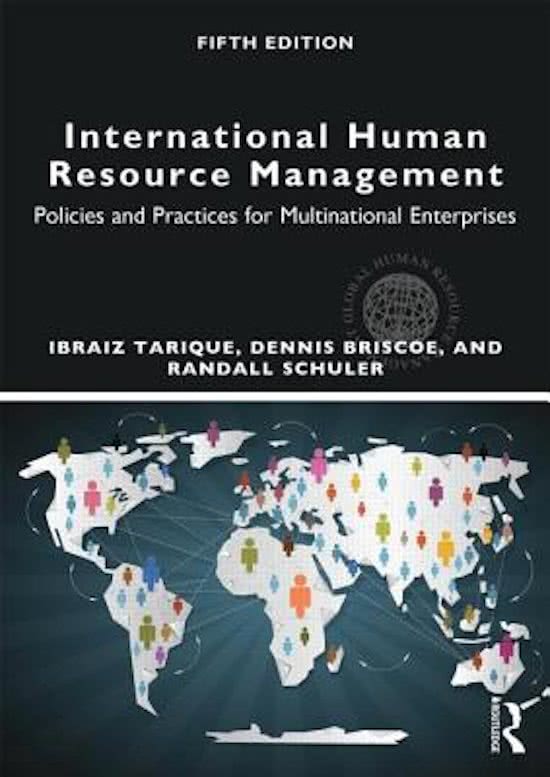
International Human Resource Management
The study and application of all human resource management activities as they impact the process
of managing human resources in enterprises in the global environment.
Learning objectives chapter 1:
1. How can you describe the many drivers of the internationalization of business?
2. How can you describe the growth and spread of internationalization?
3. How can you describe the different settings of international hrm?
4. Discuss the development of international hrm
The field of international human resource management is the study and application of all human
resource management activities as they impact the process of managing human resources in
enterprises in the global environment. HRM in the multinational enterprise (MNE) is playing an
increasingly significant role in providing solutions in business problems at the global level.
The drivers of the internationalization of business
Trade
Agreements
Homogenizati Search for
on of culture new markets
and consumer and reduced
demands costs
Rapid and
extensive
E- global
commerce communicati
on
Drivers
Rapid
development
Knowledge
and transfer
sharing
of new
Improving
technology
Increased global
travel and education
migration and a global
talent pool
1. Trade agreements
• Trade between countries and within regions of the world is constantly increasing on a global
basis, regionally, and thorough bilateral trade treaties between two countries
• Decreased trade barriers and open markets have resulted in faster-growing
economies throughout the world
• Local and national governments support and encourage growing cross-border trade and
foreign investment
• The center of global trade is moving away from the developed countries of Western
Europe, North America, and Asia Pacific to China, South Asia, and even Latin
America, Eastern Europe, the Middle East, and Africa
2. Search for new markets and reduced costs
• Global competition comes from anywhere and everywhere
• Competition forces organizations to search for new markets and revenues and lower costs,
often best found in other countries → See the relocation to China of many companies!
,3. Rapid and extensive global communication
• The technological revolution (e.g., the internet) has made global communication much
easier, quicker, cheaper, and more varied. It enables the spread of information (on a global
basis) about: how people live, what they think, what they want
• Creates global expectations for an ever-increasing quality of life
4. Rapid development and transfer of new technology
• New technologies are developed around the world and are made available everywhere
• New technologies make it possible to grow and manufacture products and deliver
services with world-class quality and prices everywhere
• Modern education and information technology allow every country to play a part in this
global economy → See now the development of 3D printers!
5. Improving global education and global talent pool
• Improving education around the world is enabling firms everywhere to produce world-class
products and services
• No country or set of countries has an overriding advantage in the global economy
• There is now a global talent pool that allows firms to operate almost anywhere in the world
today
6. Increased travel and migration
• International travel has become easier, quicker, and cheaper
• Hundreds of millions of people travel across national borders every year, for business
and pleasure
• They see how people in other countries live and experience goods and services that
are available, all of which may be better than what is known at home
• Millions of people move to other countries to work
• Relocate, usually for a limited time
• Fill jobs for which there are not enough local workers
• Flee natural disasters or political conflicts
7. Knowledge sharing
• Firms operating internationally “export” their management philosophies and techniques to
their foreign subsidiaries
• Spread their knowledge and their company cultures everywhere
8. E-commerce
• The World Wide Web and global transportation and logistics services have made it possible
for large, as well as small, firms to conduct business virtually
• If a business or an individual has a website, its business is global—anyone, from anywhere in
the world who has access to the web, has access to that website
9. Homogenization of culture and consumer demands
• Integration of cultures and values have led to common consumer demands for some types of
products and services throughout the world
• Distinct differences in culture across countries remain
• Firms operating internationally need to be sensitive to these local differences
, The growth and spread of internationalization
• Internationalization vs. globalization
• Both terms refer to the ever-increasing interaction, interconnectedness, and
integration of people, companies, cultures, and countries
• Beginning of globalization
• 50 years ago, the US economy accounted for 53% of global GDP
• Today, the US economy accounts for less than 28% global GDP
See also the Netherlands: more and more export oriented
• Business rankings found in publications such as Fortune Global 500 and Bloomberg Business
Week focus on the largest global firms
• Rankings focus on large, publicly traded firms
• Findings illustrate that the global economy increasingly involves all kinds of products
and services from around the world
• IHRM plays an important role in attaining ranking
• HR is called upon to recruit, select, develop, and retain work force talent that can
achieve internationalization and global competitiveness
The development of international HRM
Internationalizing HRM is a difficult and complex task because: different HR managers (from
headquarters, the host country, a third country) end up being sandwiched → the managers must
learn to integrate and coordinate policies and practices taking place in different environments.
Chapter 2 Strategic International Human Resource Management
Learning objectives
• Can you describe the development of SIHRM and the process of international strategic
management?
• Can you describe the evolution of the MNE in terms of various stages of internationalization
and the methods firms use to enter international markets?
• Can you describe the process for developing MNE strategy and IHRM strategy and the
relationship between the two?
SIHRM
• SIHRM focuses on creating and implementing IHRM policies and practices that help achieve
an MNE’s international strategy
• Involves the strategic management of the IHR function and department itself
Basis elements of the strategic management process
Original vision, Environmental Strategy Strategy Evaluation and
mission, goals scanning formulation implementation control
Evolution of the multinational enterprise
• As a firm internationalizes, it moves through stages
• In each stage it must make a choice of methods for market entry
• With each stage, the degree of international activity increases and IHRM responsibilities
become increasingly complex
The study and application of all human resource management activities as they impact the process
of managing human resources in enterprises in the global environment.
Learning objectives chapter 1:
1. How can you describe the many drivers of the internationalization of business?
2. How can you describe the growth and spread of internationalization?
3. How can you describe the different settings of international hrm?
4. Discuss the development of international hrm
The field of international human resource management is the study and application of all human
resource management activities as they impact the process of managing human resources in
enterprises in the global environment. HRM in the multinational enterprise (MNE) is playing an
increasingly significant role in providing solutions in business problems at the global level.
The drivers of the internationalization of business
Trade
Agreements
Homogenizati Search for
on of culture new markets
and consumer and reduced
demands costs
Rapid and
extensive
E- global
commerce communicati
on
Drivers
Rapid
development
Knowledge
and transfer
sharing
of new
Improving
technology
Increased global
travel and education
migration and a global
talent pool
1. Trade agreements
• Trade between countries and within regions of the world is constantly increasing on a global
basis, regionally, and thorough bilateral trade treaties between two countries
• Decreased trade barriers and open markets have resulted in faster-growing
economies throughout the world
• Local and national governments support and encourage growing cross-border trade and
foreign investment
• The center of global trade is moving away from the developed countries of Western
Europe, North America, and Asia Pacific to China, South Asia, and even Latin
America, Eastern Europe, the Middle East, and Africa
2. Search for new markets and reduced costs
• Global competition comes from anywhere and everywhere
• Competition forces organizations to search for new markets and revenues and lower costs,
often best found in other countries → See the relocation to China of many companies!
,3. Rapid and extensive global communication
• The technological revolution (e.g., the internet) has made global communication much
easier, quicker, cheaper, and more varied. It enables the spread of information (on a global
basis) about: how people live, what they think, what they want
• Creates global expectations for an ever-increasing quality of life
4. Rapid development and transfer of new technology
• New technologies are developed around the world and are made available everywhere
• New technologies make it possible to grow and manufacture products and deliver
services with world-class quality and prices everywhere
• Modern education and information technology allow every country to play a part in this
global economy → See now the development of 3D printers!
5. Improving global education and global talent pool
• Improving education around the world is enabling firms everywhere to produce world-class
products and services
• No country or set of countries has an overriding advantage in the global economy
• There is now a global talent pool that allows firms to operate almost anywhere in the world
today
6. Increased travel and migration
• International travel has become easier, quicker, and cheaper
• Hundreds of millions of people travel across national borders every year, for business
and pleasure
• They see how people in other countries live and experience goods and services that
are available, all of which may be better than what is known at home
• Millions of people move to other countries to work
• Relocate, usually for a limited time
• Fill jobs for which there are not enough local workers
• Flee natural disasters or political conflicts
7. Knowledge sharing
• Firms operating internationally “export” their management philosophies and techniques to
their foreign subsidiaries
• Spread their knowledge and their company cultures everywhere
8. E-commerce
• The World Wide Web and global transportation and logistics services have made it possible
for large, as well as small, firms to conduct business virtually
• If a business or an individual has a website, its business is global—anyone, from anywhere in
the world who has access to the web, has access to that website
9. Homogenization of culture and consumer demands
• Integration of cultures and values have led to common consumer demands for some types of
products and services throughout the world
• Distinct differences in culture across countries remain
• Firms operating internationally need to be sensitive to these local differences
, The growth and spread of internationalization
• Internationalization vs. globalization
• Both terms refer to the ever-increasing interaction, interconnectedness, and
integration of people, companies, cultures, and countries
• Beginning of globalization
• 50 years ago, the US economy accounted for 53% of global GDP
• Today, the US economy accounts for less than 28% global GDP
See also the Netherlands: more and more export oriented
• Business rankings found in publications such as Fortune Global 500 and Bloomberg Business
Week focus on the largest global firms
• Rankings focus on large, publicly traded firms
• Findings illustrate that the global economy increasingly involves all kinds of products
and services from around the world
• IHRM plays an important role in attaining ranking
• HR is called upon to recruit, select, develop, and retain work force talent that can
achieve internationalization and global competitiveness
The development of international HRM
Internationalizing HRM is a difficult and complex task because: different HR managers (from
headquarters, the host country, a third country) end up being sandwiched → the managers must
learn to integrate and coordinate policies and practices taking place in different environments.
Chapter 2 Strategic International Human Resource Management
Learning objectives
• Can you describe the development of SIHRM and the process of international strategic
management?
• Can you describe the evolution of the MNE in terms of various stages of internationalization
and the methods firms use to enter international markets?
• Can you describe the process for developing MNE strategy and IHRM strategy and the
relationship between the two?
SIHRM
• SIHRM focuses on creating and implementing IHRM policies and practices that help achieve
an MNE’s international strategy
• Involves the strategic management of the IHR function and department itself
Basis elements of the strategic management process
Original vision, Environmental Strategy Strategy Evaluation and
mission, goals scanning formulation implementation control
Evolution of the multinational enterprise
• As a firm internationalizes, it moves through stages
• In each stage it must make a choice of methods for market entry
• With each stage, the degree of international activity increases and IHRM responsibilities
become increasingly complex