Math 113 – Calculus III Exam 3 Practice Problems Fall 2005
1. Suppose the motion of a particle is given by
x = 4 cos t, y = sin t.
(a) Describe the motion of the particle, and sketch the curve along which the particle
travels.
(b) Find the velocity and acceleration vectors of the particle.
(c) Find the times t and the points on the curve where the speed of the particle is
greatest.
(d) Find the times t and the points on the curve where the magnitude of the acceler-
ation is greatest.
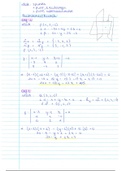
2. Find the coordinates of the points where the line
x = t, y = 1 + t, z = 5t
intersects the surface
z = x2 + y 2 .
3. Let
2
g(x, y, z) = e−(x+y) + z 2 (x + y).
Suppose that a piece of fruit is sitting on a table in a room, and at each point (x, y, z)
in the space within the room, g(x, y, z) gives the strength of the odor of the fruit.
Furthermore, suppose that a certain bug always flies in the direction in which the
fruit odor increases fastest. Suppose also that the bug always flies with a speed of 2
feet/second.
What is the velocity vector of the bug when it is at the position (2, −2, 1)?
4. The path of a particle in space is given by the functions x(t) = 2t, y(t) = cos(t), and
z(t) = sin(t). Suppose the temperature in this space is given by a function H(x, y, z).
Find dH
dt
, the rate of change of the temperature at the particle’s position. (Since the
actual function H(x, y, z) is not given, your answer will be in terms of derivatives of
H.)
1
, 5. Let
f (x, y) = x3 − xy + cos(π(x + y)).
(a) Find a vector normal to the level curve f (x, y) = 1 at the point where x = 1,
y = 1.
(b) Find the equation of the line tangent to the level curve f (x, y) = 1 at the point
where x = 1, y = 1.
(c) Find a vector normal to the graph z = f (x, y) at the point x = 1, y = 1.
(d) Find the equation of the plane tangent to the graph z = f (x, y) at the point
x = 1, y = 1.
6. Suppose f is a differentiable function such that
f (1, 3) = 1, fx (1, 3) = 2, fy (1, 3) = 4,
fxx (1, 3) = 2, fxy (1, 3) = −1, and fyy (1, 3) = 4.
(a) Find gradf (1, 3).
(b) Find a vector in the plane that is perpendicular to the contour line f (x, y) = 1 at
the point (1, 3).
(c) Find a vector that is perpendicular to the surface z = f (x, y) (i.e. the graph of
f ) at the point (1, 3, 1).
(d) At the point (1, 3), what is the rate of change of f in the direction ~i + ~j?
(e) Use a quadratic approximation to estimate f (1.2, 3.3).
7. We say that a line in 3-space is normal to a surface at a point of intersection if the
line is normal to (i.e. perpendicular to) the tangent plane of the surface at that point.
Let S be the surface defined by
x2 + y 2 + 2z 2 = 4.
(a) Find the parametric equations of the line that is normal to the surface S at the
point (1, 1, 1).
(b) The line found in (a) will intersect the surface S at two points. One of them is
(1, 1, 1), by construction. Find the other point of intersection.
8. Let
f (x, y) = (x − y)3 + 2xy + x2 − y.
(a) Find the function L(x, y) that gives the linear approximation of f near the point
(1, 2).
(b) Find the function Q(x, y) that gives the quadratic approximation of f near the
point (1, 2)
2
1. Suppose the motion of a particle is given by
x = 4 cos t, y = sin t.
(a) Describe the motion of the particle, and sketch the curve along which the particle
travels.
(b) Find the velocity and acceleration vectors of the particle.
(c) Find the times t and the points on the curve where the speed of the particle is
greatest.
(d) Find the times t and the points on the curve where the magnitude of the acceler-
ation is greatest.
2. Find the coordinates of the points where the line
x = t, y = 1 + t, z = 5t
intersects the surface
z = x2 + y 2 .
3. Let
2
g(x, y, z) = e−(x+y) + z 2 (x + y).
Suppose that a piece of fruit is sitting on a table in a room, and at each point (x, y, z)
in the space within the room, g(x, y, z) gives the strength of the odor of the fruit.
Furthermore, suppose that a certain bug always flies in the direction in which the
fruit odor increases fastest. Suppose also that the bug always flies with a speed of 2
feet/second.
What is the velocity vector of the bug when it is at the position (2, −2, 1)?
4. The path of a particle in space is given by the functions x(t) = 2t, y(t) = cos(t), and
z(t) = sin(t). Suppose the temperature in this space is given by a function H(x, y, z).
Find dH
dt
, the rate of change of the temperature at the particle’s position. (Since the
actual function H(x, y, z) is not given, your answer will be in terms of derivatives of
H.)
1
, 5. Let
f (x, y) = x3 − xy + cos(π(x + y)).
(a) Find a vector normal to the level curve f (x, y) = 1 at the point where x = 1,
y = 1.
(b) Find the equation of the line tangent to the level curve f (x, y) = 1 at the point
where x = 1, y = 1.
(c) Find a vector normal to the graph z = f (x, y) at the point x = 1, y = 1.
(d) Find the equation of the plane tangent to the graph z = f (x, y) at the point
x = 1, y = 1.
6. Suppose f is a differentiable function such that
f (1, 3) = 1, fx (1, 3) = 2, fy (1, 3) = 4,
fxx (1, 3) = 2, fxy (1, 3) = −1, and fyy (1, 3) = 4.
(a) Find gradf (1, 3).
(b) Find a vector in the plane that is perpendicular to the contour line f (x, y) = 1 at
the point (1, 3).
(c) Find a vector that is perpendicular to the surface z = f (x, y) (i.e. the graph of
f ) at the point (1, 3, 1).
(d) At the point (1, 3), what is the rate of change of f in the direction ~i + ~j?
(e) Use a quadratic approximation to estimate f (1.2, 3.3).
7. We say that a line in 3-space is normal to a surface at a point of intersection if the
line is normal to (i.e. perpendicular to) the tangent plane of the surface at that point.
Let S be the surface defined by
x2 + y 2 + 2z 2 = 4.
(a) Find the parametric equations of the line that is normal to the surface S at the
point (1, 1, 1).
(b) The line found in (a) will intersect the surface S at two points. One of them is
(1, 1, 1), by construction. Find the other point of intersection.
8. Let
f (x, y) = (x − y)3 + 2xy + x2 − y.
(a) Find the function L(x, y) that gives the linear approximation of f near the point
(1, 2).
(b) Find the function Q(x, y) that gives the quadratic approximation of f near the
point (1, 2)
2