

Manishshaw929
On this page, you find all documents, package deals, and flashcards offered by seller manishshaw929.
- 234
- 0
- 5
Community
- Followers
- Following
239 items
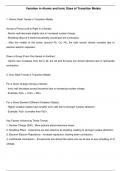
Chemistry class 12th Variation_Atomic_Ionic_Sizes_Transition_Metals
In transition metals, atomic and ionic sizes show a gradual decrease across a period due to increasing nuclear charge, which pulls electrons closer. However, the decrease is less pronounced than in main-group elements due to electron shielding by inner d-electrons. Down a group, atomic and ionic sizes increase due to the addition of electron shells, though lanthanoid contraction causes 4d and 5d series elements to be nearly the same in size. Ionic radii decrease with higher oxidation states as e...
- Book
- Class notes
- • 1 pages •
In transition metals, atomic and ionic sizes show a gradual decrease across a period due to increasing nuclear charge, which pulls electrons closer. However, the decrease is less pronounced than in main-group elements due to electron shielding by inner d-electrons. Down a group, atomic and ionic sizes increase due to the addition of electron shells, though lanthanoid contraction causes 4d and 5d series elements to be nearly the same in size. Ionic radii decrease with higher oxidation states as e...
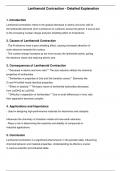
Chemistry class 12th Lanthanoid_Contraction
Lanthanoid contraction refers to the gradual decrease in atomic and ionic radii of the lanthanide elements (from lanthanum to lutetium) as the atomic number increases. This occurs due to the poor shielding effect of the 4f electrons, which leads to a stronger attraction between the nucleus and outer electrons. As a result, elements after the lanthanides in the periodic table, such as transition metals, also exhibit smaller atomic sizes than expected. Lanthanoid contraction influences chemical pr...
- Book
- Class notes
- • 1 pages •
Lanthanoid contraction refers to the gradual decrease in atomic and ionic radii of the lanthanide elements (from lanthanum to lutetium) as the atomic number increases. This occurs due to the poor shielding effect of the 4f electrons, which leads to a stronger attraction between the nucleus and outer electrons. As a result, elements after the lanthanides in the periodic table, such as transition metals, also exhibit smaller atomic sizes than expected. Lanthanoid contraction influences chemical pr...
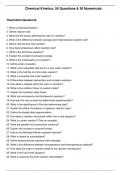
Chemistry class 12th Chemical_Kinetics_Questions_Numericals
Chemical kinetics questions and numericals focus on reaction rates, rate laws, half-life, and activation energy. Common topics include: 1. Rate Law Calculations – Determining reaction order and rate constant () from experimental data. 2. Integrated Rate Equations – Finding concentration over time for zero, first, and second-order reactions. 3. Half-life () – Calculating decay times for different reaction orders. 4. Arrhenius Equation – Finding activation energy () using...
- Book
- Class notes
- • 3 pages •
Chemical kinetics questions and numericals focus on reaction rates, rate laws, half-life, and activation energy. Common topics include: 1. Rate Law Calculations – Determining reaction order and rate constant () from experimental data. 2. Integrated Rate Equations – Finding concentration over time for zero, first, and second-order reactions. 3. Half-life () – Calculating decay times for different reaction orders. 4. Arrhenius Equation – Finding activation energy () using...
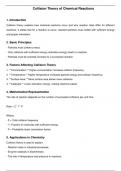
Chemistry class 12th Collision_Theory
Collision theory explains how chemical reactions occur based on molecular collisions. For a reaction to take place, reactant molecules must collide with: 1. Sufficient energy (equal to or greater than the activation energy, Ea). 2. Proper orientation to break and form bonds effectively. Only a fraction of collisions, called effective collisions, lead to product formation. The reaction rate increases with higher temperature (more energetic collisions) and concentration (more freque...
- Book
- Class notes
- • 2 pages •
Collision theory explains how chemical reactions occur based on molecular collisions. For a reaction to take place, reactant molecules must collide with: 1. Sufficient energy (equal to or greater than the activation energy, Ea). 2. Proper orientation to break and form bonds effectively. Only a fraction of collisions, called effective collisions, lead to product formation. The reaction rate increases with higher temperature (more energetic collisions) and concentration (more freque...
Chemistry class 12th Effect_of_Catalysts.
A catalyst increases the rate of a reaction by providing an alternative pathway with a lower activation energy (Ea), without being consumed. By lowering Ea, more reactant molecules have enough energy to reach the transition state, increasing the reaction rate. Catalysts do not affect the equilibrium position but help achieve equilibrium faster. Types include homogeneous catalysts (same phase as reactants, e.g., enzyme-catalyzed reactions) and heterogeneous catalysts (different phase, e.g., me...
- Book
- Class notes
- • 2 pages •
A catalyst increases the rate of a reaction by providing an alternative pathway with a lower activation energy (Ea), without being consumed. By lowering Ea, more reactant molecules have enough energy to reach the transition state, increasing the reaction rate. Catalysts do not affect the equilibrium position but help achieve equilibrium faster. Types include homogeneous catalysts (same phase as reactants, e.g., enzyme-catalyzed reactions) and heterogeneous catalysts (different phase, e.g., me...
Chemistry class 12th Frequency factor explanation
The frequency factor (A) in the Arrhenius equation (k = A e^(-Ea/RT)) represents the number of times reactant molecules collide with the correct orientation per unit time. It reflects the likelihood of a successful reaction before considering activation energy (Ea). A higher frequency factor indicates more frequent and properly oriented collisions, increasing the reaction rate. Unlike Ea, which depends on energy barriers, A is influenced by molecular size, shape, and reaction mechanism. Though o...
- Book
- Class notes
- • 2 pages •
The frequency factor (A) in the Arrhenius equation (k = A e^(-Ea/RT)) represents the number of times reactant molecules collide with the correct orientation per unit time. It reflects the likelihood of a successful reaction before considering activation energy (Ea). A higher frequency factor indicates more frequent and properly oriented collisions, increasing the reaction rate. Unlike Ea, which depends on energy barriers, A is influenced by molecular size, shape, and reaction mechanism. Though o...
Chemistry class 12th Molecularity_of_a_Reaction
Molecularity of a reaction refers to the number of reactant molecules involved in an elementary step of a reaction. It is always a whole number and can be: Unimolecular: A single molecule undergoes decomposition or rearrangement (e.g., radioactive decay). Bimolecular: Two reactant molecules collide and react (e.g., SN2 reactions). Termolecular: Three molecules collide simultaneously (rare due to low probability). Molecularity is different from reaction order, which is determined ex...
- Book
- Class notes
- • 2 pages •
Molecularity of a reaction refers to the number of reactant molecules involved in an elementary step of a reaction. It is always a whole number and can be: Unimolecular: A single molecule undergoes decomposition or rearrangement (e.g., radioactive decay). Bimolecular: Two reactant molecules collide and react (e.g., SN2 reactions). Termolecular: Three molecules collide simultaneously (rare due to low probability). Molecularity is different from reaction order, which is determined ex...
Chemistry class 12th Integrated_Rate_Equations
Integrated rate equations describe how reactant concentrations change over time for different reaction orders. Zero-order: (linear decrease, rate independent of concentration). First-order: (exponential decay, rate proportional to concentration). Second-order: (inverse relation, rate proportional to the square of concentration). Each equation helps determine reaction kinetics by analyzing concentration-time data. Half-life () varies with order: constant for first-order, but depe...
- Book
- Class notes
- • 1 pages •
Integrated rate equations describe how reactant concentrations change over time for different reaction orders. Zero-order: (linear decrease, rate independent of concentration). First-order: (exponential decay, rate proportional to concentration). Second-order: (inverse relation, rate proportional to the square of concentration). Each equation helps determine reaction kinetics by analyzing concentration-time data. Half-life () varies with order: constant for first-order, but depe...
Chemistry class 12th Zero order reactions
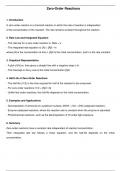
In a zero-order reaction, the reaction rate is independent of the concentration of reactants. This means the rate remains constant until the reactant is depleted. The rate law is expressed as rate = k, where k is the rate constant. The integrated rate equation is [A] = [A]₀ - kt, showing a linear decrease in concentration over time. The half-life (t₁/₂) depends on the initial concentration, given by t₁/₂ = [A]₀ / 2k. Zero-order reactions often occur in enzyme-catalyzed processes or s...
- Book
- Class notes
- • 1 pages •
In a zero-order reaction, the reaction rate is independent of the concentration of reactants. This means the rate remains constant until the reactant is depleted. The rate law is expressed as rate = k, where k is the rate constant. The integrated rate equation is [A] = [A]₀ - kt, showing a linear decrease in concentration over time. The half-life (t₁/₂) depends on the initial concentration, given by t₁/₂ = [A]₀ / 2k. Zero-order reactions often occur in enzyme-catalyzed processes or s...
Chemistry class 12th First_Order_Reactions
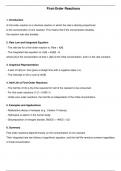
A first-order reaction is one where the reaction rate depends linearly on the concentration of a single reactant. The rate law is: text{Rate} = k[A] The integrated rate law for a first-order reaction is: ln[A] = ln[A]_0 - kt where is the rate constant, and is the initial concentration. A plot of ln[A] vs. time gives a straight line with a slope of -k. The half-life () is constant and given by: t_{1/2} = frac{0.693}{k} First-order kinetics are common in radioactive ...
- Book
- Class notes
- • 1 pages •
A first-order reaction is one where the reaction rate depends linearly on the concentration of a single reactant. The rate law is: text{Rate} = k[A] The integrated rate law for a first-order reaction is: ln[A] = ln[A]_0 - kt where is the rate constant, and is the initial concentration. A plot of ln[A] vs. time gives a straight line with a slope of -k. The half-life () is constant and given by: t_{1/2} = frac{0.693}{k} First-order kinetics are common in radioactive ...