

Manishshaw929
On this page, you find all documents, package deals, and flashcards offered by seller manishshaw929.
- 234
- 0
- 5
Community
- Followers
- Following
239 items

Chemistry class 12th Measurement of electrode potential
The measurement of electrode potential determines the voltage of an electrode in relation to a reference electrode. This is done using an electrochemical cell, where the electrode of interest is connected to a standard reference electrode, such as the Standard Hydrogen Electrode (SHE) or the Saturated Calomel Electrode (SCE). A voltmeter measures the potential difference between the two electrodes. Electrode potential depends on factors like ion concentration, temperature, and pressure. Standard...
- Book
- Class notes
- • 2 pages •
The measurement of electrode potential determines the voltage of an electrode in relation to a reference electrode. This is done using an electrochemical cell, where the electrode of interest is connected to a standard reference electrode, such as the Standard Hydrogen Electrode (SHE) or the Saturated Calomel Electrode (SCE). A voltmeter measures the potential difference between the two electrodes. Electrode potential depends on factors like ion concentration, temperature, and pressure. Standard...

Chemistry class 12th Bohr magneton
The Bohr magneton (μB) is the fundamental unit of magnetic moment in atomic physics, defined as 9.274 × 10⁻²⁴ J/T. It represents the magnetic moment of an electron due to its orbital and spin angular momentum. The formula is μB = (eħ) / (2mₑ), where e is the electron charge, ħ is the reduced Planck’s constant, and mₑ is the electron mass. It is crucial in quantum mechanics, solid-state physics, and magnetism, used to describe paramagnetic and ferromagnetic materials. Magnetic mom...
- Book
- Class notes
- • 1 pages •
The Bohr magneton (μB) is the fundamental unit of magnetic moment in atomic physics, defined as 9.274 × 10⁻²⁴ J/T. It represents the magnetic moment of an electron due to its orbital and spin angular momentum. The formula is μB = (eħ) / (2mₑ), where e is the electron charge, ħ is the reduced Planck’s constant, and mₑ is the electron mass. It is crucial in quantum mechanics, solid-state physics, and magnetism, used to describe paramagnetic and ferromagnetic materials. Magnetic mom...
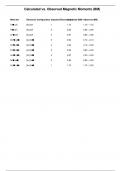
Chemistry class 12th Magnetic moment table
A magnetic moment table lists the magnetic moments of atoms, ions, or molecules, typically in units of Bohr magnetons (μB). Magnetic moments arise from electron spin and orbital motion. The table includes values for transition metals, lanthanides, and actinides, with experimental and theoretical (spin-only) values. It helps in determining magnetic properties such as paramagnetism, diamagnetism, and ferromagnetism. Factors like crystal field effects, spin-orbit coupling, and oxidation states inf...
- Book
- Class notes
- • 1 pages •
A magnetic moment table lists the magnetic moments of atoms, ions, or molecules, typically in units of Bohr magnetons (μB). Magnetic moments arise from electron spin and orbital motion. The table includes values for transition metals, lanthanides, and actinides, with experimental and theoretical (spin-only) values. It helps in determining magnetic properties such as paramagnetism, diamagnetism, and ferromagnetism. Factors like crystal field effects, spin-orbit coupling, and oxidation states inf...
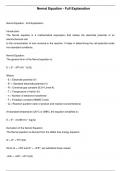
Chemistry class 12th Nernst equation explanation
The Nernst equation calculates the cell potential (Ecell) under non-standard conditions by accounting for ion concentrations. It is given by: Ecell = E°cell - (RT/nF) ln Q, where E°cell is the standard potential, R is the gas constant, T is temperature, n is the number of electrons transferred, F is the Faraday constant, and Q is the reaction quotient. It shows how Ecell changes with concentration, predicting spontaneity. At equilibrium (Ecell = 0), it relates to the equilibrium const...
- Book
- Class notes
- • 2 pages •
The Nernst equation calculates the cell potential (Ecell) under non-standard conditions by accounting for ion concentrations. It is given by: Ecell = E°cell - (RT/nF) ln Q, where E°cell is the standard potential, R is the gas constant, T is temperature, n is the number of electrons transferred, F is the Faraday constant, and Q is the reaction quotient. It shows how Ecell changes with concentration, predicting spontaneity. At equilibrium (Ecell = 0), it relates to the equilibrium const...

Chemistry class 12th Equilibrium constant from nernst equation
The Nernst equation relates the electrochemical cell potential (Ecell) to the reaction quotient (Q) and equilibrium constant (K). At equilibrium, Ecell = 0, and the equation simplifies to: E°cell = (RT/nF) ln K, or in base-10 logarithm, log K = (nE°cell × F) / (2.303 RT). This equation shows that a positive E°cell corresponds to K > 1, meaning a spontaneous reaction favoring products, while a negative E°cell indicates K < 1, favoring reactants. It helps determine equilibrium con...
- Book
- Class notes
- • 1 pages •
The Nernst equation relates the electrochemical cell potential (Ecell) to the reaction quotient (Q) and equilibrium constant (K). At equilibrium, Ecell = 0, and the equation simplifies to: E°cell = (RT/nF) ln K, or in base-10 logarithm, log K = (nE°cell × F) / (2.303 RT). This equation shows that a positive E°cell corresponds to K > 1, meaning a spontaneous reaction favoring products, while a negative E°cell indicates K < 1, favoring reactants. It helps determine equilibrium con...

Chemistry class 12th Electrochemical cell and gibbs energy
An electrochemical cell converts chemical energy into electrical energy through redox reactions. It consists of two electrodes—anode (oxidation) and cathode (reduction)—connected by an electrolyte and an external circuit. The cell potential (E°cell) determines its ability to generate electricity. The relationship between Gibbs free energy (ΔG) and cell potential is given by ΔG = -nFE°cell, where n is the number of electrons transferred and F is the Faraday constant. A negative ΔG ind...
- Book
- Class notes
- • 2 pages •
An electrochemical cell converts chemical energy into electrical energy through redox reactions. It consists of two electrodes—anode (oxidation) and cathode (reduction)—connected by an electrolyte and an external circuit. The cell potential (E°cell) determines its ability to generate electricity. The relationship between Gibbs free energy (ΔG) and cell potential is given by ΔG = -nFE°cell, where n is the number of electrons transferred and F is the Faraday constant. A negative ΔG ind...
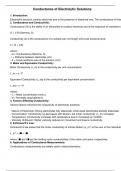
Chemistry class 12th Conductance of eletrolytic solutions
The conductance of electrolytic solutions refers to their ability to conduct electricity due to the presence of ions. It depends on electrolyte concentration, ion mobility, temperature, and solvent viscosity. Specific conductance (κ) is the conductance of a solution per unit volume, while molar conductance (Λm) is the conductance per mole of electrolyte. Strong electrolytes (e.g., NaCl) fully ionize, showing high conductance, whereas weak electrolytes (e.g., CH₃COOH) partially ionize, wit...
- Book
- Class notes
- • 2 pages •
The conductance of electrolytic solutions refers to their ability to conduct electricity due to the presence of ions. It depends on electrolyte concentration, ion mobility, temperature, and solvent viscosity. Specific conductance (κ) is the conductance of a solution per unit volume, while molar conductance (Λm) is the conductance per mole of electrolyte. Strong electrolytes (e.g., NaCl) fully ionize, showing high conductance, whereas weak electrolytes (e.g., CH₃COOH) partially ionize, wit...

Chemistry class 12th Ideal and non ideal solutions
An ideal solution follows Raoult’s law perfectly, meaning the intermolecular forces between solute and solvent are similar to those in the pure components. There is no change in enthalpy (ΔH = 0) or volume upon mixing. Examples include benzene-toluene and hexane-heptane mixtures. A non-ideal solution deviates from Raoult’s law due to differences in intermolecular forces, leading to either positive (weaker interactions, higher vapor pressure) or negative (stronger interactions, lower vapo...
- Book
- Class notes
- • 2 pages •
An ideal solution follows Raoult’s law perfectly, meaning the intermolecular forces between solute and solvent are similar to those in the pure components. There is no change in enthalpy (ΔH = 0) or volume upon mixing. Examples include benzene-toluene and hexane-heptane mixtures. A non-ideal solution deviates from Raoult’s law due to differences in intermolecular forces, leading to either positive (weaker interactions, higher vapor pressure) or negative (stronger interactions, lower vapo...

Chemistry class 12th Colligative properties and molar mass
Colligative properties are properties of solutions that depend only on the number of solute particles, not their identity. These include relative lowering of vapor pressure, boiling point elevation, freezing point depression, and osmotic pressure. They are useful for determining the molar mass of solutes by measuring their effect on a solvent. The relationship between colligative properties and molar mass follows equations like: ΔTf = iKf m (freezing point depression) ΔTb = iKb m (boi...
- Book
- Class notes
- • 3 pages •
Colligative properties are properties of solutions that depend only on the number of solute particles, not their identity. These include relative lowering of vapor pressure, boiling point elevation, freezing point depression, and osmotic pressure. They are useful for determining the molar mass of solutes by measuring their effect on a solvent. The relationship between colligative properties and molar mass follows equations like: ΔTf = iKf m (freezing point depression) ΔTb = iKb m (boi...
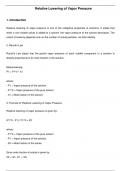
Chemistry class 12th Relative lowering of vapour pressure
- Book
- Class notes
- • 2 pages •