

Greatnurse
On this page, you find all documents, package deals, and flashcards offered by seller Greatnurse.
- 899
- 0
- 9
Community
- Followers
- Following
18 Reviews received
910 items
: Care of the Patient with a Cardiovascular or a Peripheral Vascular Disorder Nursing Test Bank
The nurse is aware that the muscle layer of the heart, which is responsible for the heart’s contraction, is the: a. endocardium. b. pericardium. c. mediastinum. d. myocardium. ANS: D The myocardium is the specialized muscle layer that allows the heart to contract. PTS: 1 DIF: Cognitive Level: Comprehension REF: Page 1533 OBJ: 2 TOP: Myocardium KEY: Nursing Process Step: Implementation
- Exam (elaborations)
- • 31 pages •
The nurse is aware that the muscle layer of the heart, which is responsible for the heart’s contraction, is the: a. endocardium. b. pericardium. c. mediastinum. d. myocardium. ANS: D The myocardium is the specialized muscle layer that allows the heart to contract. PTS: 1 DIF: Cognitive Level: Comprehension REF: Page 1533 OBJ: 2 TOP: Myocardium KEY: Nursing Process Step: Implementation
Care of the Patient with a Blood or Lymphatic Disorder Nursing Test Bank
What is the process by which certain cells engulf and digest microorganisms and cellular debris? a. Erythrocytosis b. Hematocrit c. Phagocytosis d. Hemostasis ANS: C Phagocytosis is the process by which bacteria, cellular debris, and solid particles are destroyed and removed. PTS: 1 DIF: Cognitive Level: Comprehension REF: Page 7-6 OBJ:3TOP:Diagnostic procedures KEY: Nursing Process Step: Assessment MSC: NCLEX: Physiological Integrity
- Exam (elaborations)
- • 25 pages •
What is the process by which certain cells engulf and digest microorganisms and cellular debris? a. Erythrocytosis b. Hematocrit c. Phagocytosis d. Hemostasis ANS: C Phagocytosis is the process by which bacteria, cellular debris, and solid particles are destroyed and removed. PTS: 1 DIF: Cognitive Level: Comprehension REF: Page 7-6 OBJ:3TOP:Diagnostic procedures KEY: Nursing Process Step: Assessment MSC: NCLEX: Physiological Integrity
OB Final Exam Study Guide VERY CORRECT
Signs of Pregnancy: Presumptive, Probable, & Positive Presumptive o Things that could be due to pregnancy but could also be explained by something else Fatigue, breast tenderness, N/V, Amenorrhea, Urinary Frequency, hyperpigmentation of the skin, quickening, uterine enlargement, and breast enlargement. Probable o You’re probably pregnant, but we don’t know for sure Braxton hicks contractions, Positive pregnancy test, abdominal enlargement, ballottement (examiner push...
- Exam (elaborations)
- • 28 pages •
Signs of Pregnancy: Presumptive, Probable, & Positive Presumptive o Things that could be due to pregnancy but could also be explained by something else Fatigue, breast tenderness, N/V, Amenorrhea, Urinary Frequency, hyperpigmentation of the skin, quickening, uterine enlargement, and breast enlargement. Probable o You’re probably pregnant, but we don’t know for sure Braxton hicks contractions, Positive pregnancy test, abdominal enlargement, ballottement (examiner push...
NURSING nu350 Care of Patients with Diabetes Mellitus Test Bank A Graded
. In preparing a staff in-service presentation about diabetes mellitus, the nurse includes which information? a. Diabetes increases the risk for development of epilepsy. b. The cure for diabetes is the administration of insulin. c. Diabetes increases the risk for development of cardiovascular disease. d. Carbohydrate metabolism is altered in diabetes, but protein metabolism is normal. ANS: C Diabetes mellitus is a major risk factor for morbidity and mortality caused by coronary artery di...
- Exam (elaborations)
- • 22 pages •
. In preparing a staff in-service presentation about diabetes mellitus, the nurse includes which information? a. Diabetes increases the risk for development of epilepsy. b. The cure for diabetes is the administration of insulin. c. Diabetes increases the risk for development of cardiovascular disease. d. Carbohydrate metabolism is altered in diabetes, but protein metabolism is normal. ANS: C Diabetes mellitus is a major risk factor for morbidity and mortality caused by coronary artery di...
Week 2 Assignment Darlenis Peralta Chamberlain University PHIL347N: Critical Reasoning
I consider the most valuable and important idea in this section to be “giving reasons to communicate the basis for our beliefs and decisions are universal in our species” (Faciones & Gittens, p.89, 2016). We make our decisions based on our beliefs. As the author states, “there is a way to ask “Why” in every language” (Faciones & Gittens p. 89, 2016). I find these ideas to be important because it gives us an understanding of why decisions are made, and what they are based on. Whe...
- Other
- • 4 pages •
I consider the most valuable and important idea in this section to be “giving reasons to communicate the basis for our beliefs and decisions are universal in our species” (Faciones & Gittens, p.89, 2016). We make our decisions based on our beliefs. As the author states, “there is a way to ask “Why” in every language” (Faciones & Gittens p. 89, 2016). I find these ideas to be important because it gives us an understanding of why decisions are made, and what they are based on. Whe...
NU 577 AANP Exam Pearls
Exam Format • AANP FNP exam contains very few nonclinical questions • Certification tests are designed for entry-level practice • AANP has 15 pilot questions which are not graded [there is NO WAY to identify the pilot test questions from the graded questions] • New clinical info [treatment and/or guidelines] released in the last 10 months won’t be on the exam • Questions will be on primary care disorders – if you are guessing, AVOID PICKING EXOTIC DIAGNOSIS AS AN ANSWER Lab...
- Exam (elaborations)
- • 55 pages •
Exam Format • AANP FNP exam contains very few nonclinical questions • Certification tests are designed for entry-level practice • AANP has 15 pilot questions which are not graded [there is NO WAY to identify the pilot test questions from the graded questions] • New clinical info [treatment and/or guidelines] released in the last 10 months won’t be on the exam • Questions will be on primary care disorders – if you are guessing, AVOID PICKING EXOTIC DIAGNOSIS AS AN ANSWER Lab...
Miami Dade College, Miami NUR 3165 FNP TEST
A thin patient presents in office with hyperpigmentation and salt cravings. What lab do you want to do? ADDISON Cortisol 2. Which diabetic oral medication would you not want to use in a patient with HF? ACTOS (Pioglitazone) (THIAZOLIDINEDIONES) 3. Elderly patient presents with acute eye pain, blurred vision, headache, and n/v? What would you do? Acute angle closure glaucoma, Refer to ED 4. You perform a fundoscopic exam on a patient and see a swollen optic disc with blurred ...
- Exam (elaborations)
- • 38 pages •
A thin patient presents in office with hyperpigmentation and salt cravings. What lab do you want to do? ADDISON Cortisol 2. Which diabetic oral medication would you not want to use in a patient with HF? ACTOS (Pioglitazone) (THIAZOLIDINEDIONES) 3. Elderly patient presents with acute eye pain, blurred vision, headache, and n/v? What would you do? Acute angle closure glaucoma, Refer to ED 4. You perform a fundoscopic exam on a patient and see a swollen optic disc with blurred ...
Ethics in Criminal Justice (CJ400) Exam 1:
Question 1 Morals and ethics: Question options: a) must be taught. b) are the same throughout the world. c) are synonymous with values. d) are interchangeable terms. ion 5 / 5poinJessica was invited to Howard's house for dinner. Howard spent three hours cooking and set the table with fine china and flowers. Jessica failed to show and did not call him. Jessica can best be described as: Question options: a) lacking manners and etiquette. b) morally bankrupt. c) a person of poor charac...
- Exam (elaborations)
- • 10 pages •
Question 1 Morals and ethics: Question options: a) must be taught. b) are the same throughout the world. c) are synonymous with values. d) are interchangeable terms. ion 5 / 5poinJessica was invited to Howard's house for dinner. Howard spent three hours cooking and set the table with fine china and flowers. Jessica failed to show and did not call him. Jessica can best be described as: Question options: a) lacking manners and etiquette. b) morally bankrupt. c) a person of poor charac...
HESI RN EXIT Exam Questions and Answers
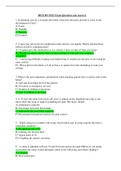
1. In planning care for a 6 month-old infant, what must the nurse provide to assist in the development of trust? A) Food B) Warmth C) Security D) Comfort 2. A nurse has just received a medication order which is not legible. Which statement best reflects assertive communication? A) "I cannot give this medication as it is written. I have no idea of what you mean." B) "Would you please clarify what you have written so I am sure I am reading it correctly?" C) "I am having difficulty ...
- Exam (elaborations)
- • 28 pages •
1. In planning care for a 6 month-old infant, what must the nurse provide to assist in the development of trust? A) Food B) Warmth C) Security D) Comfort 2. A nurse has just received a medication order which is not legible. Which statement best reflects assertive communication? A) "I cannot give this medication as it is written. I have no idea of what you mean." B) "Would you please clarify what you have written so I am sure I am reading it correctly?" C) "I am having difficulty ...
NURSING C477 Pediatric Nursing
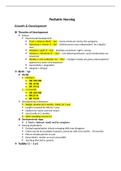
Theories of Development Erikson Psychosocial development Trust v. mistrust (birth – 1yr) – learns needs are met by the caregivers Autonomy v. shame (1 - 3yr) – child becomes more independent “im a big kid now” Initiative v. guilt (3 – 6yr) – develops conscience, right v. wrong Industry v. inferiority (6 – 12yr) – rule following behavior, social relationships are important Identity v. role confusion (12 – 19yr) – changes in body are great...
- Exam (elaborations)
- • 67 pages •
Theories of Development Erikson Psychosocial development Trust v. mistrust (birth – 1yr) – learns needs are met by the caregivers Autonomy v. shame (1 - 3yr) – child becomes more independent “im a big kid now” Initiative v. guilt (3 – 6yr) – develops conscience, right v. wrong Industry v. inferiority (6 – 12yr) – rule following behavior, social relationships are important Identity v. role confusion (12 – 19yr) – changes in body are great...
BIOL181 - Week 8 Quiz
Week 5 Case 3: Greetings Inc.: Transfer Pricing Issues
Walden University NURS 6630 Psycho Pharm Week 3 Quiz
NUR 211 LifeSpan1 - Final Exam.
Document was provided without answers. Payment was delivered,messaged provider
EDUC 1300 Chapter 4 Quiz - 3rd Edition