

Ashtonbrassfield
On this page, you find all documents, package deals, and flashcards offered by seller ashtonbrassfield.
- 5
- 0
- 0
Community
- Followers
- Following
5 items
Physiology/Anatomy and Endocrinology of Animals
These notes cover the fundamentals of anatomy and physiology, explaining how body structure (anatomy) and function (physiology) are organized and related. They describe key anatomical terminology, cell organelles, and major body systems including the integumentary (skin), skeletal, muscular, nervous, circulatory, and endocrine systems. Each system’s main organs, structures, and functions are detailed—such as how muscles contract, how blood circulates, and how hormones regulate growth, metabo...
- Class notes
- • 12 pages •
These notes cover the fundamentals of anatomy and physiology, explaining how body structure (anatomy) and function (physiology) are organized and related. They describe key anatomical terminology, cell organelles, and major body systems including the integumentary (skin), skeletal, muscular, nervous, circulatory, and endocrine systems. Each system’s main organs, structures, and functions are detailed—such as how muscles contract, how blood circulates, and how hormones regulate growth, metabo...
Eukaryotic Cell Evolution: Land Plants and Protists
These notes explain eukaryotic evolution, highlighting how eukaryotic cells developed complex structures like nuclei, mitochondria, and chloroplasts through endosymbiosis. They describe the diversity of protists, their cellular organization, feeding methods, reproduction, and ecological importance. The section on plant diversity covers the main plant groups—nonvascular, vascular seedless, and seed plants—and their evolutionary adaptations to life on land, such as cuticles, vascular tissue, a...
- Class notes
- • 9 pages •
These notes explain eukaryotic evolution, highlighting how eukaryotic cells developed complex structures like nuclei, mitochondria, and chloroplasts through endosymbiosis. They describe the diversity of protists, their cellular organization, feeding methods, reproduction, and ecological importance. The section on plant diversity covers the main plant groups—nonvascular, vascular seedless, and seed plants—and their evolutionary adaptations to life on land, such as cuticles, vascular tissue, a...
Prokaryotic Cells and Phylogenetic Trees
The document provides an overview of phylogenetic trees and how they are used to visualize evolutionary relationships among species. It explains key concepts such as monophyletic groups, synapomorphies, and species definitions based on morphological, biological, and phylogenetic species concepts. It also covers the process of speciation, mechanisms of genetic isolation, and evolutionary patterns like adaptive radiation and extinction. Finally, it includes detailed notes on prokaryotes (bacteria ...
- Class notes
- • 12 pages •
The document provides an overview of phylogenetic trees and how they are used to visualize evolutionary relationships among species. It explains key concepts such as monophyletic groups, synapomorphies, and species definitions based on morphological, biological, and phylogenetic species concepts. It also covers the process of speciation, mechanisms of genetic isolation, and evolutionary patterns like adaptive radiation and extinction. Finally, it includes detailed notes on prokaryotes (bacteria ...
Evolution In Bio
These notes summarize the foundations of biology and evolution, beginning with the scientific method—how scientists observe, hypothesize, test, and conclude to form theories. They explain how life is characterized by information, cells, energy use, replication, and evolution, and how biotic and abiotic factors shape ecosystems through energy flow and nutrient cycling. The notes also cover population growth, species interactions (competition, predation, mutualism), and succession after disturba...
- Class notes
- • 8 pages •
These notes summarize the foundations of biology and evolution, beginning with the scientific method—how scientists observe, hypothesize, test, and conclude to form theories. They explain how life is characterized by information, cells, energy use, replication, and evolution, and how biotic and abiotic factors shape ecosystems through energy flow and nutrient cycling. The notes also cover population growth, species interactions (competition, predation, mutualism), and succession after disturba...
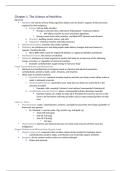
The Science of Nutrition
These notes summarize Chapter 1: The Science of Nutrition, explaining how nutrition is the study of how living organisms obtain and use food for energy, structure, and regulation of body processes. It covers the roles of nutritional scientists and dietitians, the types and classifications of nutrients (essential, nonessential, and conditionally essential), and the difference between macronutrients (needed in large amounts like carbs, proteins, and fats) and micronutrients (vitamins and minerals ...
- Class notes
- • 5 pages •
These notes summarize Chapter 1: The Science of Nutrition, explaining how nutrition is the study of how living organisms obtain and use food for energy, structure, and regulation of body processes. It covers the roles of nutritional scientists and dietitians, the types and classifications of nutrients (essential, nonessential, and conditionally essential), and the difference between macronutrients (needed in large amounts like carbs, proteins, and fats) and micronutrients (vitamins and minerals ...