
- Study guides, Class notes & Summaries
Looking for the best study guides, study notes and summaries about ? On this page you'll find 23 study documents about .
Exam (elaborations)
UTA 5315 Advanced Pathophysiology Summer Test 3 Questions and Answers Rated A+
UTA 5315 Advanced Pathophysiology Summer Test 3 Questions and Answers Rated A+ Mitral Valve Stenosis - Characterized by NARROWING of mitral valve - Normal is 4-6 cm -Narrowed is less than 2.5 cm - Caused by RHEUMATIC FEVER -More common in WOMEN
 smartgrades
Exam (elaborations)
UTA 5315 Advanced Pathophysiology Test 2 Questions and Answers Rated A+
PopularHIV EIA (3rd generation immunoassay) can use urine, saliva, or serum (most accurate), need to wait until 12 weeks post exposure to see antibodies, >99% accurate 4th generation immunoassay- "gold standard" measures P24 antigen can test 10 days post exposure Mast cell Cellular bags of granules located in loose connective tisssue close to blood vessels. Activation initiates inflammatory process. Histamine Causes vasodilation, increases vascular permeability, increases blood flow to th...
 StudyLoom01
Package deal
Complete Bundle;;; Nurs 5315 Advanced Pathophysiology Exams With Complete Solutions(Latest Update)
Advanced Patho NURS 5315 Exam 1; Questions and Answers 100% Solved 2 Exam (elaborations) Endocrine Disorders II (NURS 5315 Mod 8 Exam 4); Questions and Answers 100% Solved 3 Exam (elaborations) NURS 5315 Advanced Patho Exam 1 with Complete Solutions 4 Exam (elaborations) NURS 5315 Advanced Pathophysiology Test 1; Questions and Answers 100% Solve
 DrJon
Exam (elaborations)
UTA 5315 Advanced Pathophysiology Test 2 Questions and Answers Rated A+
UTA 5315 Advanced Pathophysiology Test 2 Questions and Answers Rated A+ can use urine, saliva, or serum (most accurate), need to wait until 12 weeks post exposure to see antibodies, >99% accurate 4th generation immunoassay- "gold standard" measures P24 antigen can test 10 days post exposure
smartgrades
Exam (elaborations)
UTA 5315 Advanced Pathophysiology Test 1 Questions and Answers Rated A+
UTA 5315 Advanced Pathophysiology Test 1 Questions and Answers Rated A+ Atrophy E. Cells decrease in size P. Still functional Physiologic: thymus gland in early childhood Pathological: disuse
smartgrades
Exam (elaborations)
UTA 5315 Advanced Pathophysiology Test 2 Questions and Answers Rated A+
HIV EIA (3rd generation immunoassay) can use urine, saliva, or serum (most accurate), need to wait until 12 weeks post exposure to see antibodies, >99% accurate 4th generation immunoassay- "gold standard" measures P24 antigen can test 10 days post exposure Mast cell Cellular bags of granules located in loose connective tisssue close to blood vessels. Activation initiates inflammatory process. Histamine Causes vasodilation, increases vascular permeability, increases blood flow to the ...
Tutorelizabeth
Exam (elaborations)
UTA 5315 Advanced Pathophysiology Test 1 Questions and Answers Rated A+
Atrophy E. Cells decrease in size P. Still functional Physiologic: thymus gland in early childhood Pathological: disuse Hypertrophy E. Increase in cell size P. Increased workload Physiologic: weightlifting Pathologic: cardiomegaly from HTN Hyperplasia E. Increase in cell number P. Increased cellular division Physiologic: liver regeneration
StudyLoom01
Exam (elaborations)
UTA 5315 Advanced Pathophysiology Test 2 Questions and Answers Rated A+
HIV EIA (3rd generation immunoassay) can use urine, saliva, or serum (most accurate), need to wait until 12 weeks post exposure to see antibodies, >99% accurate 4th generation immunoassay- "gold standard" measures P24 antigen can test 10 days post exposure Mast cell Cellular bags of granules located in loose connective tisssue close to blood vessels. Activation initiates inflammatory process. Histamine Causes vasodilation, increases vascular permeability, increases blood flow to th...
DrJon
Exam (elaborations)
UTA 5315 Advanced Pathophysiology Test 1 Questions and Answers Rated A+
Atrophy E. Cells decrease in size P. Still functional Physiologic: thymus gland in early childhood Pathological: disuse Hypertrophy E. Increase in cell size P. Increased workload Physiologic: weightlifting Pathologic: cardiomegaly from HTN Hyperplasia E. Increase in cell number P. Increased cellular division Physiologic: liver regeneration Pathologic: endometrial- usually r/t hormones
DrJon
Exam (elaborations)
UTA 5315 Advanced Pathophysiology Summer Test 3 Questions and Answers Rated A+
Mitral Valve Stenosis - Characterized by NARROWING of mitral valve - Normal is 4-6 cm -Narrowed is less than 2.5 cm - Caused by RHEUMATIC FEVER -More common in WOMEN -Oxygenated blood comes back into heart into the left atrium and down through the mitral valve to the left ventricle - Complex: Stenosis leads to volume/pressure in left atrium, which results in atrial hypertrophy/dilation, which increases pressure/volume in the pulmonary circulation & causes PULMONARY EDEMA - Simplifie...
DrJon
Package deal
Uta 5315 Advanced Pathophysiology Bundled Tests 1-3 | With Complete Verified & Updated Solutions| 2024
Uta 5315 Advanced Pathophysiology Bundled Tests 1-3 | With Complete Verified & Updated Solutions| 2024
 EmilyCharlene
Exam (elaborations)
UTA 5315 Advanced Pathophysiology Test 1 Questions and Answers Rated A+
UTA 5315 Advanced Pathophysiology Test 1 Questions and Answers Rated A+ Atrophy E. Cells decrease in size P. Still functional Physiologic: thymus gland in early childhood Pathological: disuse Hypertrophy E. Increase in cell size P. Increased workload Physiologic: weightlifting Pathologic: cardiomegaly from HTN Hyperplasia E. Increase in cell number P. Increased cellular division Physiologic: liver regeneration Pathologic: endometrial- usually r/t hormones Dysplasia E. Cells change ...
EmilyCharlene
Exam (elaborations)
UTA 5315 Advanced Pathophysiology Summer Test 3 Questions and Answers Rated A+
UTA 5315 Advanced Pathophysiology Summer Test 3 Questions and Answers Rated A+ Mitral Valve Stenosis - Characterized by NARROWING of mitral valve - Normal is 4-6 cm -Narrowed is less than 2.5 cm - Caused by RHEUMATIC FEVER -More common in WOMEN -Oxygenated blood comes back into heart into the left atrium and down through the mitral valve to the left ventricle - Complex: Stenosis leads to volume/pressure in left atrium, which results in atrial hypertrophy/dilation, which increases press...
EmilyCharlene
Exam (elaborations)
UTA 5315 Advanced Pathophysiology Test 2 Questions and Answers Rated A+
UTA 5315 Advanced Pathophysiology Test 2 Questions and Answers Rated A+ HIV EIA (3rd generation immunoassay) can use urine, saliva, or serum (most accurate), need to wait until 12 weeks post exposure to see antibodies, >99% accurate 4th generation immunoassay- "gold standard" measures P24 antigen can test 10 days post exposure Mast cell Cellular bags of granules located in loose connective tisssue close to blood vessels. Activation initiates inflammatory process. Histamine Causes v...
EmilyCharlene
Package deal
Bundle For Uta 5315 Advanced Pathophysiology Tets| Questions And Answers With Complete And Certified Solutions Graded A+
Bundle For Uta 5315 Advanced Pathophysiology Tets| Questions And Answers With Complete And Certified Solutions Graded A+
 Favorgrades
Exam (elaborations)
UTA 5315 Advanced Pathophysiology Test 2 Questions and Answers Rated A+
HIV EIA (3rd generation immunoassay) can use urine, saliva, or serum (most accurate), need to wait until 12 weeks post exposure to see antibodies, >99% accurate 4th generation immunoassay- "gold standard" measures P24 antigen can test 10 days post exposure Mast cell Cellular bags of granules located in loose connective tisssue close to blood vessels. Activation initiates inflammatory process. Histamine Causes vasodilation, increases vascular permeability, increases blood flow to the ...
Favorgrades
Exam (elaborations)
UTA 5315 Advanced Pathophysiology Summer Test 3 Questions and Answers Rated A+
Mitral Valve Stenosis - Characterized by NARROWING of mitral valve - Normal is 4-6 cm -Narrowed is less than 2.5 cm - Caused by RHEUMATIC FEVER -More common in WOMEN -Oxygenated blood comes back into heart into the left atrium and down through the mitral valve to the left ventricle - Complex: Stenosis leads to volume/pressure in left atrium, which results in atrial hypertrophy/dilation, which increases pressure/volume in the pulmonary circulation & causes PULMONARY EDEMA - Simplified: ...
Favorgrades
Exam (elaborations)
UTA 5315 Advanced Pathophysiology Test 1 Questions and Answers Rated A+
Atrophy E. Cells decrease in size P. Still functional Physiologic: thymus gland in early childhood Pathological: disuse Hypertrophy E. Increase in cell size P. Increased workload Physiologic: weightlifting Pathologic: cardiomegaly from HTN Hyperplasia E. Increase in cell number P. Increased cellular division Physiologic: liver regeneration Pathologic: endometrial- usually r/t hormones Dysplasia E. Cells change in size, shape, organization P. AKA atypical hyperplasia, a disorderly pr...
Favorgrades
Exam (elaborations)
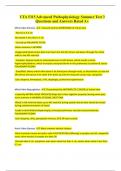
UTA 5315 Advanced Pathophysiology Summer Test 3 Questions and Answers Rated A+
UTA 5315 Advanced Pathophysiology Summer Test 3 Questions and Answers Rated A+
Scores
Exam (elaborations)
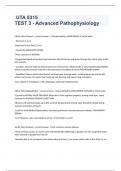
UTA 5315 TEST 3 - Advanced Pathophysiology exam 2023 with 100% correct answers
Mitral Valve Stenosis - Characterized by NARROWING of mitral valve - Normal is 4-6 cm -Narrowed is less than 2.5 cm - Caused by RHEUMATIC FEVER -More common in WOMEN -Oxygenated blood comes back into heart into the left atrium and down through the mitral valve to the left ventricle - Complex: Stenosis leads to volume/pressure in left atrium, which results in atrial hypertrophy/dilation, which increases pressure/volume in the pulmonary circulation & causes PULMONARY EDEMA - Simplified: Sk...
 YANCHY