- Study guides, Class notes & Summaries
Looking for the best study guides, study notes and summaries about ? On this page you'll find 11 study documents about .
11 results
-
Exam (elaborations)
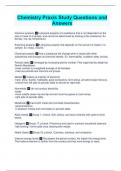
Chemistry Praxis Study Questions and Answers
-
---21June 20242023/2024A+
- Intensive property A physical property of a substance that is not dependent on the size of mass of a sample, and cannot be determined by looking at the substance. Ex: density, mp, bp, temperature. 
Extensive property A physical property that depends on the amount of matter in a sample. Ex: mass, volume. 
Chemical property How a substance will change when it reacts with other substances and changes its chemical identity. Ex: flammability, oxidation state, toxicity. 
Periodic table -Arranged by in...
-
$10.49 More Info
Salano
-
Exam (elaborations)
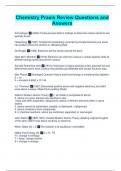
Chemistry Praxis Review Questions and Answers
-
---23June 20242023/2024A+
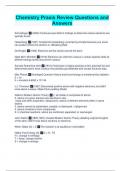
- Schrodinger (1925) Continued upon Bohr's findings to determine where electrons are typically found. 
Heisenberg (1927) Created the heisenberg uncertainty principle because you never can predict where the electron is. (Breaking Bad) 
De Broglie (1924) Electrons act like waves around the atom. 
Niels Bohr (Bohrbit) (1913) Electrons can orbit the nucleus in certain special orbits at different energy levels around the nucleus. 
Earnest Rutherford (foil) (1910) Fired beam of alpha particles at thin ...
-
$12.99 More Info
Salano
-
Exam (elaborations)
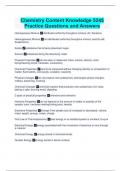
Chemistry Content Knowledge 5245 Practice Questions and Answers
-
---8June 20242023/2024A+
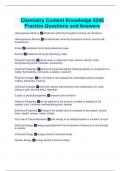
- Homogeneous Mixture distributed uniformly throughout mixture; Air; Solutions 
Heterogeneous Mixture not distributed uniformly throughout mixture; sand & salt; Suspensions 
Solute substance that is being dissolved; sugar 
Solvent substance doing the dissolving; water 
Physical Properties can be seen or observed; mass, volume, density, color, boing/freezing points, hardness, conductivity 
Chemical Properties cannot be measured without changing identity or composition of matter; flammability, corro...
-
$9.49 More Info
Salano
-
Exam (elaborations)
Chemistry Content Knowledge 5245 (Reactions/Structures) Review Questions and Answers
-
---18June 20242023/2024A+
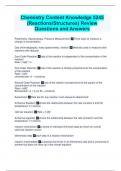
- Polarimetry, Spectroscopy, Pressure Measurement Three ways to measure a change in concentration 
Gas chromatography, mass spectrometry, titration Methods used to measure slow reactions with aliquots 
Zero Order Reaction rate of the reaction is independent of the concentration of the reactant Rate = k[A]⁰ = k 
First Order Reaction rate of the reaction is directly proportional to the concentration of the reactant Rate = k[A]¹ Unimolecular: A → products 
Second Order Reaction rate of the react...
-
$9.49 More Info
Salano
-
Exam (elaborations)
Chemistry (5245) Praxis Practice Questions and Answers
-
---12June 20242023/2024A+
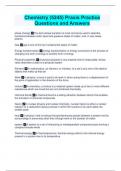
- phase change The term phase transition is most commonly used to describe transitions between solid, liquid and gaseous states of matter, and, in rare cases, plasma 
Gas gas is one of the four fundamental states of matter 
Energy transformation energy transformation or energy conversion is the process of changing one form of energy to another form of energy 
Physical properties A physical property is any property that is measurable, whose value describes a state of a physical system 
Element In m...
-
$9.99 More Info
Salano
-
Exam (elaborations)
Chemistry Content Knowledge 5245 (Reactions/Structures) Review Questions and Answers
-
---18April 20242023/2024A+
- Polarimetry, Spectroscopy, Pressure Measurement Three ways to measure a change in concentration 
 
Gas chromatography, mass spectrometry, titration Methods used to measure slow reactions with aliquots 
 
Zero Order Reaction rate of the reaction is independent of the concentration of the reactant 
Rate = k[A]⁰ = k 
 
First Order Reaction rate of the reaction is directly proportional to the concentration of the reactant 
Rate = k[A]¹ 
Unimolecular: A → products 
 
Second Order Reaction rate o...
-
$9.49 More Info
twishfrancis
-
Exam (elaborations)
Praxis Chemistry 5245 Study Questions and Answers
-
---2April 20242023/2024A+
- First Law of Thermodynamics Law of Conservation of Energy 
 
Law of Conservation of Mass Total Mass of Products = Total Mass of Reactants 
 
Kinetic Energy KE = 1/2 mv² 
 
Heat Flow of Thermal Energy 
 
Conduction Heat transferred directly 
 
Convention Heat transferred through currents 
 
Radiation Heat transferred through electromagnetic waves 
 
Specific Heat The amount of heat requires to raise the temperature of a unit of mass by 1°. C = Q/m delta T 
 
Sublimation Point The portion of the...
-
$8.99 More Info
twishfrancis
-
Exam (elaborations)
Chemistry (5245) Praxis Practice Questions and Answers
-
---12April 20242023/2024A+
- phase change The term phase transition is most commonly used to describe transitions between solid, liquid and gaseous states of matter, and, in rare cases, plasma 
 
Gas gas is one of the four fundamental states of matter 
 
Energy transformation energy transformation or energy conversion is the process of changing one form of energy to another form of energy 
 
Physical properties A physical property is any property that is measurable, whose value describes a state of a physical system 
 
Elem...
-
$9.49 More Info
twishfrancis
-
Exam (elaborations)
Chemistry Praxis Study Questions and Answers
-
---21April 20242023/2024A+
- Intensive property A physical property of a substance that is not dependent on the size of mass of a sample, and cannot be determined by looking at the substance. Ex: density, mp, bp, temperature. 
 
Extensive property A physical property that depends on the amount of matter in a sample. Ex: mass, volume. 
 
Chemical property How a substance will change when it reacts with other substances and changes its chemical identity. Ex: flammability, oxidation state, toxicity. 
 
Periodic table -Arranged...
-
$10.99 More Info
twishfrancis
-
Exam (elaborations)
Chemistry Content Knowledge 5245 Practice Questions and Answers
-
---8April 20242023/2024A+
- Homogeneous Mixture distributed uniformly throughout mixture; Air; Solutions 
 
Heterogeneous Mixture not distributed uniformly throughout mixture; sand & salt; Suspensions 
 
Solute substance that is being dissolved; sugar 
 
Solvent substance doing the dissolving; water 
 
Physical Properties can be seen or observed; mass, volume, density, color, boing/freezing points, hardness, conductivity 
 
Chemical Properties cannot be measured without changing identity or composition of matter; flammabil...
-
$8.99 More Info
twishfrancis
-
Exam (elaborations)
Chemistry Praxis Review Questions and Answers
-
---23April 20242023/2024A+
- Schrodinger (1925) Continued upon Bohr's findings to determine where electrons are typically found. 
 
Heisenberg (1927) Created the heisenberg uncertainty principle because you never can predict where the electron is. (Breaking Bad) 
 
De Broglie (1924) Electrons act like waves around the atom. 
 
Niels Bohr (Bohrbit) (1913) Electrons can orbit the nucleus in certain special orbits at different energy levels around the nucleus. 
 
Earnest Rutherford (foil) (1910) Fired beam of alpha particles ...
-
$9.99 More Info
twishfrancis