
- Study guides, Class notes & Summaries
Looking for the best study guides, study notes and summaries about ? On this page you'll find 27 study documents about .
Popular textbooks
Exam (elaborations)
Test Bank for Pediatric Nursing A Case-Based Approach 1st Edition Tagher Knapp Chapter 1-34| Complete Guide A+
Test Bank for Pediatric Nursing A Case-Based Approach 1st Edition Tagher Knapp Chapter 1-34| Complete Guide A+
 VICTORYSUCCESS
Exam (elaborations)
TEST BANK FOR PEDIATRIC NURSING – A CASE-BASED APPROACH 1ST EDITION BY TAGHER KNAPP
PopularTEST BANK FOR PEDIATRIC NURSING – A CASE-BASED APPROACH 1ST EDITION BY TAGHER KNAPP TEST BANK FOR PEDIATRIC NURSING – A CASE-BASED APPROACH 1ST EDITION BY TAGHER KNAPP
 nursemoen
Exam (elaborations)
Pediatric Nursing – A Case-Based Approach (2nd Edition) by Tagher Knapp | Comprehensive Case-Based Study Guide
This document covers the core content of Pediatric Nursing: A Case-Based Approach, 2nd Edition by Tagher Knapp, using real-life clinical cases to explain pediatric nursing concepts and decision-making. It addresses assessment, diagnosis, nursing interventions, and patient-centered care across a wide range of pediatric conditions, making it ideal for exam preparation and clinical practice support.
 studyvault1
Exam (elaborations)
Test Bank for Pediatric Nursing A Case-Based Approach 1st Edition Tagher Knapp Chapter 1-34| Complete Guide A+
Test Bank for Pediatric Nursing A Case-Based Approach 1st Edition Tagher Knapp Chapter 1-34| Complete Guide A+
 DeligentSuccess
Exam (elaborations)
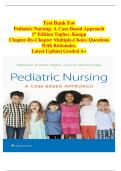
Pediatric Nursing – A Case-Based Approach (1st Edition, Tagher & Knapp) | Chapter-by-Chapter Multiple-Choice Questions with Rationales | Latest Updated Test Bank
This document provides a complete test bank for Pediatric Nursing: A Case-Based Approach (1st Edition) by Tagher and Knapp. It includes chapter-organized multiple-choice questions accompanied by detailed rationales to support understanding of pediatric concepts, clinical judgment, and case-based application. The material is comprehensive and aligned with course objectives, making it ideal for exam preparation, review, and mastery of pediatric nursing content.
PassPath
Exam (elaborations)
Pediatric Nursing – A Case-Based Approach, 2nd Edition, Tagher & Knapp – Complete Test Bank
Pediatric Nursing – A Case-Based Approach, 2nd Edition, Tagher & Knapp – Complete Test BankPediatric Nursing – A Case-Based Approach, 2nd Edition, Tagher & Knapp – Complete Test BankPediatric Nursing – A Case-Based Approach, 2nd Edition, Tagher & Knapp – Complete Test BankPediatric Nursing – A Case-Based Approach, 2nd Edition, Tagher & Knapp – Complete Test BankPediatric Nursing – A Case-Based Approach, 2nd Edition, Tagher & Knapp – Complete Test BankPediatric Nursing – A C...
 STUVANA
Exam (elaborations)
CHAPTER 18: CARE OF THE SCHOOL-AGE CHILD
MULTIPLE CHOICE 1. A school nurse is conducting a class on safety for parents of school-age children. Which statement indicates the parents need further teaching? a. Our child needs to wear sunscreen when playing soccer. b. Our young school-age child will continue to ride belted in the back seat. c. We will monitor the volume when our child is listening to music on the i-Pod with ear buds. d. Were glad our child will be home after school to let repairmen in while we are working. ANS: ...
ExamsRevision
Exam (elaborations)
CHAPTER 17: CARE OF THE PRESCHOOLER
MULTIPLE CHOICE 1. A child age 4 1/2 years sometimes wakes her parents up at night screaming, thrashing, sweating, and apparently frightened, yet she is not aware of her parents presence when they check on her. She lies down and sleeps without any parental intervention. This is most likely what? a. Nightmare b. Sleep terror c. Sleep apnea d. Seizure activity ANS: B This is a description of a sleep terror. The child is observed during the episode and not disturbed unless there is a ...
ExamsRevision
Exam (elaborations)
CHAPTER 16: CARE OF THE TODDLER
MULTIPLE CHOICE 1. Which comment indicates that the mother of a toddler needs further teaching about dental care? a. We use well water so I give my toddler fluoride supplements. b. My toddler brushes his teeth with my help. c. My child will not need a dental checkup until his permanent teeth come in. d. I use a small nylon bristle brush for my toddlers teeth. ANS: C 2. Which assessment finding in a preschooler would suggest the need for further investigation? a. The child is able ...
ExamsRevision
Exam (elaborations)
CHAPTER 20: ALTERATIONS IN RESPIRATORY FUNCTION
MULTIPLE CHOICE 1. A 3-year-old child is experiencing pain after a tonsillectomy. The child has not taken in any fluids and does not want to drink anything, saying, My tummy hurts. The following health care prescriptions are available: acetaminophen (Tylenol) PO (orally) or PR (rectally) PRN, ice chips, clear liquids. What should the nurse implement to relieve the childs pain? a. Ice chips b. Tylenol PO c. Tylenol PR d. Popsicle ANS: C The throat is very sore after a tonsillectomy....
ExamsRevision
Exam (elaborations)
CHAPTER 19: CARE OF THE ADOLESCENT
MULTIPLE CHOICE 1. Which statement by the nurse is most appropriate to a 15-year-old adolescent whose friend has mentioned suicide? a. Tell your friend to come to the clinic immediately. b. You need to gather details about your friends suicide plan. c. Your friends threat needs to be taken seriously and immediate help for your friend is important. d. If your friend mentions suicide a second time, you will want to get your friend some help. ANS: C Suicide is the third most common ca...
ExamsRevision
Exam (elaborations)
CHAPTER 12: SICKLE CELL ANEMIA
1. How should the nurse respond when asked by the mother of a child with beta-thalassemia why the child is receiving deferoxamine? a. To improve the anemia. b. To decrease hepatosplenomegaly. c. To prevent organ damage. d. To prepare your child for a bone marrow transplant. ANS: C Multiple transfusions result in hemosiderosis. Deferoxamine is given to chelate iron and prevent organ damage and complications from repeated transfusions. Preparation for a bone marrow transplant would not ...
ExamsRevision
Exam (elaborations)
CHAPTER 11: SECOND-DEGREE BURNS
1. The process of burn shock continues until which physiological mechanism occurs? 2. To assess the child with severe burns for adequate perfusion, the nurse monitors which area? 3. Which medication would be best for the nurse to administer before a dressing change for the severely burned child?
ExamsRevision
Exam (elaborations)
CHAPTER 15: CARE OF THE NEWBORN AND INFANT
MULTIPLE CHOICE 1. Which statement concerning physiological factors of infancy is true? a. The infant has a slower metabolic rate than an adult. b. An infant is not able to digest protein and lactase. c. Infants have a slower circulatory response than adults. d. The kidneys of an infant are less efficient in concentrating urine than an adults kidneys. ANS: D The infants kidneys are not as effective at concentrating urine compared with an adults kidneys because of immaturity of the ...
ExamsRevision
Exam (elaborations)
CHAPTER 14: OBESITY
1. The nurse is teaching a class on obesity prevention to parents in the community. What is a contributing factor to childhood obesity? a. Birth weight b. Parental overweight c. Age at the onset of puberty d. Asian ethnic background ANS: B There is a high correlation between parental adiposity and childhood adiposity. Obese children do not have higher birth weights than nonobese children. Early menarche is associated with obesity, but the age of puberty is not a contributing factor. A...
ExamsRevision
Exam (elaborations)
CHAPTER 13: ATTENTION DEFICIT HYPERACTIVITY DISORDER
1. A nurse is assessing a child with attention-deficit hyperactivity disorder (ADHD). Which manifestation should the nurse not expect to assess? 2. A nurse is assessing a child with a depressive disorder. Which symptom is likely to be manifested by the child? 3. What is the goal of therapeutic management for a child diagnosed with attention-deficit hyperactivity (ADHD) disorder?
ExamsRevision
Exam (elaborations)
CHAPTER 8: FAILURE TO THRIVE
1. A 6-month-old infant presents to the clinic with failure to thrive, a history of frequent respiratory infections, and increasing exhaustion during feedings. On physical examination, a systolic murmur is detected, no central cyanosis, and chest radiography reveals cardiomegaly. An echocardiogram is done that shows left-to-right shunting. This assessment data is characteristic of what? a. Tetralogy of Fallot b. Coarctation of the aorta c. Pulmonary stenosis d. Ventricular septal defect A...
ExamsRevision
Exam (elaborations)
CHAPTER 10: DIABETES MELLITUS TYPE 1
1. Which sign is the nurse most likely to assess in a child with hypoglycemia? a. Urine positive for ketones and serum glucose greater than 300 mg/dL b. Normal sensorium and serum glucose greater than 160 mg/dL c. Irritability and serum glucose less than 70 mg/dL d. Increased urination and serum glucose less than 120 mg/dL ANS: C Irritability and serum glucose less than 70 mg/dL are neuroglycopenic manifestations of hypoglycemia. Serum glucose greater than 300 mg/dL and urine positive...
ExamsRevision
Exam (elaborations)
CHAPTER 9: TONIC-CLONIC SEIZURES
1. What is the most appropriate nursing action when a child is in the tonic phase of a generalized tonic-clonic seizure? a. Guide the child to the floor if he is standing and go for help. b. Turn the childs body on his side. c. Place a padded tongue blade between the teeth. d. Quickly slip soft restraints on the childs wrists. ANS: B Positioning the child on his side will prevent aspiration. The child should be placed on a soft surface if he is not in bed; however, it would be inappro...
ExamsRevision
Exam (elaborations)
CHAPTER 7: HEART FAILURE
1. Which congenital heart disease causes cyanosis when not repaired? Select all that apply. a. Patent ductus arteriosus (PDA) b. Tetralogy of Fallot c. Pulmonary atresia d. Transposition of the great arteries ANS: B, C, D Tetralogy of Fallot is a cyanotic lesion with decreased pulmonary blood flow. The hypoxia results in baseline oxygen saturations as low as 75% to 85%. Even with oxygen administration, saturations do not reach the normal range. Pulmonary atresia is a cyanotic lesion w...
ExamsRevision