

- Study guides, Class notes & Summaries
Looking for the best study guides, study notes and summaries about ? On this page you'll find 26 study documents about .
Exam (elaborations)
Chapter 26: Upper Respiratory Problems Lewis: Medical-Surgical Nursing, 10th Edition
Chapter 26: Upper Respiratory Problems Lewis: Medical-Surgical Nursing, 10th Edition The nurse teaches a patient about discharge instructions after a rhinoplasty. Which statement, if made by the patient, indicates that the teaching was successful? a. "My nose will look normal after 24 to 48 hours." b. "I can take 800 mg ibuprofen every 6 hours for pain." c. "I will remove and reapply the nasal packing every day." d. "I will elevate my head for 48 hours to minimize swelling." - ANS A...
 lDEALNURSE
Exam (elaborations)
Lewis Chapter 42: Nursing Management: Lower Gastrointestinal Problems(With Correct Solutions)
PopularLewis Chapter 42: Nursing Management: Lower Gastrointestinal Problems (With Correct Solutions) 1. Which action will the nurse include in the plan of care for a 42-year-old patient who is being admitted with Clostridium difficile? a. Educate the patient about proper food storage. b. Order a diet with no dairy products for the patient. c. Place the patient in a private room on contact isolation. d. Teach the patient about why antibiotics will not be used. - ANS ANS: C Because C. diffici...
lDEALNURSE

Exam (elaborations)
Chapter 32, 33, 34, 35, 37, 38, 66: Lewis Med-Surg QUESTIONS AND ANSWERS 100% VERIFIED
Chapter 32, 33, 34, 35, 37, 38, 66: Lewis Med-Surg QUESTIONS AND ANSWERS 100% VERIFIED Chapter 32 1.A patient with a tricuspid valve disorder will have impaired blood flow between the: a. vena cava and right atrium b. left atrium and left ventricle c. right atrium and right ventricle d. right ventricle and pulmonary artery - ANS c 2. A patient has a severe blockage in his right coronary artery. Which cardiac structures are most likely to be affected by this blockage (select all that a...
lDEALNURSE
Exam (elaborations)
Lewis's Medical-Surgical Nursing: Assessment With 100% Verified Solutions
Lewis's Medical-Surgical Nursing: Assessment With 100% Verified Solutions A 42-year-old male patient complains of shoulder pain when the nurse moves his arm behind the back. Which question should the nurse ask? a. "Are you able to feed yourself without difficulty?" b. "Do you have difficulty when you are putting on a shirt?" c. "Are you able to sleep through the night without waking?" d. "Do you ever have trouble lowering yourself to the toilet?" - ANS B. The patient's pain ...
lDEALNURSE
Exam (elaborations)
Lewis Ch. 27 - Lower Respiratory Problems
Lewis Ch. 27 - Lower Respiratory Problems Following assessment of a patient with pneumonia, the nurse identifies a nursing diagnosis of ineffective airway clearance. Which assessment data best supports this diagnosis? a. Weak, nonproductive cough effort b. Large amounts of greenish sputum c. Respiratory rate of 28 breaths/minute d. Resting pulse oximetry (SpO2) of 85% - ANS ANS: A The weak, nonproductive cough indicates that the patient is unable to clear the airway effectively. The ...
lDEALNURSE
Exam (elaborations)
Lewis: Chapter 36 Inflammatory and Structural Heart Disorders
Lewis: Chapter 36 Inflammatory and Structural Heart Disorders The nurse obtains a health history from a 65-year-old patient with a prosthetic mitral valve who has symptoms of infective endocarditis (IE). Which question by the nurse is most appropriate? a. "Do you have a history of a heart attack?" b. "Is there a family history of endocarditis?" c. "Have you had any recent immunizations?" d. "Have you had dental work done recently?" - ANS ANS: D Dental procedures place the patient w...
lDEALNURSE
Exam (elaborations)
Chapter 54: Male Reproductive and Genital Problems Lewis: Medical-Surgical Nursing, 10th Edition WITH 100% VERIFIED SOLUTIONS
Chapter 54: Male Reproductive and Genital Problems Lewis: Medical-Surgical Nursing, 10th Edition WITH 100% VERIFIED SOLUTIONS To determine the severity of the symptoms for a patient with benign prostatic hyperplasia (BPH), the nurse will ask the patient about a. blood in the urine. . b. lower back or hip pain. c. force of urinary stream d. erectile dysfunction (ED). - ANS ANS: C The American Urological Association Symptom Index for a patient with BPH asks questions about the force and fr...
lDEALNURSE
Exam (elaborations)
Chapter 68: Emergency and Disaster Nursing Lewis: Medical-Surgical Nursing, 10th Edition
Chapter 68: Emergency and Disaster Nursing Lewis: Medical-Surgical Nursing, 10th Edition During the primary assessment of a victim of a motor vehicle collision, the nurse determines that the patient has an unobstructed airway. Which action should the nurse take next? a. Palpate extremities for bilateral pulses. b. Observe the patient's respiratory effort. c. Check the patient's level of consciousness. d. Examine the patient for any external bleeding. - ANS ANS: B Even with a patent airwa...
lDEALNURSE

Exam (elaborations)
Chapter 67: Acute Respiratory Failure and Acute Respiratory Distress Syndrome Lewis: Medical-Surgical Nursing, 10th Edition
Chapter 67: Acute Respiratory Failure and Acute Respiratory Distress Syndrome Lewis: Medical-Surgical Nursing, 10th Edition Which diagnostic test will provide the nurse with the most specific information to evaluate the effectiveness of interventions for a patient with ventilatory failure? a. Chest x-ray b. O2 saturation c. Arterial blood gas analysis d. Central venous pressure monitoring - ANS ANS: C Arterial blood gas (ABG) analysis is most useful in this setting because ventilatory fail...
lDEALNURSE
Exam (elaborations)
Lewis Ch. 25 - Assessment of Respiratory System
Lewis Ch. 25 - Assessment of Respiratory System A patient with acute shortness of breath is admitted to the hospital. Which action should the nurse take during the initial assessment of the patient? a. Ask the patient to lie down to complete a full physical assessment. b. Briefly ask specific questions about this episode of respiratory distress. c. Complete the admission database to check for allergies before treatment. d. Delay the physical assessment to first complete pulmonary func...
lDEALNURSE

Exam (elaborations)
Lewis Med-Surg Ch. 46 Acute Kidney Injury and CKD A+ RATED QUESTIONS AND ANSWERS
Lewis Med-Surg Ch. 46 Acute Kidney Injury and CKD A+ RATED QUESTIONS AND ANSWERS After the insertion of an arteriovenous graft (AVG) in the right forearm, a patient complains of pain and coldness of the right fingers. Which action should the nurse take? a. Teach the patient about normal AVG function. b. Remind the patient to take a daily low-dose aspirin tablet. c. Report the patient's symptoms to the health care provider. d. Elevate the patient's arm on pillows to above the heart level....
lDEALNURSE
Exam (elaborations)
Chapter 47: Assessment of Endocrine System Lewis: Medical-Surgical Nursing, 10th Edition
Chapter 47: Assessment of Endocrine System Lewis: Medical-Surgical Nursing, 10th Edition A young adult patient is being seen in the clinic with increased secretion of the anterior pituitary hormones. The nurse would expect the laboratory test results to show a. increased urinary cortisol. . b. decreased serum thyroxine. c. elevated serum aldosterone levels d. low urinary catecholamines excretion. - ANS ANS: A Increased secretion of adrenocorticotropic hormone (ACTH) by the anterior pitui...
lDEALNURSE
Exam (elaborations)
Lewis Chapter 66: Shock QUESTIONS AND CORRECT SOLUTIONS
Lewis Chapter 66: Shock QUESTIONS AND CORRECT SOLUTIONS A 78-kg patient with septic shock has a urine output of 30 mL/hr for the past 3 hours. The pulse rate is 120/minute and the central venous pressure and pulmonary artery wedge pressure are low. Which order by the health care provider will the nurse question? a. Give PRN furosemide (Lasix) 40 mg IV. b. Increase normal saline infusion to 250 mL/hr. c. Administer hydrocortisone (Solu-Cortef) 100 mg IV. d. Titrate norepinephrine (Levophed) ...
lDEALNURSE
Exam (elaborations)
Chapter 60: Spinal Cord and Peripheral Nerve Problems Lewis: Medical-Surgical Nursing, 10th Edition
Chapter 60: Spinal Cord and Peripheral Nerve Problems Lewis: Medical-Surgical Nursing, 10th Edition The nurse assessing a patient with newly diagnosed trigeminal neuralgia will ask the patient about a. visual problems caused by ptosis. b. triggers leading to facial discomfort. c. poor appetite caused by loss of taste. d. weakness on the affected side of the face. - ANS ANS: B The major clinical manifestation of trigeminal neuralgia is severe facial pain triggered by cutaneous stimulation o...
lDEALNURSE
Exam (elaborations)
Chapter 55: Assessment of Nervous System Lewis: Medical-Surgical Nursing, 10th Edition
Chapter 55: Assessment of Nervous System Lewis: Medical-Surgical Nursing, 10th Edition When admitting an acutely confused patient with a head injury, which action should the nurse take? a. Ask family members about the patient's health history. b. Ask leading questions to assist in obtaining health data. c. Wait until the patient is better oriented to ask questions. d. Obtain only the physiologic neurologic assessment data. - ANS ANS: A When admitting a patient who is likely to be a poor...
lDEALNURSE
Exam (elaborations)
Lewis Chapter 41: Upper GI Problems NCLEX QUESTIONS AND CORRECT SOLUTIONS
Lewis Chapter 41: Upper GI Problems NCLEX QUESTIONS AND CORRECT SOLUTIONS 1. A patient with deep partial-thickness burns experiences severe pain associated with nausea during dressing changes. Which action will be most useful in decreasing the patient's nausea? a. The patient NPO for 2 hours before and after dressing changes. b. Avoid performing dressing changes close to the patient's mealtimes. c. Administer the prescribed morphine sulfate before dressing changes. d. Give the ordered pr...
lDEALNURSE
Exam (elaborations)
Chapter 57: Stroke Lewis: Medical-Surgical Nursing, 10th Edition
Chapter 57: Stroke Lewis: Medical-Surgical Nursing, 10th Edition After a patient experienced a brief episode of tinnitus, diplopia, and dysarthria with no residual effects, the nurse anticipates teaching the patient about a. cerebral aneurysm clipping. b. heparin intravenous infusion. c. oral low-dose aspirin therapy. d. tissue plasminogen activator (tPA). - ANS ANS: C The patient's symptoms are consistent with transient ischemic attack (TIA), and drugs that inhibit platelet aggregation ...
lDEALNURSE
Exam (elaborations)
Lewis Ch. 23 - Integumentary Problems (COMPLETE Q& A 100% VERIFIED)
Lewis Ch. 23 - Integumentary Problems (COMPLETE Q& A 100% VERIFIED) Which information should the nurse include when teaching patients about decreasing the risk for sun damage to the skin? a. Use a sunscreen with an SPF of at least 8 to 10 for adequate protection. b. Water resistant sunscreens will provide good protection when swimming. c. Increase sun exposure by no more than 10 minutes a day to avoid skin damage. d. Try to stay out of the sun between the hours of 10 AM and 2 PM (regu...
lDEALNURSE
Exam (elaborations)
Chapter 37: Vascular Disorders Lewis: Medical-Surgical Nursing, 10th Edition 100% VERIFIED
Chapter 37: Vascular Disorders Lewis: Medical-Surgical Nursing, 10th Edition 100% VERIFIED A patient in the outpatient clinic has a new diagnosis of peripheral artery disease (PAD). Which group of drugs will the nurse plan to include when teaching about PAD management? a. Statins b. Antibiotics c. Thrombolytics d. Anticoagulants - ANS ANS: A Research indicates that statin use by patients with PAD improves multiple outcomes. There is no research that supports the use of the other drug cate...
lDEALNURSE
Exam (elaborations)
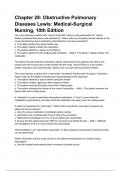
Chapter 28: Obstructive Pulmonary Diseases Lewis: Medical-Surgical Nursing, 10th Edition
Chapter 28: Obstructive Pulmonary Diseases Lewis: Medical-Surgical Nursing, 10th Edition The nurse teaches a patient with *chronic bronchitis* about a new prescription for *Advair Diskus (combined fluticasone and salmeterol)*. Which action by the patient would indicate to the nurse that teaching about medication administration has been successful? a. The patient shakes the device before use. b. The patient rapidly inhales the medication. c. The patient attaches a spacer to the Diskus. d. Th...
lDEALNURSE