
- Study guides, Class notes & Summaries
Looking for the best study guides, study notes and summaries about ? On this page you'll find 95 study documents about .
Popular textbooks

Exam (elaborations)
Integumentary Assessment Case Study 2026 Update – Complete Questions with Verified Answers
NewAccess the Integumentary Assessment Case Study Complete Questions with Verified Answers 2026 fully updated, designed to help nursing students and healthcare professionals master clinical assessment of the integumentary system. This comprehensive resource includes verified practice questions, detailed answers, and key topics covering skin, hair, nails, dermatological conditions, lesion identification, patient assessment techniques, and documentation. Ideal for exam preparation, case study practic...
 Educatorjake

Exam (elaborations)
Integumentary System Assessment – Skin, Hair, Nails, and Pressure Ulcers 2026 Update – Complete Exam Questions with Verified Answers
PopularAccess the Integumentary System Assessment – Skin, Hair, Nails, and Pressure Ulcers Complete Exam Questions with Verified Answers 2026 updated version, designed to help nursing students and healthcare professionals master skin and integumentary system assessments. This comprehensive resource includes verified practice questions, detailed answers, and key topics covering inspection, palpation, common dermatological conditions, pressure ulcer identification and staging, patient care, and documen...
Educatorjake
Exam (elaborations)
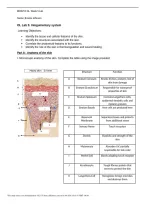
BIOS 251 Final Labs – Week 5 Integumentary System Online Lab
NewReview the anatomy and physiology of the integumentary system with this BIOS 251 Week 5 Online Lab resource. Explore key concepts related to skin structure, epidermal and dermal layers, hair, nails, sweat glands, sebaceous glands, and the functions of the integumentary system. Designed for students completing BIOS 251 laboratory coursework, this resource supports focused review and reinforces understanding of skin anatomy, physiological functions, and the structures that contribute to protection...
 NurseBreckenridge
Exam (elaborations)
Integumentary System Exam Questions And Correct Answers (Verified Answers) Plus Rationales 2026 Q&A | Instant Download Pdf
NewIntegumentary System Exam Questions And Correct Answers (Verified Answers) Plus Rationales 2026 Q&A | Instant Download Pdf
 beatricegicobi
Package deal
Full Package-;;Integumentary System (Wound Care Standards) EXAMS
NewIntegumentary System (Wound Care Standards): Midterm Exam (Units 1-7) - Questions with Correct Answer 3 Exam (elaborations) Integumentary System (Wound Care Standards): Practice Test 1 (Units 1-7) - Questions with Correct Answers 4 Exam (elaborations) Integumentary System (Wound Care Standards): Practice Test 2 (Units 8-13) - Questions with Correct
 TheePlug
Package deal
Integumentary System (Wound Care Standards) Exam BUNDLE (Exam 1-3 + Midterm Exam)
NewIntegumentary System (Wound Care Standards): Final Exam (Comprehensive) - Questions with Correct Answers 2 Exam (elaborations) Integumentary System (Wound Care Standards): Midterm Exam (Units 1-7) - Questions with Correct Answer 3 Exam (elaborations) Integumentary System (Wound Care Standards): Exam 3 Questions with Correct Answers
TheePlug
Exam (elaborations)
Integumentary System (Wound Care Standards): Exam 3 Questions with Correct Answers
NewIntegumentary System (Wound Care Standards): Exam 3 Questions with Correct Answers 100 questions 1. Transepidermal water loss increases when: A. The skin barrier is damaged, as in burns, eczema or harsh cleansing B. The skin is moisturized C. The stratum corneum is intact D. Humidity is high Correct Answer: A. The skin barrier is damaged, as in burns, eczema or harsh cleansing Rationale: Measuring water loss is used in research to assess barrier function. Moisturizers and an intact ba...
TheePlug
Exam (elaborations)
Integumentary System (Wound Care Standards): Exam 2 Questions with Correct Answers
NewIntegumentary System (Wound Care Standards): Exam 2 Questions with Correct Answers 100 questions 1. Ceruminous glands are modified sweat glands that produce: A. Earwax (cerumen) in the ear canal B. Tears C. Breast milk D. Saliva Correct Answer: A. Earwax (cerumen) in the ear canal Rationale: Cerumen protects the ear canal and traps debris. Tears come from lacrimal glands, milk from mammary glands and saliva from salivary glands. 2. Carotenemia from eating large amounts of carrots cau...
TheePlug

Exam (elaborations)
Integumentary System (Wound Care Standards): Exam 1 Questions with Correct Answers
NewIntegumentary System (Wound Care Standards): Exam 1 Questions with Correct Answers 100 questions 1. Ultraviolet A (UVA) differs from ultraviolet B (UVB) in that UVA: A. Causes only sunburn B. Is completely blocked by clouds C. Makes vitamin D D. Penetrates deeper and contributes mainly to aging and some skin cancer, while UVB causes sunburn Correct Answer: D. Penetrates deeper and contributes mainly to aging and some skin cancer, while UVB causes sunburn Rationale: Broad-spectrum sun...
TheePlug
Exam (elaborations)
Integumentary System (Wound Care Standards): Practice Test 2 (Units 8-13) - Questions with Correct Answers
NewIntegumentary System (Wound Care Standards): Practice Test 2 (Units 8-13) - Questions with Correct Answers 100 questions 1. Medical device-related pressure injuries (MDRPIs): A. Are always stage 1 B. Take the shape of the device and are staged using the standard staging system C. Are not real pressure injuries D. Only occur in adults Correct Answer: B. Take the shape of the device and are staged using the standard staging system Rationale: Common causes include oxygen masks, tubing, ca...
TheePlug
Exam (elaborations)
Integumentary System (Wound Care Standards): Practice Test 1 (Units 1-7) - Questions with Correct Answers
NewIntegumentary System (Wound Care Standards): Practice Test 1 (Units 1-7) - Questions with Correct Answers 100 questions 1. Langer's lines (cleavage lines) matter in surgery because incisions made parallel to them: A. Always become infected B. Tend to heal with less tension and less visible scarring C. Heal more slowly D. Cannot be sutured Correct Answer: B. Tend to heal with less tension and less visible scarring Rationale: The lines follow the direction of collagen fibers. Incisions...
TheePlug
Exam (elaborations)
Integumentary System (Wound Care Standards): Midterm Exam (Units 1-7) - Questions with Correct Answer
NewIntegumentary System (Wound Care Standards): Midterm Exam (Units 1-7) - Questions with Correct Answers 100 questions 1. The three main layers of the skin and underlying tissue, from outside in, are: A. Dermis, epidermis and muscle B. Subcutaneous tissue, epidermis and dermis C. Epidermis, dermis and subcutaneous tissue (hypodermis) D. Epidermis, muscle and dermis Correct Answer: C. Epidermis, dermis and subcutaneous tissue (hypodermis) Rationale: The epidermis is the thin outer barrier,...
TheePlug
Exam (elaborations)
Integumentary System (Wound Care Standards): Final Exam (Comprehensive) - Questions with Correct Answers
NewIntegumentary System (Wound Care Standards): Final Exam (Comprehensive) - Questions with Correct Answers 100 questions 1. Wound pain should be assessed: A. At rest, during dressing changes and between changes, using a validated scale B. Only at admission C. Never, as wounds are painless D. Only by family Correct Answer: A. At rest, during dressing changes and between changes, using a validated scale Rationale: Pain affects quality of life and healing, and new or increasing pain can sig...
TheePlug

Exam (elaborations)
Integumentary System Test – Questions and Answers
NewThis document contains test preparation material covering the integumentary system, including the skin, hair, nails, glands, and related structures and functions. It is designed to help students review key anatomy and physiology concepts and prepare for an integumentary system assessment.
luninjong

Exam (elaborations)
Integumentary System |Verified Questions And Answers | 100% Accurate, A+ Graded, Guaranteed Success!
NewIntegumentary System |Verified Questions And Answers | 100% Accurate, A+ Graded, Guaranteed Success!
 Apphia

Package deal
package deal
Newpackage deal
Educatorjake
Exam (elaborations)
Integumentary System Atual Exam 2026 With Verified Answers
NewINTEGUMENTARY SYSTEM ATUAL EXAM 2026 WITH VERIFIED ANSWERS Keratinocytes - ANSWER --an epidermal cell that produces keratin, the fibrous protein that helps give the epidermis its protective properties desmosomes - ANSWER Melanocytes - ANSWER (packaged into melanosomes) --fasten cells together into strong sheets --spider shaped, deep in the epidermis; produce melanin ~ Melanosomes transferred to keratinocytes (protect nucleus from UV damage) Integumentary System: Lo...
munenenjeri37

Exam (elaborations)
The Integumentary System Final Exam 2026 With Correct Answers
NewTHE INTEGUMENTARY SYSTEM FINAL EXAM 2026 WITH CORRECT ANSWERS Sweat Glands - ANSWER products --Produce a fluid that contains water, salts, and other waste How does our skin help regulate temperature? - ANSWER air hitting the moist skin cools the body down --Sweat releases heat and the What are the main parts of the integumentary system? - ANSWER Hair - ANSWER --skin, hair and nails --Consists of dead cells and keratin, provides insulation Nails - ANSWER th...
munenenjeri37
Exam (elaborations)
Lecture #5: The Integumentary System – Study Guide and Review Notes
NewLecture #5: The Integumentary System – Study Guide and Review Notes
 BravelRadon

Exam (elaborations)
Chapter 7 Quiz: Integumentary System – Study Guide and Review Questions
NewChapter 7 Quiz: Integumentary System – Study Guide and Review Questions
BravelRadon
Exam (elaborations)
Medical Terminology Module 12: Integumentary System – Study Guide and Review
NewMedical Terminology Module 12: Integumentary System – Study Guide and Review
BravelRadon

Exam (elaborations)
Integumentary System 2026 Wound Care Standards
New1. A nurse is assessing a pressure injury. Which finding indicates a Stage 1 pressure injury? A. Full-thickness tissue loss with exposed bone B. Non-blanchable erythema of intact skin C. Visible subcutaneous fat D. Deep crater with tunneling Correct Answer: B. Non-blanchable erythema of intact skin Rationale: Stage 1 pressure injuries present as intact skin with persistent redness that does not blanch. 2. Which intervention is most effective for preventing pressure injuries in immobile ...
 gradexam