
- Study guides, Class notes & Summaries
Looking for the best study guides, study notes and summaries about ? On this page you'll find 9 study documents about .
Exam (elaborations)
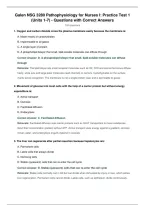
Galen NSG 3280 Pathophysiology for Nurses I: Practice Test 1 (Units 1-7) - Questions with Correct Answers
New1. Oxygen and carbon dioxide cross the plasma membrane easily because the membrane is: A. Made mostly of carbohydrates B. Impermeable to all gases C. A single layer of protein D. A phospholipid bilayer that small, lipid-soluble molecules can diffuse through Correct Answer: D. A phospholipid bilayer that small, lipid-soluble molecules can diffuse through Rationale: The lipid bilayer lets small nonpolar molecules such as O2, CO2 and steroid hormones diffuse freely, while ions and large pol...
 TheePlug
Exam (elaborations)
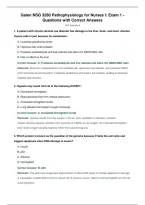
Galen NSG 3280 Pathophysiology for Nurses I: Exam 1 Questions with Correct Answers
Popular1. A patient with chronic alcohol use disorder has damage to the liver, brain, and heart. Alcohol injures cells in part because its metabolism: A. Increases glutathione stores B. Improves fatty acid oxidation C. Produces acetaldehyde and free radicals and alters the NADH/NAD ratio D. Has no effect on the liver Correct Answer: C. Produces acetaldehyde and free radicals and alters the NADH/NAD ratio Rationale: Ethanol is metabolized to toxic acetaldehyde, generates free radicals, and increa...
TheePlug
Package deal
Full Package-;;Galen NSG 3280 Pathophysiology for Nurses I EXAMS
NewGalen NSG 3280 Pathophysiology for Nurses I: Exam 3 Questions with Correct Answers 2 Exam (elaborations) Galen NSG 3280 Pathophysiology for Nurses I: Final Exam (Comprehensive) - Questions with Correct Answers 3 Exam (elaborations) Galen NSG 3280 Pathophysiology for Nurses I: Midterm Exam (Units 1-7) - Questions with Correct Answer
TheePlug
Package deal
Galen NSG 3280 Pathophysiology for Nurses I Exam BUNDLE (Midterm, Exam 1-3 & Final Exam)
NewGalen NSG 3280 Pathophysiology for Nurses I: Exam 3 Questions with Correct Answers 2 Exam (elaborations) Galen NSG 3280 Pathophysiology for Nurses I: Final Exam (Comprehensive) - Questions with Correct Answers 3 Exam (elaborations) Galen NSG 3280 Pathophysiology for Nurses I: Midterm Exam (Units 1-7) - Questions with Correct Answers 4 Exam (elabora
TheePlug
Exam (elaborations)
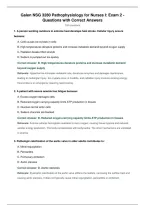
Galen NSG 3280 Pathophysiology for Nurses I: Exam 2 Questions with Correct Answers
New1. A person working outdoors in extreme heat develops heat stroke. Cellular injury occurs because: A. Cold causes ice crystals in cells B. High temperatures denature proteins and increase metabolic demand beyond oxygen supply C. Radiation breaks DNA strands D. Sodium is pumped out too quickly Correct Answer: B. High temperatures denature proteins and increase metabolic demand beyond oxygen supply Rationale: Hyperthermia increases metabolic rate, denatures enzymes and damages membranes, ...
TheePlug
Exam (elaborations)
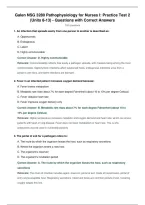
Galen NSG 3280 Pathophysiology for Nurses I: Practice Test 2 (Units 8-13) - Questions with Correct Answers
New1. An infection that spreads easily from one person to another is described as: A. Opportunistic B. Endogenous C. Latent D. Highly communicable Correct Answer: D. Highly communicable Rationale: Communicability reflects how easily a pathogen spreads, with measles being among the most communicable. Opportunistic infections affect weakened hosts, endogenous infections arise from a person's own flora, and latent infections are dormant. 2. Fever in an infected patient increases oxygen dem...
TheePlug
Exam (elaborations)
Galen NSG 3280 Pathophysiology for Nurses I: Midterm Exam (Units 1-7) - Questions with Correct Answers
New1. Asphyxial injury from strangulation causes cell injury by: A. Increasing oxygen delivery B. Causing hyperthermia C. Obstructing airflow and blood flow, leading to hypoxia D. Releasing lipases Correct Answer: C. Obstructing airflow and blood flow, leading to hypoxia Rationale: Strangulation compresses the airway and blood vessels, preventing oxygen delivery to the brain. Petechiae in the eyes and face are common findings. The other mechanisms do not apply. 2. Frostbite injures tissues ...
TheePlug
Exam (elaborations)
Galen NSG 3280 Pathophysiology for Nurses I: Final Exam (Comprehensive) - Questions with Correct Answers
New1. Hyperkalemia is often caused by which medication class? A. Loop diuretics B. Thiazide diuretics C. Beta-2 agonists D. ACE inhibitors and potassium-sparing diuretics Correct Answer: D. ACE inhibitors and potassium-sparing diuretics Rationale: ACE inhibitors, ARBs and spironolactone reduce aldosterone effects, causing potassium retention, especially in kidney disease. Loop and thiazide diuretics cause potassium loss, and beta-2 agonists shift potassium into cells. 2. Administering a hy...
TheePlug
Exam (elaborations)
Galen NSG 3280 Pathophysiology for Nurses I: Exam 3 Questions with Correct Answers
New1. Wet gangrene differs from dry gangrene in that wet gangrene: A. Is always confined and slow B. Occurs only in the toes C. Has no odor D. Involves bacterial invasion with liquefaction and spreads rapidly Correct Answer: D. Involves bacterial invasion with liquefaction and spreads rapidly Rationale: Wet gangrene develops when bacteria invade necrotic tissue, causing swelling, foul odor and rapid spread with risk of sepsis. Dry gangrene is coagulative, black and well demarcated, often in ...
TheePlug