
- Study guides, Class notes & Summaries
Looking for the best study guides, study notes and summaries about ? On this page you'll find 49 study documents about .

Exam (elaborations)
midterm exam normal electroencephalography questions and answers
midterm exam normal electroencephalography questions and answers
 millyphilip
Exam (elaborations)
Eeg Mock Exam Questions With Solutions
PopularEeg Mock Exam Questions With Solutions Which describes the action of a capacitor: a. Opposes changes in current flow b. Converts alternating current to direct current c. Creates a direct current resistance d. Stores electrical energy D Which of the following statements about current is false: a. Current may be AC or DC b. Current flows when there is a source of voltage and a conductive pathway c. Current is movement of electrons in a conductor d. Current is measured in coulombs B
 StuviaTutors
Exam (elaborations)
EEG Board Prep Exam 2025 | Newest Actual Exam Questions with Verified Correct Answers | Detailed Rationales Included | Excellent Scores Guaranteed | Latest Edition
Mu Rhythm - Correct-answer--c3/c4 region -7-11Hz -does not block with eye opening -easy to see with eyes open -blocks unilaterally with contralateral hand -asymmetrical and asynchronous -NORMAL Beta - Correct-answer-->14 HZ -detected during wakefulness, enhanced during drowsiness, and decreased in deeper sleep -seen on barbiturates and benzodiazepines
 ExamGenie

Package deal
Anatomy And Physiology Exam Pack With Complete Solutions
1 Exam (elaborations) Anatomy and physiology exam 1 chamberlain university college of nursing.Questions and Answers Graded A+ 2 Exam (elaborations) Anatomy and Physiology Exam 1 (ch. 1-5) Questions and Answers 3 Exam (elaborations) Anatomy and Physiology Exam 1 (ch. 1-5) Questions and Answers 100% Solved 4 Exam (elaborations) Anatomy and Physiol
StuviaTutors

Package deal
Anatomy (Biol 222O) Exam Pack With Complete Solutions
Anatomy (BIOL 2220) Exam 2 – Cummings Questions And Answers 2 Exam (elaborations) Anatomy 2220 Clemson Skeleton Questions And Answers 3 Exam (elaborations) Anatomy Test 2- BIOL 2220 Clemson Questions With Complete Solutions 4 Exam (elaborations) Anatomy Lab Exam 1 (WSU Biology 315) Latest Update Rated A+ 5 Exam (elaborations) APHY 102: Anatomy
StuviaTutors
Package deal
Electroencephalogram(Eeg) Bundled Exams With Complete Solutions
PREP U CH. 65electroencephalogram (EEG) Questions With Solutions 2 Exam (elaborations) Physiology - Electroencephalography (EEG) (B7) Questions With Solutions 3 Exam (elaborations) Lecture 3 & 4: Electroencephalography (EEG) Questions With Solutions 4 Exam (elaborations) Lab #9: Electroencephalography (EEG) Questions With Solutions
StuviaTutors
Exam (elaborations)
Physiology - Electroencephalography (EEG) (B7) Questions With Solutions
Physiology - Electroencephalography (EEG) (B7) Questions With Solutions A flat EEG (no electrical activity) is clinical evidence of death Patterns of rhythmic neuronal electrical activity recorded are called brain waves (brain rhythms) scalp EEG a pair of electrodes are attached to scalp connected to a differential amplifier •Amplifier will reveal a pattern of voltage fluctuations over time •Amplitude between -100 µV and +100 µV •Frequency 0-100 Hz
StuviaTutors

Exam (elaborations)
Electroencephalography Questions With Solutions
Electroencephalography Questions With Solutions Electroencephalography: Resolution (2)? 1) Excellent temporal resolution 2) Poor spatial resolution Electroencephalography: Records? record potential differences (micro-volts) Electroencephalography: Instruments? array of surface electrodes on the scalp Electroencephalography: Usually used for? - Much psychological research is based on measuring the speed and accuracy of participants' responses - (i.e. reaction time tests). Electroence...
StuviaTutors
Exam (elaborations)
Electroencephalography (EEG) Questions With Solutions
Electroencephalography (EEG) Questions With Solutions Who initially invented EEGs? Hans Berger detected the first EEG signal in 1924 with electrodes attached to the scalp of a human and reported the results in 1929. Berger initially studied medicine because he was convinced that there is "psychic energy", which might allow for telepathy. Berger also first described the alpha rhythm - when people closed their eyes, the electrical signal was not constant, but it varied with a ch...
StuviaTutors

Exam (elaborations)
Electroencephalography (EEG) Questions With Solutions
Electroencephalography (EEG) Questions With Solutions EEG Records the Electric Activity of the Brain Things that EEG diagnose Epilepsy Brain tumor Head injury Encephalopathy Inflammation of the brain (encephalitis) Stroke Sleep disorders Memory impairment
StuviaTutors

Exam (elaborations)
Electroencephalography (EEG) Questions With Solutions
Electroencephalography (EEG) Questions With Solutions Neurophysiological basis of EEG: • Single neuron activity is too small to be picked up by EEG • EEG reflects the summation of the synchronous activity of many neurons with similar spatial orientations • Cortical pyramidal neurons produce most of the EEG signal Neural basis of EEG: Pyramidal neurons are spatially aligned and perpendicular to the cortical surface. Thus, EEG represents mainly the postsynaptic potentials of ...
StuviaTutors
Exam (elaborations)
Electroencephalography (EEG) & Evoked Potentials Questions With Solutions
Electroencephalography (EEG) & Evoked Potentials Questions With Solutions 1. EEG defined a. The EEG is a measurement of ?. These voltage fluctuations are called? b. EEG recording: i. In humans, the electrodes are small metal disks pasted to the surface of the scalp by an electricity conducting gel. ii. There are two electrodes plugged into each amplifier on the EEG machine. The EEG recorder detects the voltage differences between the recording and reference electrode for each channel ...
StuviaTutors
Exam (elaborations)
Midterm Exam Normal Electroencephalography Questions With Solutions
Midterm Exam Normal Electroencephalography Questions With Solutions ELectrooculogram Record horizontal and vertical eye movements needed for sleep staging in neonates Rapidly changing background activity holoprosencephaly periodic hypsarrhythmia in term infants Nonketotic hyperglycemia, other inborn errors or metabolims and genetically determined encephalopathties Periodic rolandic sharp waves Intraventricular hemorrhages (IVH) or periventricular Leukomlacia
StuviaTutors
Exam (elaborations)
Lecture 3 & 4: Electroencephalography (EEG) Questions With Solutions
Lecture 3 & 4: Electroencephalography (EEG) Questions With Solutions Why did Burger study medicine? Because he was convinced that there is "psychic energy", which might allow for telepathy He wanted to discover the objective activity in the brain and "psychic phenomena", but he did not realise the basis and potential of his discovery at the time What else did Burger describe? Alpha rhythm: characteristic frequency of electrical signal when eyes closed What is the characte...
StuviaTutors

Exam (elaborations)
Lab 4 Electroencephalography Questions With Solutions
Lab 4 Electroencephalography Questions With Solutions Beta waves are of lower amplitude, but they have the fastest frequency of all the brain waves Visual stimuli and mental activity evoke them seen in rapid-eye-movement (REM) sleep sleep paralysis . During REM sleep, signals from the brainstem shut down both sensory afferents and motor efferents (BETA) The aminergic (inhibitory) neurons in the brain switch off, leaving the cholinergic (excitatory) neurons free to fire in response t...
StuviaTutors
Exam (elaborations)
Lab #9: Electroencephalography (EEG) Questions With Solutions
Lab #9: Electroencephalography (EEG) Questions With Solutions brain activity under different conditions What does an EEG record? alpha Brain wave patterns that occur when you are relaxed with eyes closed 8-13 What is the frequency range of alpha waves in hertz? beta Brain wave patterns that occur when you are alert with eyes open. 13-30 What is the frequency range of beta waves in hertz?
StuviaTutors

Exam (elaborations)
Electroencephalography Lab Questions With Solutions
Electroencephalography Lab Questions With Solutions How does greater cortical activation affect alpha activity? lowers it When are beta waves seen? awake, alert, eyes open. When are theta waves seen? not in adults, more in children. Normal during sleep at all ages When are gamma waves seen? higher mental activity
StuviaTutors
Exam (elaborations)
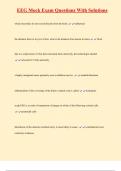
EEG Mock Exam Questions With Solutions
EEG Mock Exam Questions With Solutions which electrodes do not record directly from the brain subdermal the distance from cz to pz is 6.8cm. what is the distance from nasion to inion 34cm due to a scalp lesion, C4 has been relocated 4mm anteriorly, the technologist should: relocated C3 3mm anteriorly a highly malignant tumor primarily seen in children may be: medulla blastoma inflammation of the coverings of the brain or spinal cord is called meningitis scalp EEG is a result of summatio...
StuviaTutors

Exam (elaborations)
EEG Lesson 1 Questions With Solutions
EEG Lesson 1 Questions With Solutions Which of the following is a critical item and requires a sterilization? A) tape measure B) sphenoidal electrodes C) surface electrodes D) electrode cap B Anaphylaxis. Mark all that apply. A) Can be a result of food. B) is life threatening. C) will not show up in the EEG laboratory. D) Can have a symptom of vomiting. ABD
StuviaTutors

Exam (elaborations)
FINAL EXAM (END 201, 202, and 203) Questions With Solutions
FINAL EXAM (END 201, 202, and 203) Questions With Solutions Founding Fathers of Neurological Testing o 1875 - Richard Caton records the first electrical activity of a brain from animals o 1890 - Adolf Beck identified the localization of senses on the brain with evoked potentials o 1929 - Hans Berger identifies the 1st recording of the electric field of the human brain -Berger is known as the 'Father of EEG' o 1951 - George D. Dawson demonstrated the evoked potential of an ulnar ne...
StuviaTutors
Exam (elaborations)
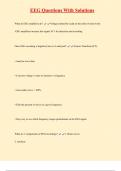
EEG Questions With Solutions
EEG Questions With Solutions What do EEG amplifiers do? Voltage emitted by scalp on the order of microvolts -EEG amplifiers increase this signal 10^5 for detection and recording Once EEG recording is digitized, how is it analyzed? Fourier Transform (FT): • Analyze wave data. • Converts voltage vs time to intensity vs frequency • Area under curve = 100% • Tells the percent of waves at a given frequency • Easy way to see which frequency ranges predominate in the EEG signal.
StuviaTutors