

- Study guides, Class notes & Summaries
Looking for the best study guides, study notes and summaries about ? On this page you'll find 478 study documents about .
Exam (elaborations)
ADVANCED CARDIAC DYSRHYTHMIAS
ADVANCED CARDIAC DYSRHYTHMIAS SVT - Correct answer- PVC - Correct answer- V Tach - Correct answer- PJCs - Correct answer- Junctional Escape Rhythm - Correct answer- SVT - Correct answer- SVT - Correct answer- Second degree heart block type 1 (Wenkebach) - Correct answer- Second degree heart block type 1 (Wenkebach) - Correct answer- Third degree heart block - Correct answer- Sick Sinus Syndrome - Correct answer- Torsades - Correct answer-
 drdenniskizito
Exam (elaborations)
Dysrhythmias Chapter 31 Exam with Questions and Verified Solutions
Dysrhythmias Chapter 31 Exam with Questions and Verified Solutions 1. Which priority concept does the nurse focus on when a client is diagnosed with a dysrhythmia? A. Clotting B. Fluid and electrolyte balance C. Perfusion D. Acid-base balance ANSWER 1. C Perfusion is the priority concept for the client with dysrhythmias. It occurs when there is adequate arterial blood flow through the peripheral tissues (peripheral perfusion) and blood that is pumped by the heart to oxygenate major body ...
examchief78
Exam (elaborations)
Dysrhythmias Patients NCLEX Exam with Questions and Solutions
Dysrhythmias Patients NCLEX Exam with Questions and Solutions The nurse is caring for a patient with acute coronary syndrome (ACS) and atrial fibrillation who has a new prescription for metoprolol (Toprol). Which monitoring is essential when administering the medication? A. ST segment B. Heart rate C. Troponin D. Myoglobin ANSWER ANS: B - Heart rate: The monitoring of the patient's heart rate is essential. The effects of metoprolol are to decrease heart rate, blood pressure, and myo...
examchief78
Exam (elaborations)
Dysrhythmias Patients NCLEX Exam with Questions and Solutions
Dysrhythmias Patients NCLEX Exam with Questions and Solutions The nurse is caring for a patient with acute coronary syndrome (ACS) and atrial fibrillation who has a new prescription for metoprolol (Toprol). Which monitoring is essential when administering the medication? A. ST segment B. Heart rate C. Troponin D. Myoglobin ANSWER ANS: B - Heart rate: The monitoring of the patient's heart rate is essential. The effects of metoprolol are to decrease heart rate, blood pressure, and myo...
examchief78
Exam (elaborations)
Dysrhythmias Chapter 35 Test with Questions and Answers
Dysrhythmias Chapter 35 Test with Questions and Answers Observe for symptoms of hypotension or angina. ANSWER A patient admitted with ACS has continuous ECG monitoring. An examination of the rhythm strip reveals the following characteristics: atrial rate 74 beats/min and regular; ventricular rate 62 beats/min and irregular; P wave normal shape; PR interval lengthens progressively until a P wave is not conducted; QRS normal shape. The priority nursing intervention would be to a. perform syn...
examchief78
Exam (elaborations)
Dysrhythmias NCLEX Exam Prep with Questions and Solutions
Dysrhythmias NCLEX Exam Prep with Questions and Solutions You are the nurse working on the telemetry unit and you have finally gotten to sit down to work on some charting. Suddenly the heart monitors at the station start beeping. The patient in room 18 is showing a ventricular fibrillation rhythm on the monitor. The medical team advances together into the room and finds them unconscious. What is priority action by the nurse? A) Prepare to administer adenosine to the patient B) Begin chest...
examchief78
Exam (elaborations)
Dysrhythmias Chapter 35 Exam with Questions and Answers
Dysrhythmias Chapter 35 Exam with Questions and Answers 1. What accurately describes electrocardiographic (ECG) monitoring? a. Depolarization of the cells in the ventricles produces the T wave on the ECG. b. An abnormal cardiac impulse that arises in the atria, ventricles, or atrioventricular (AV) junction can create a premature beat that is known as an artifact. c. Lead placement for V1 includes one lead each for right arm, right leg, left arm, and left leg with the fifth lead on the...
examchief78
Exam (elaborations)
Dysrhythmias Pharm Drugs Chapter 30 Exam with Complete Solutions
Dysrhythmias Pharm Drugs Chapter 30 Exam with Complete Solutions A patient with type 1 diabetes on insulin therapy reports that he takes propranolol (Inderal) for hypertension. The nurse will teach the patient to check glucose levels more frequently because of what concern? A. The propranolol can produce insulin resistance. B. The two drugs used together will increase the risk of ketoacidosis. C. Propranolol will increase insulin requirements by antagonizing the effects at the receptors. ...
examchief78
Exam (elaborations)
Dysrhythmias Exam Prep with Complete Solutions
Dysrhythmias Exam Prep with Complete Solutions To determine whether there is a delay in impulse conduction through the ventricles, the nurse will measure the duration of the patient's a. P wave. c. PR interval. b. Q wave. d. QRS complex. ANSWER ANS: D The QRS complex represents ventricular depolarization. The P wave represents the depolarization of the atria. The PR interval represents depolarization of the atria, atrioventricular node, bundle of His, bundle branches, and the Purkinje f...
examchief78
Exam (elaborations)
Atrial Dysrhythmias Chapter 6 Exam with Questions and Answers
Atrial Dysrhythmias Chapter 6 Exam with Questions and Answers 1) What medical conditions place pressure on the atria, causing atrial dysrhythmias to occur? A) Renal conditions, hypertension, thrombus B) Myocardial infarction, valvular problems, neurological influences C) Cerebrovascular accident, pulmonary embolism, neurological influences D) Valvular problems, palpitations, angina ANSWER Answer: B Explanation: Atrial dysrhythmias occur due to conditions that cause pressure on the atria,...
examchief78
Exam (elaborations)
Dysrhythmias Exam with Practice Questions and Answers
Dysrhythmias Exam with Practice Questions and Answers You are the nurse working on the telemetry unit and you have finally gotten to sit down to work on some charting. Suddenly the heart monitors at the station start beeping. Patient in room 18 is showing this rhythm on the monitor. The medical team advances together into the room and finds them unconscious. What is priority action by the nurse? A) Prepare to administer adenosine to the patient B) Begin chest compressions C) Prepare for de...
examchief78
Exam (elaborations)
Dysrhythmias (NCLEX) Exam 1 with Questions and Answers
Dysrhythmias (NCLEX) Exam 1 with Questions and Answers A client's electrocardiogram strip shows atrial and ventricular rates of 80 complexes per minute. The PR interval is 0.14 second, and the QRS complex measures 0.08 second. The nurse interprets this rhythm is: A) Normal sinus rhythm B) Sinus bradycardia C) Sinus tachycardia D) Sinus dysrhythmia ANSWER A A client has frequent bursts of ventricular tachycardia on the cardiac monitor. A nurse is most concerned with this dysrhythmi...
examchief78
Exam (elaborations)
Pharm 2 Final Exam- Drugs For Dysrhythmias Test: Questions With Accurate Solutions
Pharm 2 Final Exam- Drugs For Dysrhythmias Test: Questions With Accurate Solutions
 LeCrae
Package deal
DYSRHYTHMIA'S QUESTIONS 100% CORRECT ANSWERS | VERIFIED | LATEST 2025 VERSION
DYSRHYTHMIA'S QUESTIONS 100% CORRECT ANSWERS | VERIFIED | LATEST 2025 VERSION
PrepMaster
Exam (elaborations)
Lewis Ch35 Dysrhythmias Student Review Questions 100% Correct Answers | Verified | Latest 2025 Version
Lewis Ch35 Dysrhythmias Student Review Questions 100% Correct Answers | Verified | Latest 2025 Version
PrepMaster
Exam (elaborations)
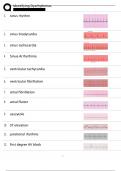
Identifying Dysrhythmias Questions And Answers Latest
Identifying Dysrhythmias Questions And Answers Latest
PrepMaster
Exam (elaborations)
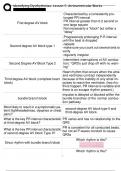
Identifying Dysrhythmias: Lesson 5: Atrioventricular Blocks
Identifying Dysrhythmias: Lesson 5: Atrioventricular Blocks
PrepMaster
Exam (elaborations)
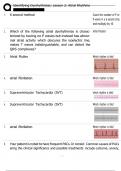
Identifying Dysrhythmias Lesson 2 Atrial Rhythms Questions and Complete Solutions Graded A+
Identifying Dysrhythmias Lesson 2 Atrial Rhythms Questions and Complete Solutions Graded A+
PrepMaster
Exam (elaborations)
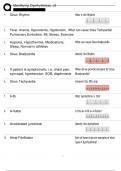
Identifying Dysrhythmias <3 Exam Questions And Answers
1. Sinus Rhythm What is this Rhythm? 2. Fever, Anemia, Hypovolemia, Hypotension, What can cause Sinus Tachycardia? Pulmonary Embolism, MI, Stress, Exercise 3. Hypoxia, Hypothermia, Medications, Sleep, Normal in athletes What can cause Sinus Bradycardia 4. Sinus Bradycardia Identify this Rhythm 5. If patient is symptomatic: i.e. chest pain, syncopal, hypotension, SOB, diaphroesis When do we provide Atropine for Sinus Bradycardia? 6. Sinus Tachycardia Interpret this EKG strip 7. A-f...
PrepMaster
Exam (elaborations)
Exam 1: Dysrhythmias (NCLEX) Study Guide Exam / 50 Actual Questions with Answers & Rationales (A+ Guide Solution) Newest 2025/2026
Exam 1: Dysrhythmias (NCLEX) Study Guide Exam / 50 Actual Questions with Answers & Rationales (A+ Guide Solution) Newest 2025/2026 Terms in this set (49) A client's electrocardiogram strip shows atrial and ventricular rates of 80 complexes per minute. The PR interval is 0.14 second, and the QRS complex measures 0.08 second. The nurse interprets this rhythm is: A) Normal sinus rhythm B) Sinus bradycardia C) Sinus tachycardia D) Sinus dysrhythmia A A client has frequent bursts of ventricular ta...
PrepMaster