
- Study guides, Class notes & Summaries
Looking for the best study guides, study notes and summaries about ? On this page you'll find 25 study documents about .
Exam (elaborations)
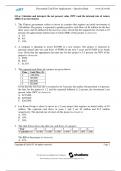
Discounted Cash Flow Model Exam Question bank
Discounted Cash Flow Model Exam Question bank
 SmartScoreAcademics
Exam (elaborations)
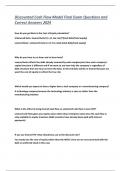
Discounted Cash Flow Model Final Exam Questions and Correct Answers 2024
Discounted Cash Flow Model Final Exam Questions and Correct Answers 2024 How do you get Beta in the Cost of Equity calculation? Unlevered beta= levered beta/ (1+ (1-tax rate)*(total debt/total equity) Levered Beta= unlevered beta (1+ (1-Tax rate) (total debt/total equity) Why do you have to un-lever and re-lever beta? Levered beta reflects the debt already assumed by each company but since each company's capital structure is different and if we want to see how risky the company is rega...
 EDWARDLEON
Exam (elaborations)
Discounted Cash Flow Model Exam Wallstreet Prep LATEST UPDATE 2024 / 2025 PASS A+
Discounted Cash Flow Model Exam Wallstreet Prep LATEST UPDATE 2024 / 2025 PASS A+
evansonevans64
Exam (elaborations)
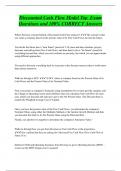
Discounted Cash Flow Model Top Exam Questions and 100% CORRECT Answers
What's the basic concept behind a Discounted Cash Flow analysis? The concept is that you value a company based on the present value of its Free Cash Flows far into the future. You divide the future into a "near future" period of 5-10 years and then calculate, project, discount, and add up those Free Cash Flows; and then there's also a "far future" period for everything beyond that, which you can't estimate as precisely, but which you can approximate using different approaches. Y...
 STANFORDGRADESS
Exam (elaborations)
Discounted Cash Flow Model UPDATED Exam Questions and 100% CORRECT Answers
A DCF values a company based on: The present value of its cash flows and the present value of its terminal value. Walk me through a DCF First, you project out the company's financials using assumptions for revenue growth, expenses and working capital. Then you get FCF for each year which you sum up and discount to a NPV based on your discount rate, usually the WACC. Then you determine the company's terminal value using either the multiples method or the Gordon Growth Method and dico...
STANFORDGRADESS