
- Study guides, Class notes & Summaries
Looking for the best study guides, study notes and summaries about ? On this page you'll find 66 study documents about .
Exam (elaborations)
USAHS Clinical Neuroscience Exam Questions And Answers.docx
USAHS Clinical Neuroscience Exam Questions And A
 Cindellera
Exam (elaborations)
Clinical Neuroscience Practice Questions And Answers.docx
Clinical Neuroscience Practice Questions And A
Cindellera
Exam (elaborations)
Clinical Neuroscience Exam 1 USAHS Questions and Answers.docx
Clinical Neuroscience Exam 1 USAHS Questions and A
Cindellera
Exam (elaborations)
Clinical Neuroscience Exam 2 Questions And Answers.docx
Clinical Neuroscience Exam 2 Questions And A
Cindellera
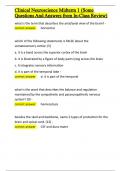
Exam (elaborations)
Clinical Neuroscience Midterm 1 (Some Questions And Answers from In-Class Review).docx
Clinical Neuroscience Midterm 1 (Some Questions And Answers from In-Class Review).docx
Cindellera
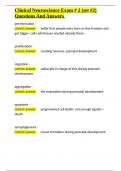
Exam (elaborations)
Clinical Neuroscience Exam - 2 (set -2) Questions And Answers.docx
Clinical Neuroscience Exam - 2 (set -2) Questions And A
Cindellera
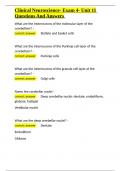
Exam (elaborations)
Clinical Neuroscience- Exam 4- Unit 11 Questions And Answers.docx
Clinical Neuroscience- Exam 4- Unit 11 Questions And A
Cindellera
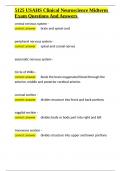
Exam (elaborations)
5125 USAHS Clinical Neuroscience Midterm Exam Questions And Answers.docx
5125 USAHS Clinical Neuroscience Midterm Exam Questions And A
Cindellera
Exam (elaborations)
CLINICAL NEUROSCIENCE EXAM QUESTIONS WITH COMPLETE SOLUTIONS
CLINICAL NEUROSCIENCE EXAM QUESTIONS WITH COMPLETE SOLUTIONS brain formation begins on day _______ and consists of - Answer-28; prosencephalon (forebrain); mesencephalon (midbrain); rhombencephalon (hindbrain); part of telencephalon - Answer-cerebral hemispheres; cerebral cortex; subcortical white matter; basal ganglia growth of the cerebral hemispheres happens - Answer-ventralaterally midbrain tetum; midbrain tegmentum; cerebrl peduncles are part of the - Answer-midbrain (mesencepha...
 Freshy
Exam (elaborations)
CLINICAL NEUROSCIENCE EXAM QUESTIONS WITH VERIFIED ANSWERS
CLINICAL NEUROSCIENCE EXAM QUESTIONS WITH VERIFIED ANSWERS asomatoagnosia - Answer-general term for agnosia for your own body anosognosia - Answer-unawareness of illness or disability anosodiaphoria - Answer-indifference to illness autopagnosia - Answer-inability to recognize or identify body parts finger agnosia - Answer-inability to recognize your own fingers ideomotor apraxia - Answer-inability to imitate/pantomine/ use objects vestibular system - Answer-what system is re...
Freshy
Exam (elaborations)
CLINICAL NEUROSCIENCE EXAM 1 USAHS EXAM | ALL QUESTIONS AND CORRECT ANSWERS | LATEST VERSION | GRADED A+ | VERIFIED ANSWERS
CLINICAL NEUROSCIENCE EXAM 1 USAHS EXAM | ALL QUESTIONS AND CORRECT ANSWERS | LATEST VERSION | GRADED A+ | VERIFIED ANSWERS
 StudyWay
Exam (elaborations)
Clinical Neuroscience Exam 2 QUESTIONS AND ANSWERS 2024/2025
QUESTIONS AND ANSWERS
 TheHUB26
Exam (elaborations)
Clinical Neuroscience Exam 2 QUESTIONS AND ANSWERS 2024/2025
QUESTIONS AND ANSWERS
 Brilliantgrades
Exam (elaborations)
Clinical Neuroscience Final Exam Review | Questions with 100% Correct Answers | Verified | Latest Update 2024
Lesion; Autopsy; DTI-they inject dye, any kind of cutting, injection, or damage - Name a type of neuroimaging that is invasive and describe how it is invasive Which methods use X-Ray - CT Which methods use magnetic fields - MRI, fMRI Which methods use radioactive isotopes - PET What is the difference between static and functional - Static image: is just a picture at one point in time Functional image: shows movement or changes over time in different areas Which of the following have the ...
 ClassHero
Exam (elaborations)
Clinical Neuroscience Exam 1 | 425 Questions with 100% Correct Answers | Verified | Latest Update 2024
there is a midbrain-diencephalic junction that has a _______ bend - 90 degree structure above midbrain, the front is _______ and back is ________ - rostral, caudal midbrain and below, the spinal cord is - perpendicular structures below the midbrain, the superior is _______ and the inferior is ________ - rostral, caudal autonomic is part of the motor division of PNS. t/f - true autonomic control is a 2 neuron system. How so? - CNS to ganglion, ganglion to effector (example motor to autonomi...
ClassHero
Exam (elaborations)
Clinical Neuroscience Final Exam Review | Questions with 100% Correct Answers | Verified | Latest Update 2024
Lesion; Autopsy; DTI-they inject dye, any kind of cutting, injection, or damage - Name a type of neuroimaging that is invasive and describe how it is invasive Which methods use X-Ray - CT Which methods use magnetic fields - MRI, fMRI Which methods use radioactive isotopes - PET What is the difference between static and functional - Static image: is just a picture at one point in time Functional image: shows movement or changes over time in different areas Which of the following have the ...
 Preach
Exam (elaborations)
Clinical Neuroscience Exam 1 | 425 Questions with 100% Correct Answers | Verified | Latest Update 2024 | 47 Pages
there is a midbrain-diencephalic junction that has a _______ bend - 90 degree structure above midbrain, the front is _______ and back is ________ - rostral, caudal midbrain and below, the spinal cord is - perpendicular structures below the midbrain, the superior is _______ and the inferior is ________ - rostral, caudal autonomic is part of the motor division of PNS. t/f - true autonomic control is a 2 neuron system. How so? - CNS to ganglion, ganglion to effector (example motor to autonomi...
Preach
Package deal
Clinical Neuroscience TESTS COMPILATION BUNDLE
Clinical Neuroscience TESTS COMPILATION BUNDLE
 Demetrius
Exam (elaborations)
Clinical Neuroscience Week 1| 110 questions| With Complete Solutions
What are the orientation/planes of reference? correct answer: dorsal, ventral, rostral, caudal How large is the bend at the midbrain-diencephalic junction? correct answer: 90 degrees How do the plane of references change at the midbrain/below? correct answer: -spinal cord becomes perpendicular -"arrow" diagram rotates 90 degrees where dorsal faces occipital lobe What are the main functions of the nervous system? correct answer: -maintain homeostasis -receive sensory input -inte...
Demetrius
Exam (elaborations)
Clinical Neuroscience Week 2| 100 QUESTIONS| WITH COMPLETE SOLUTIONS
What is the role of the autonomic nervous system? correct answer: -regulates homeostasis: RRC DMSB -respiration, reproduction, circulation, digestion, metabolism, secretions, body temperature Where are the afferents and efferents from in the ANS? correct answer: -aff: from viscera -eff: motor to smooth muscle, cardiac muscle, glands What are the receptors of the ANS? correct answer: mechano, chemo, thermo, nociceptors Where are mechanoreceptors located in the ANS? correct answer: ...
Demetrius