
Popular courses 'CHAPTER 25' at CHAPTER 25
CHAPTER 25 - Study guides, Class notes & Summaries
Looking for the best study guides, study notes and summaries about CHAPTER 25? On this page you'll find 14 study documents about CHAPTER 25.
Exam (elaborations)
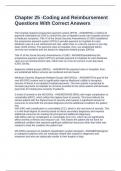
Chapter 25 -Coding and Reimbursement Questions With Correct Answers
The hospital inpatient prospective payment system (IPPS) - ANSWERSIs a method of payment undertaken by CMS to control the cost of inpatient acute-care hospital services to Medicare recipients. Title VI of the Social Security Amendments of 1983 established the prospective payment system (PPS) to provide payment to hospitals for each Medicare case at a set reimbursement rate, rather than on a fee-for-service or per-day basis (CMS 2014a). The payment rates to hospitals, then, are established before...
 Brilliantscores1

Exam (elaborations)
Assessment of Cardiovascular Function Chapter 25 Hinkle
Popular______ (awakening at night to urinate) is common in patients with HF. - Nocturia ______ is a common nonprescription medication that improves outcomes in patients with CAD when taken daily. - Aspirin ______ is a neurohormone that helps regulate BP and fluid volume. - BNP ______ may also be used if the patient cannot exercise. - Dobutamine (S3) Gallop sounds are very low-frequency sounds and are heard with the ______ of the stethoscope placed very lightly against the chest. - bell A 12-ho...
 Lectharvard
Exam (elaborations)
Chapter 25
Chapter 25
annn15671

Exam (elaborations)
Chapter 25_ Documenting Assessment of the Anus, Rectum, Prostate, and Male Genitalia.
Chapter 25_ Documenting Assessment of the Anus, Rectum, Prostate, and Male Genitalia.
 sylvianthiwa

Exam (elaborations)
Chapter 25- Test Bank Exam Questions With Correct Answers 100% Verified.
©THESTAR 2024/2025 ALL RIGHTS RESERVED 11:42PM. A+ 1 Chapter 25- Test Bank Exam Questions With Correct Answers 100% Verified. Over the next 20 to 30 years, the number of Canadians living with and dying from chronic diseases will increase. Why is this the case? A Because new registered nurses will be introduced to the workforce B Because the aging population will be increasing C Because many nurses will retire and we will have a nursing shortage D Because the aging population will b...
 TheStar
Exam (elaborations)
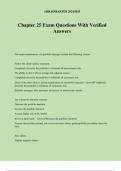
Chapter 25 Exam Questions With Verified Answers
©BRAINBARTER 2024/2025 Chapter 25 Exam Questions With Verified Answers The major requirements of a portfolio manager include the following, except Follow the client's policy statement. Completely diversify the portfolio to eliminate all unsystematic risk. The ability to derive above-average risk adjusted returns. Completely diversify the portfolio to eliminate all systematic risk. None of the above (that is, all are requirements of a portfolio manager) - answerCompletely diversify the...
 Brainbarter
Exam (elaborations)
Chapter 25
Chapter 25
edunurse
Exam (elaborations)
Chapter 25: Circulatory and Lymphatic System Infections with questions and answers
Chapter 25: Circulatory and Lymphatic System Infections
psavorite14

Exam (elaborations)
Chapter 25- Test Bank Questions And Answers 2023
Chapter 25- Test Bank Questions And Answers 2023
 profAlex
Exam (elaborations)
Chapter 25 The Cardiovascular Test
Chapter 25 The Cardiovascular Test
 NorthWest
Exam (elaborations)
Assessment of Cardiovascular Function Chapter 25 Hinkle
______ (awakening at night to urinate) is common in patients with HF. - Nocturia ______ is a common nonprescription medication that improves outcomes in patients with CAD when taken daily. - Aspirin ______ is a neurohormone that helps regulate BP and fluid volume. - BNP ______ may also be used if the patient cannot exercise. - Dobutamine (S3) Gallop sounds are very low-frequency sounds and are heard with the ______ of the stethoscope placed very lightly against the chest. - bell A 12-ho...
Lectharvard

Exam (elaborations)
ONLINE QUESTIONS (OB Adaptive Quizing) - Chapter 25 High-Risk Newborn
1. A 1-day-old neonate, 32 weeks' gestation, is in an overhead warmer. The nurse assesses the morning axillary temperature as 96.9°F. Which of the following could explain this assessment finding? 1. This is a normal temperature for a preterm neonate. 2. Axillary temperatures are not valid for preterm babies. 3. The supply of brown adipose tissue is incomplete. 4. Conduction heat loss is pronounced in the baby. - 3 1. The normal temperature of a premature baby is the same as a full-ter...
Lectharvard

Exam (elaborations)
Detailed Answer Key Pharmacology Proctored Exam Cloned Assessment with multiple selection docs 2021
Detailed Answer Key Pharmacology Proctored Exam Cloned Assessment with multiple selection docs 2021
 smartzone