
- Study guides, Class notes & Summaries
Looking for the best study guides, study notes and summaries about ? On this page you'll find 32 study documents about .
Exam (elaborations)
BIOSCI 201 mid term test prep Exam questions and answers Graded A+ Co-translational translocation -Protein enters the ER while it is still being made by the ribosome; uses SRP and happens on the rough ER. Post-translational translocation -Protein is f
NewBIOSCI 201 mid term test prep Exam questions and answers Graded A+ Co-translational translocation -Protein enters the ER while it is still being made by the ribosome; uses SRP and happens on the rough ER. Post-translational translocation -Protein is fully made in the cytosol first and then transported into an organelle using chaperones. Difference: timing (co vs post) -Co-translational happens during translation, post-translational h
 Wisegrades

Exam (elaborations)
BIOSCI 201 Module A Exam questions and answers Graded A+ Transmission Electron Microscopy (TEM) -High-resolution imaging technique using electrons to visualise cell structures like ribosomes Cell Culture -Growing cells outside the organism for experim
PopularBIOSCI 201 Module A Exam questions and answers Graded A+ Transmission Electron Microscopy (TEM) -High-resolution imaging technique using electrons to visualise cell structures like ribosomes Cell Culture -Growing cells outside the organism for experimental study Primary Cells -D
Wisegrades
Package deal
ANA Pictures Clinical Immunology Exam questions and answers
NewANA Pictures Clinical Immunology Exam questions and answers
Wisegrades
Exam (elaborations)
Biosci 201 - Module 1 Exam questions and answers Graded A+ Where does post translational translocation occur -cytosolic proteins translated in cytosol (mitochondria, nucleus and chloroplast) Where does co-translational translocation occur? -Secretory
NewBiosci 201 - Module 1 Exam questions and answers Graded A+ Where does post translational translocation occur -cytosolic proteins translated in cytosol (mitochondria, nucleus and chloroplast) Where does co-translational translocation occur? -Secretory proteins translated on ribosomes attatched to RER (membrane, golgi and secreted) Pulse chase experiment -radiolabelled aa are incorporated into new proteins and chased with normal aa. Proteins were seen to attach to ER. Cell fractination -Ho...
Wisegrades
Exam (elaborations)
Biosci 201 - module 2 Exam questions and answers Graded A+ Griffiths experiment -genetic material could be transferred between dead bacteria and living bacteria how did griffiths experiment work -rough strain and heat killed have no previously killed
NewBiosci 201 - module 2 Exam questions and answers Graded A+ Griffiths experiment -genetic material could be transferred between dead bacteria and living bacteria how did griffiths experiment work -rough strain and heat killed have no previously killed the mouse however when combined there is a transformation and transfer of bacterial phenotype to become virulent Avery-McCarty-Mcleo
Wisegrades
Exam (elaborations)
BIOSCI 201 - Module A Exam questions and answers Graded A+ Translation on attached RER Targeted to PM for secretion Translation on free ribosomes targeted to cytosol cell fractionalization seperation of parts depending on size and density Readout
NewBIOSCI 201 - Module A Exam questions and answers Graded A+ Translation on attached RER Targeted to PM for secretion Translation on free ribosomes targeted to cytosol cell fractionalization seperation of parts depending on size and density Readout experiment In vitro translation of IgG mRN
Wisegrades
Exam (elaborations)
BIOSCI 201 - Molecular biology - The central dogma and beyond Exam questions and answers Graded A+ Central dogma analogy Nucleus = reading room / blueprint (DNA) Cytoplasm = job site / photocopies (RNA) Cellular machine = protein RNA is the ...? of
NewBIOSCI 201 - Molecular biology - The central dogma and beyond Exam questions and answers Graded A+ Central dogma analogy Nucleus = reading room / blueprint (DNA) Cytoplasm = job site / photocopies (RNA) Cellular machine = protein RNA is the ...? of the
Wisegrades
Exam (elaborations)
BIOSCI 201 Exam questions and answers Graded A+ what determines mitotic spindle angle -PAR protein what happens if PAR 3 is overexpressed -no rotation what happens if no PAR 3 -wrong orientation out of nematode and
NewBIOSCI 201 Exam questions and answers Graded A+ what determines mitotic spindle angle -PAR protein what happens if PAR 3 is overexpressed -no rotation what happens if no PAR 3 -wrong orientation out of nematode and
Wisegrades

Exam (elaborations)
Biosci 201 - module 2 Exam questions and answers Graded A+ Griffiths experiment -genetic material could be transferred between dead bacteria and living bacteria how did griffiths experiment work -rough strain and heat killed have no previously killed
NewBiosci 201 - module 2 Exam questions and answers Graded A+ Griffiths experiment -genetic material could be transferred between dead bacteria and living bacteria how did griffiths experiment work -rough strain and heat killed have no previously killed the mouse however when combined there is a transformation and transfer of bacterial phenotype to become virulent Avery-McCarty-Mcleod -isolated and degraded the transforming component isolation -obtained only a f
Wisegrades

Exam (elaborations)
biosci 201 test prep (rosales) Exam questions and answers Graded A+ how is myocardium repaired - Cells of the immune response -T lymphocytes b lymphocytes natural killer cells macrophages dendritic cells- alert lymphocytes to presence of stuff that
Newbiosci 201 test prep (rosales) Exam questions and answers Graded A+ how is myocardium repaired - Cells of the immune response -T lymphocytes b lymphocytes natural killer cells macrophages dendritic cells- alert lymphocytes to presence of stuff that's foreign reticular cellsTunics of Blood Vess
Wisegrades

Exam (elaborations)
biosci 201 RD Exam questions and answers Graded A+ What is normal cell fate? They have restricted cell fates. Their proliferation and differentiation is tightly regulated, ending in long-term senescence or death. Cells are also constrained to a parti
Newbiosci 201 RD Exam questions and answers Graded A+ What is normal cell fate? They have restricted cell fates. Their proliferation and differentiation is tightly regulated, ending in long-term senescence or death. Cells are also constrained to a particular site in a particular tissue (strong adhesion to neighbouring cells). What are the characteristics of cancer cells? - uncontrolled proliferation: autonomous growth signalling (gain of function of oncogenes), lack of gro
Wisegrades

Exam (elaborations)
biosci 201 notes Exam questions and answers Graded A+ co-translational translocation (6) e.g insulin, enzymes, growth factos, antibodies. collagen, venom -1. N' signal sequence (hydrophobic, ~6-12 amino acids) 2. Signal recognition particle (SR
Newbiosci 201 notes Exam questions and answers Graded A+ co-translational translocation (6) e.g insulin, enzymes, growth factos, antibodies. collagen, venom -1. N' signal sequence (hydrophobic, ~6-12 amino acids) 2. Signal recognition particle (SRP) binds the sequence and the ribosome (halts translation) 3. SRP targets the complex to the ER by binding the SRP receptor in the membrane, GTP binding 4. SRP receptor subu
Wisegrades

Exam (elaborations)
biosci 201 module B lecrture 3 and 4 Exam questions and answers Graded A+ What are the three main processes involved in mRNA processing? Transcription, mRNA processing, and mRNA translation. What is the role of RNA Polymerase II (RNA Pol II) in mRNA p
Newbiosci 201 module B lecrture 3 and 4 Exam questions and answers Graded A+ What are the three main processes involved in mRNA processing? Transcription, mRNA processing, and mRNA translation. What is the role of RNA Polymerase II (RNA Pol II) in mRNA processing? RNA Pol II is responsible for transcribing mRNA and hosts enzymes for capping, splicing, cleavage, and polyadenylation. What is the significance of the 5′ cap on mRNA? The 5′ cap protects the RNA from degradation, masks the 5...
Wisegrades

Exam (elaborations)
BIOSCI 201 Module B Exam questions and answers Graded A+ Gene Expression: What is gene expression? -The process of making RNA and protein from a gene Gene Expression: Why do different cells express different genes? -Because only specific genes are
NewBIOSCI 201 Module B Exam questions and answers Graded A+ Gene Expression: What is gene expression? -The process of making RNA and protein from a gene Gene Expression: Why do different cells express different genes? -Because only specific genes are transcri
Wisegrades

Exam (elaborations)
biosci 201 lecture 5 and 6 module A Exam questions and answers Graded A+ What is the role of lysosomal proteins? They break down macromolecules into monomer building blocks and recycle organelles. What modification serves as the lysosomal sorting sig
Newbiosci 201 lecture 5 and 6 module A Exam questions and answers Graded A+ What is the role of lysosomal proteins? They break down macromolecules into monomer building blocks and recycle organelles. What modification serves as the lysosomal sorting signal? Mannose-6-phos
Wisegrades

Exam (elaborations)
biosci 201 lecture 3 and 4 module A Exam questions and answers Graded A+ What are COP I and COP II coated vesicles? COP I and COP II are types of vesicles that transport proteins between the endoplasmic reticulum (ER) and the Golgi apparatus. What is
Newbiosci 201 lecture 3 and 4 module A Exam questions and answers Graded A+ What are COP I and COP II coated vesicles? COP I and COP II are types of vesicles that transport proteins between the endoplasmic reticulum (ER) and the Golgi apparatus. What is the primary function of COP I vesicles? COP I vesicles are involved in retrograde transport, moving proteins back to the ER. What initiates the formation of COP II vesicles? COP II vesicles are initia
Wisegrades
Exam (elaborations)
biosci 201 lecture 1 and 2 module 1 Exam questions and answers Graded A+ What does the signal hypothesis address? It addresses how proteins are targeted to different parts of the cell. What are the two main methods of protein targeting in eukaryotic c
Newbiosci 201 lecture 1 and 2 module 1 Exam questions and answers Graded A+ What does the signal hypothesis address? It addresses how proteins are targeted to different parts of the cell. What are the two main methods of protein targeting in eukaryotic cells? Post-translational translocation and co-translational translocation. Where are cytosolic proteins translated? In the cytosol. What type of proteins ar
Wisegrades

Exam (elaborations)
biosci 201 JM Exam questions and answers Graded A+ Proteins of the immune system Cytokines, prostaglandins Organs of the immune system Bone marrow, thymus, lymph nodes, spleen 4 key features of the immune system Tolerance - can distinguish self-ant
Newbiosci 201 JM Exam questions and answers Graded A+ Proteins of the immune system Cytokines, prostaglandins Organs of the immune system Bone marrow, thymus, lymph nodes, spleen 4 key features of the immune system Tolerance - can distinguish self-antigens from foreign antigens. Diversity - can recognise & respond to many different molecules. Specificity - can distinguish
Wisegrades
Exam (elaborations)
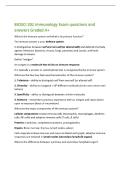
BIOSCI 201 immunology Exam questions and answers Graded A+ What is the immune system and what is its primary function? The immune system is your defence system. It distinguishes between self and non-self (or altered self) and defends the body against
NewBIOSCI 201 immunology Exam questions and answers Graded A+ What is the immune system and what is its primary function? The immune system is your defence system. It distinguishes between self and non-self (or altered self) and defends the body against infections (bacteria, viruses, fungi, parasites) and cancer, and heals damage to tissues. Define "antigen". An antigen is a molecule
Wisegrades

Exam (elaborations)
biosci 201 HS Exam questions and answers Graded A+ Cleavage in C. elegans The embryo is rapidly cleaved into smaller and smaller cells called blastomeres. At the two cell stage there are two cells AB (future anterior) and P1 (future posterior). Why
Newbiosci 201 HS Exam questions and answers Graded A+ Cleavage in C. elegans The embryo is rapidly cleaved into smaller and smaller cells called blastomeres. At the two cell stage there are two cells AB (future anterior) and P1 (future posterior). Why is cleavage so rapid in C. elegans? Early cleavage divisions don't depend on new gene activity from the zygotic DNA, instead, maternal p
Wisegrades