
- Study guides, Class notes & Summaries
Looking for the best study guides, study notes and summaries about ? On this page you'll find 43 study documents about .
Exam (elaborations)
BIOS 256 FINAL EXAM STUDY Q&A | Comprehensive ATI
BIOS 256 FINAL EXAM STUDY Q&A 1 The urinary system does all of the following, EXCEPT it A secretes excess glucose molecules B regulates blood volume C contributes to stabilizing blood pH D eliminates organic waste products E regulates plasma concentrations of electrolytes 2 Conical structures that are located in the renal medulla are called A pyramids B renal columns C renal pelvises D nephrons E calyces 3 The region known as the macula densa is part of A the proximal convoluted tubule B the dis...
 SylviaMn
Exam (elaborations)
BIOS 256 FINAL EXAM STUDY Q&A | Comprehensive ATI
BIOS 256 FINAL EXAM STUDY Q&A 1 The urinary system does all of the following, EXCEPT it A secretes excess glucose molecules B regulates blood volume C contributes to stabilizing blood pH D eliminates organic waste products E regulates plasma concentrations of electrolytes 2 Conical structures that are located in the renal medulla are called A pyramids B renal columns C renal pelvises D nephrons E calyces 3 The region known as the macula densa is part of A the proximal convoluted tubule B the dis...
 SmartShirley
Exam (elaborations)
BIOS 256 FINAL EXAM STUDY Q&A | Comprehensive ATI
BIOS 256 FINAL EXAM STUDY Q&A 1 The urinary system does all of the following, EXCEPT it A secretes excess glucose molecules B regulates blood volume C contributes to stabilizing blood pH D eliminates organic waste products E regulates plasma concentrations of electrolytes 2 Conical structures that are located in the renal medulla are called A pyramids B renal columns C renal pelvises D nephrons E calyces 3 The region known as the macula densa is part of A the proximal convoluted tubule B the dis...
NeshAcademia
Exam (elaborations)
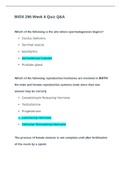
BIOS 256 Week 6 Quiz Q&A
BIOS 256 Week 6 Quiz Q&A Which of the following is the site where spermatogenesis begins? • Ductus Deferens • Seminal vesicle • Epididymis • Seminiferous tubules • Prostate gland Which of the following reproductive hormones are involved in BOTH the male and female reproductive systems (note more than one answer may be correct) • Gonadotropin Releasing Hormone • Testosterone • Progesterone • Luteinizing Hormone • Follicular Stimulating Hormone
keenstar
Exam (elaborations)
BIOS 256 Week 6 Quiz Q&A
BIOS 256 Week 6 Quiz Q&A Which of the following is the site where spermatogenesis begins? • Ductus Deferens • Seminal vesicle • Epididymis • Seminiferous tubules • Prostate gland Which of the following reproductive hormones are involved in BOTH the male and female reproductive systems (note more than one answer may be correct) • Gonadotropin Releasing Hormone • Testosterone • Progesterone • Luteinizing Hormone • Follicular Stimulating Hormone
brightkid
Exam (elaborations)
BIOS 256 Week 6 Quiz Q&A
BIOS 256 Week 6 Quiz Q&A Which of the following is the site where spermatogenesis begins? • Ductus Deferens • Seminal vesicle • Epididymis • Seminiferous tubules • Prostate gland Which of the following reproductive hormones are involved in BOTH the male and female reproductive systems (note more than one answer may be correct) • Gonadotropin Releasing Hormone • Testosterone • Progesterone • Luteinizing Hormone • Follicular Stimulating Hormone
verifiedtutors
Exam (elaborations)
BIOS 256 OL, Week 4 Lab Q&A
BIOS 256 OL, Week 4 Lab Q&A OL Lab 4: Renal Physiology: Find the mode of action of a diuretic drug Learning Objectives: • Understand the morphological relationships between the kidney tubules and the circulatory system • Analyze experimental data for calculating glomerular filtration rate • Set up and perform a perfusion of renal tubules, including the calculation of liquid absorption rates • Learn about the epithelial transport mechanism in the kidney tubules • Use experime...
keenstar
Exam (elaborations)
BIOS 256 OL, Week 4 Lab Q&A
BIOS 256 OL, Week 4 Lab Q&A OL Lab 4: Renal Physiology: Find the mode of action of a diuretic drug Learning Objectives: • Understand the morphological relationships between the kidney tubules and the circulatory system • Analyze experimental data for calculating glomerular filtration rate • Set up and perform a perfusion of renal tubules, including the calculation of liquid absorption rates • Learn about the epithelial transport mechanism in the kidney tubules • Use experime...
brightkid
Exam (elaborations)
BIOS 256 OL, Week 4 Lab Q&A
BIOS 256 OL, Week 4 Lab Q&A OL Lab 4: Renal Physiology: Find the mode of action of a diuretic drug Learning Objectives: • Understand the morphological relationships between the kidney tubules and the circulatory system • Analyze experimental data for calculating glomerular filtration rate • Set up and perform a perfusion of renal tubules, including the calculation of liquid absorption rates • Learn about the epithelial transport mechanism in the kidney tubules • Use experime...
verifiedtutors
Exam (elaborations)
Bios 256 Final Exam Study Guide 2022 Latest Update
Questions And Answers
 EXEMPLARY1
Exam (elaborations)
BIOS 256 Exam 3 Q&A Comprehensive ATI
BIOS 256 Exam 3 Q&A Innate immune Function 1. Which of the following DO NOT form part of physical barriers? a. sweat b. sebaceous secretions c. unbroken skin d. mucous membrane e. T cells 2. The term _____ is given to any foreign substance that stimulates a specific immune system response. a. Antigen 3. The immune defenses are divided into how many basic categories. a. five b. four c. two d. three 4. Chemical barriers include: (Select all that apply) a. Mucous b. Food c....
keenstar
Exam (elaborations)
BIOS 256 Exam 3 Q&A Comprehensive ATI
BIOS 256 Exam 3 Q&A Innate immune Function 1. Which of the following DO NOT form part of physical barriers? a. sweat b. sebaceous secretions c. unbroken skin d. mucous membrane e. T cells 2. The term _____ is given to any foreign substance that stimulates a specific immune system response. a. Antigen 3. The immune defenses are divided into how many basic categories. a. five b. four c. two d. three 4. Chemical barriers include: (Select all that apply) a. Mucous b. Food c....
brightkid
Exam (elaborations)
BIOS 256 Exam 2 Q&A Study Notes Comprehensive ATI
BIOS 256 Exam 2 Q&A Study Notes 1. Carbs are polymers of what? Slide 28? a. Monosaccharides – galactose, fructose, glucose b. Disaccharides = sucrose, maltose, lactose c. Polysaccharides = starches, glycogen, fibers 2. Combining small simple molecules into synthesizing into complex molecules is the definition of Anabolism. 3. Which vitamin is for Ca abs. Slide 62 a. Vitamin D 4. Which of hormones will DOMINATE in the Post absorptive state (125-127) a. Insulin b. Glucagon c. c...
keenstar
Exam (elaborations)
BIOS 256 Exam 2 Q&A Study Notes Comprehensive ATI
BIOS 256 Exam 2 Q&A Study Notes 1. Carbs are polymers of what? Slide 28? a. Monosaccharides – galactose, fructose, glucose b. Disaccharides = sucrose, maltose, lactose c. Polysaccharides = starches, glycogen, fibers 2. Combining small simple molecules into synthesizing into complex molecules is the definition of Anabolism. 3. Which vitamin is for Ca abs. Slide 62 a. Vitamin D 4. Which of hormones will DOMINATE in the Post absorptive state (125-127) a. Insulin b. Glucagon c. c...
brightkid
Exam (elaborations)
BIOS 256 Exam 2 Q&A Study Notes Comprehensive ATI
BIOS 256 Exam 2 Q&A Study Notes 1. Carbs are polymers of what? Slide 28? a. Monosaccharides – galactose, fructose, glucose b. Disaccharides = sucrose, maltose, lactose c. Polysaccharides = starches, glycogen, fibers 2. Combining small simple molecules into synthesizing into complex molecules is the definition of Anabolism. 3. Which vitamin is for Ca abs. Slide 62 a. Vitamin D 4. Which of hormones will DOMINATE in the Post absorptive state (125-127) a. Insulin b. Glucagon c. c...
verifiedtutors
Exam (elaborations)
BIOS 256 Exam 1 Q&A
BIOS 256 Exam 1 Q&A Question 3 3 / 3 pts The chief cells of the stomach secrete , while the parietal cells secrete . HCl; gastrin Intrinsic factor; gastrin Gastrin; gastric lipase Gastric lipase; HCl HCl; pepsinogen Question 4 3 / 3 pts Which of the following is considered an accessory organ of the digestive system? Pancreas Small intestine Spleen Colon Esophagus Question 5 3 / 3 pts Waves of smooth muscle contraction that propel the contents of the digestive tract...
keenstar
Exam (elaborations)
BIOS 256 Exam 1 Q&A
BIOS 256 Exam 1 Q&A Question 3 3 / 3 pts The chief cells of the stomach secrete , while the parietal cells secrete . HCl; gastrin Intrinsic factor; gastrin Gastrin; gastric lipase Gastric lipase; HCl HCl; pepsinogen Question 4 3 / 3 pts Which of the following is considered an accessory organ of the digestive system? Pancreas Small intestine Spleen Colon Esophagus Question 5 3 / 3 pts Waves of smooth muscle contraction that propel the contents of the digestive tract...
brightkid
Exam (elaborations)
BIOS 256 Exam 3 Q&A Comprehensive ATI
BIOS 256 Exam 3 Q&A Innate immune Function 1. Which of the following DO NOT form part of physical barriers? a. sweat b. sebaceous secretions c. unbroken skin d. mucous membrane e. T cells 2. The term _____ is given to any foreign substance that stimulates a specific immune system response. a. Antigen 3. The immune defenses are divided into how many basic categories. a. five b. four c. two d. three 4. Chemical barriers include: (Select all that apply) a. Mucous b. Food c....
verifiedtutors
Exam (elaborations)
BIOS 256 FINAL EXAM STUDY Q&A | Comprehensive ATI
BIOS 256 FINAL EXAM STUDY Q&A 1 The urinary system does all of the following, EXCEPT it A secretes excess glucose molecules B regulates blood volume C contributes to stabilizing blood pH D eliminates organic waste products E regulates plasma concentrations of electrolytes 2 Conical structures that are located in the renal medulla are called A pyramids B renal columns C renal pelvises D nephrons E calyces 3 The region known as the macula densa is part of A the proximal convoluted tubule B the dis...
 Learnexam
Exam (elaborations)
BIOS 256 FINAL EXAM STUDY Q&A | Comprehensive ATI
BIOS 256 FINAL EXAM STUDY Q&A 1 The urinary system does all of the following, EXCEPT it A secretes excess glucose molecules B regulates blood volume C contributes to stabilizing blood pH D eliminates organic waste products E regulates plasma concentrations of electrolytes 2 Conical structures that are located in the renal medulla are called A pyramids B renal columns C renal pelvises D nephrons E calyces 3 The region known as the macula densa is part of A the proximal convoluted tubule B the dis...
 chrisjaypapers