
- Study guides, Class notes & Summaries
Looking for the best study guides, study notes and summaries about ? On this page you'll find 37 study documents about .

Exam (elaborations)
Biol 2325L: Fundamentals Of Microbiology Laboratory| Lab Report 7| Latest Updated 2024 Scored A +
BIOL 2325L: FUNDAMENTALS OF MICROBIOLOGY LABORATORY| LAB REPORT 7| LATEST UPDATED 2024 SCORED A + Lab 7 Report: Differential Tests, Fermentation, Respiration and Reduction Potential Introduction: All cells require energy for growth and maintenance. The major metabolic pathways involved in energy production (i.e., Glycolysis, Krebs’s Cycle and Electron Transport Chain) include the enzymatic breakdown of organic compounds like sugars and carbohydrates, resulting in the removal of high-energy ...
 klmz

Exam (elaborations)
Biol 2325L| Fundamentals Of Microbiology Laboratory| Lab Report 3| 2024
PopularBiol 2325L| Fundamentals Of Microbiology Laboratory| Lab Report 3| 2024
klmz

Exam (elaborations)
Biol 2325L| Fundamentals Of Microbiology Laboratory| Lab Report 1| Latest Updated 2024, Already Passed
BIOL 2325L| FUNDAMENTALS OF MICROBIOLOGY LABORATORY| LAB REPORT 1| LATEST UPDATED 2024, ALREADY PASSED Introduction: The major learning objectives for the first two micro lab sessions included testing the efficacy of hand washing, illustrating microbial transmission via direct contact, performing proper aseptic technique, learning about common types of media, isolating bacterial colonies, and describing colony morphologies. Students learned that humans are home to a diverse population of micr...
klmz

Exam (elaborations)
Biol 2325L| Fundamentals Of Microbiology Laboratory Lab Report 2| 2024 Already Passed / Scored A+
BIOL 2325L| FUNDAMENTALS OF MICROBIOLOGY LABORATORY LAB REPORT 2| 2024 ALREADY PASSED / SCORED A+ Introduction: The major learning objectives for the micro lab sessions three through five included learning how to operate and properly care for a compound light microscope, becoming competent in slide preparation (including wet mounts, dry mounts, and smears), observing/describing bacterial cell morphologies and structures, and learning to properly perform, observe, and interpret results for seve...
klmz

Exam (elaborations)
Biol 2325L: Fundamentals Of Microbiology Laboratory| Lab Report 4|Latest Updated 2024 /Scored A+
BIOL 2325L: FUNDAMENTALS OF MICROBIOLOGY LABORATORY| LAB REPORT 4|LATEST UPDATED 2024 /SCORED A+ Bacterial Structure, Simple Stains, Negative Stains, Gram and Acid-Fast Stains Introduction: Visualizing bacteria is difficult because of their small size and also because their refractive index is close to their aqueous surroundings, making them nearly transparent. To effectively visualize bacteria, they must be stained to enhance the contrast between the cells and their surroundings (Leboffe and...
klmz

Exam (elaborations)
Biol 2325L: Fundamentals Of Microbiology Laboratory| Lab Report 5| Latest Updated 2024 Scored A+
BIOL 2325L: FUNDAMENTALS OF MICROBIOLOGY LABORATORY| LAB REPORT 5| LATEST UPDATED 2024 SCORED A+ Differential Staining: Capsules, Endospores and Flagellates Introduction: Many staining procedures are available for use with microorganisms. Such stains target a specific part of the cell or may be used to identify a certain class or type of microorganism due to some unique staining feature. Several examples of such “structural” stains are the endospore stain, the capsule stain, and the flage...
klmz

Exam (elaborations)
Biol 2325L: Fundamentals Of Microbiology Laboratory| Lab Report 9| Latest Updated 2024 Scored A+
BIOL 2325L: FUNDAMENTALS OF MICROBIOLOGY LABORATORY| LAB REPORT 9| LATEST UPDATED 2024 SCORED A+ Lab 9 Report: Molecular Genetics: DNA Extraction via Freeze-Thaw Cell Lysis Introduction: DNA is a polymer. The monomer units of DNA are nucleotides, and the polymer is known as a "polynucleotide." Each nucleotide consists of a 5-carbon sugar (deoxyribose), a nitrogen containing base attached to the sugar, and a phosphate group (Leboffe and Pierce, 2012). There are four different types of nucleo...
klmz

Exam (elaborations)
Biol 2325L| Fundamentals Of Microbiology Laboratory| Lab Report 3| 2024
Biol 2325L| Fundamentals Of Microbiology Laboratory| Lab Report 3| 2024
 NURSINGEXAMS

Exam (elaborations)
Biol 2325L: Fundamentals Of Microbiology Laboratory| Lab Report 9| Latest Updated 2024 Scored A+
BIOL 2325L: FUNDAMENTALS OF MICROBIOLOGY LABORATORY| LAB REPORT 9| LATEST UPDATED 2024 SCORED A+ Lab 9 Report: Molecular Genetics: DNA Extraction via Freeze-Thaw Cell Lysis Introduction: DNA is a polymer. The monomer units of DNA are nucleotides, and the polymer is known as a "polynucleotide." Each nucleotide consists of a 5-carbon sugar (deoxyribose), a nitrogen containing base attached to the sugar, and a phosphate group (Leboffe and Pierce, 2012). There are four different types of nu...
NURSINGEXAMS

Exam (elaborations)
Biol 2325L: Fundamentals Of Microbiology Laboratory| Lab Report 7| Latest Updated 2024 Scored A +
BIOL 2325L: FUNDAMENTALS OF MICROBIOLOGY LABORATORY| LAB REPORT 7| LATEST UPDATED 2024 SCORED A + Lab 7 Report: Differential Tests, Fermentation, Respiration and Reduction Potential Introduction: All cells require energy for growth and maintenance. The major metabolic pathways involved in energy production (i.e., Glycolysis, Krebs’s Cycle and Electron Transport Chain) include the enzymatic breakdown of organic compounds like sugars and carbohydrates, resulting in the removal of high-e...
NURSINGEXAMS

Exam (elaborations)
Biol 2325L: Fundamentals Of Microbiology Laboratory| Lab Report 6| Latest Update 2024 Scored A+
BIOL 2325L: FUNDAMENTALS OF MICROBIOLOGY LABORATORY| LAB REPORT 6| LATEST UPDATE 2024 SCORED A+ Lab 6 Report: Selective and Differential Media Introduction: In addition to streaking for isolation, manipulation of the culture medium can assist in obtaining a pure culture or identification of unknown microorganisms. An important aspect to this is the use of selective and differential media. Selective media are media that inhibit the growth of certain types of microorganisms and thusselect ...
NURSINGEXAMS

Exam (elaborations)
Biol 2325L: Fundamentals Of Microbiology Laboratory| Lab Report 5| Latest Updated 2024 Scored A+
BIOL 2325L: FUNDAMENTALS OF MICROBIOLOGY LABORATORY| LAB REPORT 5| LATEST UPDATED 2024 SCORED A+ Differential Staining: Capsules, Endospores and Flagellates Introduction: Many staining procedures are available for use with microorganisms. Such stains target a specific part of the cell or may be used to identify a certain class or type of microorganism due to some unique staining feature. Several examples of such “structural” stains are the endospore stain, the capsule stain, and the ...
NURSINGEXAMS

Exam (elaborations)
Biol 2325L: Fundamentals Of Microbiology Laboratory| Lab Report 4|Latest Updated 2024 /Scored A+
BIOL 2325L: FUNDAMENTALS OF MICROBIOLOGY LABORATORY| LAB REPORT 4|LATEST UPDATED 2024 /SCORED A+ Bacterial Structure, Simple Stains, Negative Stains, Gram and Acid-Fast Stains Introduction: Visualizing bacteria is difficult because of their small size and also because their refractive index is close to their aqueoussurroundings, making them nearly transparent. To effectively visualize bacteria,they must be stained to enhance the contrast between the cells and their surroundings (Leboffe a...
NURSINGEXAMS

Exam (elaborations)
Biol 2325L| Fundamentals Of Microbiology Laboratory Lab Report 2| 2024 Already Passed / Scored A+
BIOL 2325L| FUNDAMENTALS OF MICROBIOLOGY LABORATORY LAB REPORT 2| 2024 ALREADY PASSED / SCORED A+ Introduction: The major learning objectives for the micro lab sessions three through five included learning how to operate and properly care for a compound light microscope, becoming competent in slide preparation (including wet mounts, dry mounts, and smears), observing/describing bacterial cell morphologies and structures, and learning to properly perform, observe, and interpret resultsfors...
NURSINGEXAMS

Exam (elaborations)
Biol 2325L| Fundamentals Of Microbiology Laboratory| Lab Report 1| Latest Updated 2024, Already Passed
BIOL 2325L| FUNDAMENTALS OF MICROBIOLOGY LABORATORY| LAB REPORT 1| LATEST UPDATED 2024, ALREADY PASSED Introduction: The major learning objectives for the first two micro lab sessions included testing the efficacy of hand washing, illustrating microbial transmission via direct contact, performing proper aseptic technique, learning about common types of media, isolating bacterial colonies, and describing colony morphologies. Students learned that humans are home to a diverse population of ...
NURSINGEXAMS

Exam (elaborations)
Biol 2325L| Fundamentals Of Microbiology Laboratory| Lab Report 1| 2024
BIOL 2325L| FUNDAMENTALS OF MICROBIOLOGY LABORATORY| LAB REPORT 1| 2024 Introduction: The major learning objectives for the first two micro lab sessions included testing the efficacy of hand washing, illustrating microbial transmission via direct contact, performing proper aseptic technique, learning about common types of media, isolating bacterial colonies, and describing colony morphologies. Students learned that humans are home to a diverse population of microorganisms. In fact, approximate...
 lljj
Exam (elaborations)
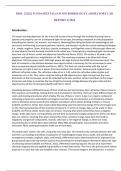
Biol 2325L| Fundamentals Of Microbiology Laboratory Lab Report 2| 2024
BIOL 2325L| FUNDAMENTALS OF MICROBIOLOGY LABORATORY LAB REPORT 2| 2024 Introduction: The major learning objectives for the micro lab sessions three through five included learning how to operate and properly care for a compound light microscope, becoming competent in slide preparation (including wet mounts, dry mounts, and smears), observing/describing bacterial cell morphologies and structures, and learning to properly perform, observe, and interpret results for several staining techniques (i....
lljj

Exam (elaborations)
Biol 2325L: Fundamentals Of Microbiology Laboratory| Lab Report 4| 2024
BIOL 2325L: FUNDAMENTALS OF MICROBIOLOGY LABORATORY| LAB REPORT 4| 2024 Bacterial Structure, Simple Stains, Negative Stains, Gram and Acid-Fast Stains Introduction: Visualizing bacteria is difficult because of their small size and also because their refractive index is close to their aqueous surroundings, making them nearly transparent. To effectively visualize bacteria, they must be stained to enhance the contrast between the cells and their surroundings (Leboffe and Pierce, 2012). There are...
lljj

Exam (elaborations)
Biol 2325L: Fundamentals Of Microbiology Laboratory| Lab Report 5| 2024
BIOL 2325L: FUNDAMENTALS OF MICROBIOLOGY LABORATORY| LAB REPORT 5| 2024 Differential Staining: Capsules, Endospores and Flagellates Introduction: Many staining procedures are available for use with microorganisms. Such stains target a specific part of the cell or may be used to identify a certain class or type of microorganism due to some unique staining feature. Several examples of such “structural” stains are the endospore stain, the capsule stain, and the flagella stain (Leboffe and Pi...
lljj

Exam (elaborations)
Biol 2325L: Fundamentals Of Microbiology Laboratory| Lab Report 6| 2024
BIOL 2325L: FUNDAMENTALS OF MICROBIOLOGY LABORATORY| LAB REPORT 6| 2024 Lab 6 Report: Selective and Differential Media Introduction: In addition to streaking for isolation, manipulation of the culture medium can assist in obtaining a pure culture or identification of unknown microorganisms. An important aspect to this is the use of selective and differential media. Selective media are media that inhibit the growth of certain types of microorganisms and thus select for the growth of only certa...
lljj