
- Study guides, Class notes & Summaries
Looking for the best study guides, study notes and summaries about ? On this page you'll find 33 study documents about .
Other
Astrophysics
Documents Consist Of Knowledge On Theories,Theorists,Definitions,Study Guide,Case Studies,Practice Exam And Scenarios.
 MoreKnowledge

Exam (elaborations)
Astrophysics Exam Questions and Answers Latest Update Graded A+
PopularAstrophysics Exam Questions and Answers Latest Update Graded A+ Which of the following parts of the Sun is the hottest one? Core Convection zone Photosphere Chromosphere Corona - Answers Core Which of the following parts of the Sun is the hottest one? Photosphere Chromosphere Corona Sunspots - Answers Corona Approximately how long does energy take to travel from the core to the surface of the Sun? - Answers 16 million years The Sun's core is generating energy in the form...
TutorJosh

Exam (elaborations)
Astrophysics & Modern Cosmology 2026 Study Guide
New1. What is the currently accepted age of the universe according to the ΛCDM model (as of 2026)? A) 10.5 billion years B) 13.8 billion years C) 15.2 billion years D) 20 billion years Correct Answer: B) 13.8 billion years 2. Which force is primarily responsible for the "accelerated expansion" of the universe? A) Gravity B) Dark Energy C) The Strong Nuclear Force D) Electromagnetism Correct Answer: B) Dark Energy 3. What percentage of the universe's mass-energy content is est...
 gradexam
Exam (elaborations)
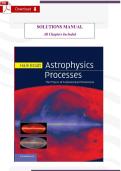
Astrophysics Processes: The Physics of Astronomical Phenomena (Hale Bradt, 2008 Edition) – Verified Solutions Manual (All Chapters, Step‑by‑Step Answers & Detailed Explanations)
NewThe Solutions Manual for Astrophysics Processes: The Physics of Astronomical Phenomena (2008 Edition) by Hale Bradt is a premium academic resource designed for astrophysics, physics, astronomy, and space‑science students. This verified solutions manual aligns with Bradt’s widely used textbook and provides complete, step‑by‑step solutions to all end‑of‑chapter problems. It is an essential companion for mastering the physical processes that govern stars, galaxies, radiation, plasmas, a...
 ScholarNova
Package deal
Aqa A-Level Physics Astrophysics Revision Exam Questions With Correct Answers Provided 2025/2026 Edition
NewAqa A-Level Physics Astrophysics Revision Exam Questions With Correct Answers Provided 2025/2026 Edition
 NursingAcademy
Exam (elaborations)
Biochemical Foundations of Pharmaceutical Biotechnology and CRISPR Gene EditingExam questions and answers
NewBiochemical Foundations of Pharmaceutical Biotechnology and CRISPR Gene EditingExam questions and answers What is a genetically modified (GM) animal? An animal whose genome has been intentionally modified using biotechnology, including gene editing, insertion, or deletion. What defines a transgenic animal? A genetically modified animal that carries foreign DNA artificially introduced into its genome, often from a different species. Name an example of a transgenic animal that pr...
NursingAcademy
Exam (elaborations)
BIO B: Mechanisms of Genetics Exam questions and answers
NewBIO B: Mechanisms of Genetics Exam questions and answers Enzyme - A protein machine, usually ending in "-ase" mRNA - The RNA that is a copy of the DNA read by tRNA in order for translation to occur TRANSCRIPTION/TRANSLATION tRNA - The RNA containing anticodons and amino acids for TRANSLATION Hydrogen Bonds - The chemical bonds between base pairs Ribosome - Organelle responsible for holding mRNA during TRANSLATION
NursingAcademy
Exam (elaborations)
Behavioral Health (The Medical Assistant Chapter 37) Exam questions and answers
NewBehavioral Health (The Medical Assistant Chapter 37) Exam questions and answers ADHD (Attention-Deficit Hyperactivity Disorder) - a psychological disorder marked by extreme inattention and/or hyperactivity and impulsivity mental health - Includes psychological, emotional, and social well being psychiatry - Healthcare specialty that studies the brain and its effects on the body behavioral health - Is mental health, substance abuse, and associated physical disorders psychiatrist - A ...
NursingAcademy
Exam (elaborations)
Behavioral Health (The Medical Assistant Chapter 37) Exam questions and answers
NewBehavioral Health (The Medical Assistant Chapter 37) Exam questions and answers ADHD (Attention-Deficit Hyperactivity Disorder) - a psychological disorder marked by extreme inattention and/or hyperactivity and impulsivity mental health - Includes psychological, emotional, and social well being psychiatry - Healthcare specialty that studies the brain and its effects on the body behavioral health - Is mental health, substance abuse, and associated physical disorders psychiatrist - A ...
NursingAcademy
Exam (elaborations)
Astrophysics: Stars, Galaxies, and Cosmology Key Concepts Exam questions and answers
NewAstrophysics: Stars, Galaxies, and Cosmology Key Concepts Exam questions and answers apparent brightness - how bright an object appears in the sky, as contrasted with its actual luminosity brown dwarf - an object intermediate in size between a planet and a star; sometimes called a "failed star" color index - difference between the magnitudes of a star in two different spectral regions giant - a star of exaggerated size with a large, extended photosphere luminosity - the rat...
NursingAcademy

Exam (elaborations)
ASTROPHYSICS VOCABULARY Exam questions and answers
NewASTROPHYSICS VOCABULARY Exam questions and answers astrophysics - thiên văn vật lí astronomy - thiên văn học celestial body - thiên thể gravity - lực hấp dẫn gravitational force - lực hấp dẫn gravitational field - trường hấp dẫn orbit - quỹ đạo orbital motion - chuyển động quỹ đạo
NursingAcademy

Exam (elaborations)
Astrophysics Final '25 Exam questions and answers
NewAstrophysics Final '25 Exam questions and answers How do the Balmer and Lyman line series form in the hydrogen spectrum? Balmer lines form when electrons transition from higher levels down to the n=2 energy level, producing visible-light emission. Lyman lines form when electrons fall to the n=1 level, producing ultraviolet emission. What is the Doppler effect? Give one example in astronomy. The Doppler effect is the change in observed wavelength due to the motion of a source tow...
NursingAcademy

Exam (elaborations)
Astrophysics Final Exam questions and answers
NewAstrophysics Final Exam questions and answers Apparent magnitude - Logarithmic measure of brightness as seen from Earth Absolute magnitude - Measure of the intrinsic brightness of a star where it is the apparent magnitude if the object was 10 parsecs away Equation relating absolute and apparent magnitude - Luminosity classes - OBAFGKMLTY Stellar parallax - Apparent shift of a nearby object when viewed from different locations Parallax equation - Inverse square law for light -...
NursingAcademy

Exam (elaborations)
Astrophysics Exam questions and answers
NewAstrophysics Exam questions and answers converging lens - bends light so that the light rays come together to a point lens equation - 1/f= 1/u + 1/v refracting telescope - telescope that uses lenses to focus visible light. object at infinity - parallel rays normal adjustment - principle focus of lens same as eye, so image at infinity chromatic aberration - the property of a lens whereby light of different colors is focused at different places problems with refracting telescope - ...
NursingAcademy

Exam (elaborations)
Astrophysics Exam questions and answers
NewAstrophysics Exam questions and answers Ratio of luminosity - =(₅√100)^∆M or 2,51^∆M Stellar cluster - A group of stars that are near each other in space and created by the collapse of the same gas cloud. Light year - The distance light travels in 1 year General structure of solar system (a lot) - The planets orbit the Sun in ellipses and moons orbit planets. Order of planets: MVEMJSUN. The asteroid belt is the region of the Solar System located roughly between the orbits ...
NursingAcademy

Exam (elaborations)
Astrophysics Exam questions and answers
NewAstrophysics Exam questions and answers [1] What can you say about the mass of the Sun? Compare with other masses? M☉ = 1.99 · 10^30 kg Planets: 10^-7 - 10^-3 M☉ most stars in the narrow range of: 0.1-20 M☉ Globular cluster: 10^5 M☉ Galaxy: 10^11 M☉ Cluster of galaxies: 10^14 - 10^15 M☉ [2] What can you say about measures of distance? 1 AU = 1.50 · 10^11m 1 pc = 3.09 · 10^16m (≈2 · 10^5 AU) Proxima Centauri: 1.31 pc (interstellar range) Our galaxy: 100 p...
NursingAcademy

Exam (elaborations)
Astrophysics Exam questions and answers
NewAstrophysics Exam questions and answers converging lens - bends light so that the light rays come together to a point lens equation - 1/f= 1/u + 1/v refracting telescope - telescope that uses lenses to focus visible light. object at infinity - parallel rays normal adjustment - principle focus of lens same as eye, so image at infinity chromatic aberration - the property of a lens whereby light of different colors is focused at different places
NursingAcademy

Exam (elaborations)
Astrophysics and Stellar Evolution: Key Concepts and Processes Exam questions and answers
NewAstrophysics and Stellar Evolution: Key Concepts and Processes Exam questions and answers Cycle of death for a low mass star evolves into a red giant, undergoes helium fusion, and ultimately sheds its outer layers to form a planetary nebula, leaving behind a white dwarf. Cycle of death for a high mass star exhausts its nuclear fuel, undergoes supernova explosion, and may leave behind a neutron star or black hole. Significance of the helium flash is a rapid onset of helium fus...
NursingAcademy

Exam (elaborations)
Astrophysics and Space Science: Key Concepts and Phenomena Exam questions and answers
NewAstrophysics and Space Science: Key Concepts and Phenomena Exam questions and answers What is the name for the type of light with an energy that is 10x larger than red's energy? - Violet What is the wavelength of a wave? - The distance between two neighboring peaks in the wave. What statement about sound is correct? - Sound waves push air molecules back and forth in the direction of the wave's motion. What happens if the distance between two stars is decreased by a factor of 2?...
NursingAcademy
Exam (elaborations)
Astrophysics and Space Science: Sun, Stars, Exoplanets, and Cosmology Exam questions and answers
NewAstrophysics and Space Science: Sun, Stars, Exoplanets, and Cosmology Exam questions and answers How does the Sun’s method of producing energy differ from the method used in human- made nuclear power plants? The sun produces energy by nuclear fusion (hydrogen nuclei fuse into helium) nuclear power plants produce energy through nuclear fission (splitting heavy atoms like uranium) If a newly discovered comet has a highly elongated orbit, moves retrograde, is steeply tilted relative...
NursingAcademy
Exam (elaborations)
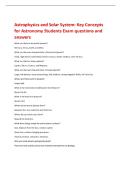
Astrophysics and Solar System: Key Concepts for Astronomy Students Exam questions and answers
NewAstrophysics and Solar System: Key Concepts for Astronomy Students Exam questions and answers What are the four terrestrial planets? Mercury, Venus, Earth, and Mars. What are the main characteristics of terrestrial planets? Small, high dense (rock/metal), few/no moons, slower rotation, near the Sun. What are the four Jovian planets? Jupiter, Saturn, Uranus, and Neptune. What are the main characteristics of Jovian planets? Large, low density, many moons/rings, fast rotation, s...
NursingAcademy
Exam (elaborations)
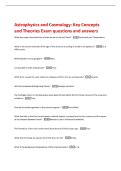
Astrophysics and Cosmology: Key Concepts and Theories Exam questions and answers
NewAstrophysics and Cosmology: Key Concepts and Theories Exam questions and answers What two major characteristics of stars do we use to sort them? - Luminosity and Temperature. What is the current estimate of the age of the universe according to modern astrophysics? - 13.8 billion years. Which planet is not a gas giant? - Mars. Is it possible to orbit a black hole? - True. What force caused the solar nebula to collapse and form the Sun and planets? - Grav
NursingAcademy