
A&E (NURS311)
New York University
Here are the best resources to pass A&E (NURS311). Find A&E (NURS311) study guides, notes, assignments, and much more.
Exam (elaborations)
NYU nursing A&E III exam 1 questions with complete solutions
Nine Emerging global trends correct answer: 1. overall aging population 2. increasing life expectancy 3. rising number of oldest old 4. chronic diseases are major cause of death 5. some total populations will shrink 6. changing family structure 7. shifting patterns of work & retirement 8. changing social insurance systems 9. new economic challenges Nurse roles in caring for older adults correct answer: generalist and specialist -direct care providers -case managers -nurse leade...
 Classroom
Exam (elaborations)
A&E 3 Final Exam questions with complete solutions
PopularAnemia correct answer: • Common disorder of aging • Clinical sign → not a specific disease • Falsely attributed to normal aging • Vague symptoms until disease is severe Anemia: causes correct answer: o Dietary problems, genetic disorders, bone marrow disease, excessive bleeding Anemia: CM correct answer: o Fatigue, low energy, shortness of breath, mental status change, pallor o Severe anemia with: tachycardia, palpitations, systolic murmurs, angina, dyspnea, orthostatic hy...
Classroom
Exam (elaborations)
A&E 1 Exam 2 questions WITH COMPLETE SOLUTIONS
1. After teaching a client how to perform diaphragmatic breathing, the nurse assesses the client's understanding. Which action demonstrates that the client correctly understands the teaching? a) The client lays on his or her side with his or her knees bent. b) The client places his or her hands on his or her abdomen. c) The client lays in a prone position with his or her legs straight. d) The client places his or her hands above his or her head. correct answer: b) The client places his o...
Classroom
Exam (elaborations)
A&E1 Exam#3 - Book Test Bank QUESTIONS WITH COMPLETE SOLUTIONS
What is the nurse's best defense if a patient alleges nursing negligence? A) testimony of other nurses B) testimony of expert witnesses C) patient's record D) patient's family correct answer: C) patient's record A nurse is documenting the intensity of a patient's pain. What would be the most accurate entry? A) "Patient complaining of severe pain." B) "Patient appears to be in a lot of pain and is crying." C) "Patient states has pain; walking in hall with ease." D) "Patien...
Classroom
Exam (elaborations)
A&E II Exam 1 QUESTIONS WITH COMPLETE SOLUTIONS
What is the difference between pneumothorax, tension pneumothorax, and hemothorax? correct answer: pneumothorax = air or gas in pleural space causing lung collapse (but some air is escaping on expiration) tension pneumothorax = air or gas in the lungs THAT CANNOT EXIT ON EXPIRATION hemothorax = blood in plural space (hemopneumothorax = blood and air) In a tension pneumothorax, air cannot escape: (+/-) pressure compresses makes lungs not be able to inflate How does this affect...
Classroom
Exam (elaborations)
A&E II final exam NYU nursing QUESTIONS WITH COMPLETE SOLUTIONS
Bell's Palsy correct answer: Peripheral Facial Nerve Paralysis (CNVII) -Benign, unilateral -cause unknown -Flaccidity of affected side of face w/dropping of mouth -recovery within a few weeks or months. Small number have long term facial paralysis Bell's palsy Clinical manifestations correct answer: -increased pain -inability to close eys -tearing -flattening of naso-labial fold -loss of taste -dropping of mouth -fever -tinnitus -pain behind the ear on affected side Bell's...
Classroom
Exam (elaborations)
NYU- A&E 1 - Week 7- Peripheral vascular disease and hypertension QUESTIONS WITH COMPLETE SOLUTIONS
What are peripheral arterial disease correct answer: disorders that alter the natural flow of blood through the arterial and veins of the peripheral vasculature. connection between diabetes and hypertension correct answer: diabetes damages blood vessels which contributes to hypertension and they have the same risk factors prevalence of hypertension in men vs. women correct answer: higher prevalence in men younger than 45 but higher in women after age 54. what percentage of Americans ...
Classroom
Exam (elaborations)
A&E I - Exam 2 QUESTIONS WITH COMPLETE SOLUTIONS
What is the somatosensory cortex vs. the association cortex (limbic system) responsible for in regard to how we sense pain? correct answer: somatosensory = location and intensity of pain association/limbic = how a person feels about it (how we associate the pain with ourselves) What is modulation in regard to pain? correct answer: AKA reflex response -- protective reflex response that occurs with pain reception to try to inhibit the pain impulse anymore Gate-Control theory of pain: Clos...
Classroom
Exam (elaborations)
A&E 1 Final| 408 QUESTIONS| WITH COMPLETE SOLUTIONS
What is the perioperative period correct answer: The total surgical episode What are the three phases of the perioperative period correct answer: Preoperative Intraoperative Postoperative What is the preoperative phase correct answer: period of time from decision for surgery until patient is transferred into operating room What is the intraoperative phase correct answer: Period of time between when patient is transferred to OR bed to when patient is transferred to Post Anesthesia ...
Classroom
Exam (elaborations)
A&E 1 Final| 121 QUESTIONS| WITH COMPLETE SOLUTIONS
A 70-year-old patient who suffers from worsening dementia is no longer able to live alone. When discussing health care services and possible long-term living arrangements with the patient's only son, what should the nurse suggest? a. An apartment setting with neighbors close by b. Having the patient utilize weekly home health visits c. A nursing center because home care is no longer safe d. That placement is irrelevant because the patient is retreating to a place of inactivity correct answe...
Classroom
Exam (elaborations)
A&E 1 Final: Weekly Practice Questions WITH COMPLETE SOLUTIONS
The patient has Helicobacter pylori. Which action should the nurse take? A. Encourage completion of antibiotic therapy. B. Encourage nonsteroidal antiinflammatory drugs. C. Encourage avoidance of wheat and oats. D. Encourage milkshakes as a nutritious snack. correct answer: A. Encourage completion of antibiotic therapy. A patient is on a Mechanical Soft diet. Which food item choice by the patient will cause the nurse to intervene? A. Chicken leg B. Pureed vegetables C. Mashed b...
Classroom
Exam (elaborations)
A&E II Exam 2 (Week 5,6, 7, 8 Class) 340 questions| with complete solutions
The home care nurse visits a patient with chronic heart failure who is taking digoxin and furosemide. The patient complains of nausea and vomiting. Which action is most appropriate for the nurse to take? A:Perform a dipstick urine test for protein. B:Notify the health care provider immediately. C: Have the patient eat foods high in potassium. D:Ask the patient to record a weight every morning. correct answer: B: Notify the health care provider immediately. A patient with left-sided hea...
Classroom
Exam (elaborations)
NYU A&E Week 3 Safety, Fall prevention and Mobility questions with complete solutions
Falls correct answer: An unexpected event in which the participant comes to rest on the ground, floor, or lower level. Intrinsic risk factors correct answer: Older age, history of falls, gait impairment, balance disorders, orthostatic or postural hypotension, depression, muscle weakness, chronic conditions such as dementia, arthritis, Parkinson's Disease. Extrinsic/ Environmental Risk factors correct answer: Polypharmacy, loose carpets, use of adaptive devices such as cane and whee...
Classroom
Exam (elaborations)
A&E exam 1| 102 questions| with complete solutions
Describe and discuss common health care issues among community dwelling and hospitalized older adults correct answer: -Poor Nutrition- malnourished or overweight and malnourished, less appetite -Impaired Mobility- RISK FOR FALLS -Stress and Loss- deaths in the family/friends -Depression, Dementia and Delirium (3 D's)- but not everyone who's older suffers from these -delirium v. dementia- delirium is reversible and rapid/short term, dementia is not reversible and progressive, onset, slow ...
Classroom
Exam (elaborations)
A&E Exam 2 Book Questions With Complete Solutions
A nurse is teaching a client with diabetes mellitus who asks, "Why is it necessary to maintain my blood glucose levels no lower than about 60 mg/dL?" How should the nurse respond? a. "Glucose is the only fuel used by the body to produce the energy that it needs." b. "Your brain needs a constant supply of glucose because it cannot store it." c. "Without a minimum level of glucose, your body does not make red blood cells." d. "Glucose in the blood prevents the formation of lactic acid...
Classroom
Exam (elaborations)
A&E Exam 2 Quiz Questions WITH COMPLETE SOLUTIONS
The most important long-term goal for a client with hypertension would be to: A. Learn how to avoid stress. B. Explore a job change or early retirement. C. Make a commitment to a long-term lifestyle change. D. Lose weight. correct answer: C A student nurse asks what "essential hypertension" is. What response by the registered nurse is best A. "It means it is caused by another disease." B. "It means it is 'essential' that it be treated." C. "It is hypertension wit...
Classroom
Exam (elaborations)
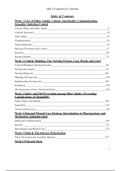
NURS 311 A&E I Comprehensive_Test_Bank | A&E I Comprehensive_Test_Bank_12 Weeks & 50 Chapters
A&E I Comprehensive Testbank Table of Contents Week 1 Care of Older Adults: Culture, Spirituality, Communication, Sexuality, Infection Control Chronic Illness and Older Adults__________________________________________________3 Cultural Awareness____________________________________________________________10 Older Adult__________________________________________________________________18 Communication_______________________________________________________________28 Patient Education________...
 Academiks