

CHM 228 (CHM122)
Middlesex County College
Here are the best resources to pass CHM 228 (CHM122). Find CHM 228 (CHM122) study guides, notes, assignments, and much more.
Exam (elaborations)
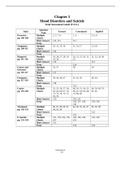
Chapter 5:Mood Disorders and Suicide;Total Assessment Guide (T.A.G.)
Chapter 5:Mood Disorders and Suicide;Total Assessment Guide (T.A.G.)
 Smartsolutions
Exam (elaborations)
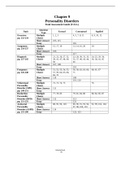
Chapter 9:Personality Disorders;Total Assessment Guide (T.A.G.)
PopularChapter 9:Personality Disorders;Total Assessment Guide (T.A.G.) Chapter 9: Personality Disorders Multiple Choice 9.1.1. To meet the definition of a personality disorder in DSM-5, one must meet the criteria of a. personality traits never seen in normal people. b. an enduring pattern of behavior that differs considerably from one's culture. c. the presence of emotional symptoms that make one aggressive. d. the presence of psychotic symptoms. Answer: b. Difficulty: 2 Question ID: 9.1.1 ...
Smartsolutions
Class notes
General Chemistry for Integrated Science l
This course is titled “General Chemistry for Integrated Science l" this present course, you will be presented information in chemistry in a structured way to make learning easier. All the units follow the same pattern and so after the first few units, the rest will become easy to follow.
 tiktokshorts
Class notes
General Chemistry for Integrated Science l
This course is titled “General Chemistry for Integrated Science l" this present course, you will be presented information in chemistry in a structured way to make learning easier. All the units follow the same pattern and so after the first few units, the rest will become easy to follow.
tiktokshorts
Class notes
General Chemistry for Integrated Science l
This course is titled “General Chemistry for Integrated Science l" this present course, you will be presented information in chemistry in a structured way to make learning easier. All the units follow the same pattern and so after the first few units, the rest will become easy to follow.
tiktokshorts
Class notes
General Chemistry for Integrated Science l
This course is titled “General Chemistry for Integrated Science l" this present course, you will be presented information in chemistry in a structured way to make learning easier. All the units follow the same pattern and so after the first few units, the rest will become easy to follow.
tiktokshorts
Class notes
General Chemistry for Integrated Science l
This course is titled “General Chemistry for Integrated Science l" this present course, you will be presented information in chemistry in a structured way to make learning easier. All the units follow the same pattern and so after the first few units, the rest will become easy to follow.
tiktokshorts
Class notes
General Chemistry for Integrated Science l
This course is titled “General Chemistry for Integrated Science l" this present course, you will be presented information in chemistry in a structured way to make learning easier. All the units follow the same pattern and so after the first few units, the rest will become easy to follow.
tiktokshorts
Class notes
General Chemistry for Integrated Science l
This course is titled “General Chemistry for Integrated Science l" this present course, you will be presented information in chemistry in a structured way to make learning easier. All the units follow the same pattern and so after the first few units, the rest will become easy to follow.
tiktokshorts
Class notes
General Chemistry for Integrated Science l
This course is titled “General Chemistry for Integrated Science l" this present course, you will be presented information in chemistry in a structured way to make learning easier. All the units follow the same pattern and so after the first few units, the rest will become easy to follow
tiktokshorts
Class notes
General Chemistry for Integrated Science l
This course is titled “General Chemistry for Integrated Science l" this present course, you will be presented information in chemistry in a structured way to make learning easier. All the units follow the same pattern and so after the first few units, the rest will become easy to follow.
tiktokshorts
Exam (elaborations)
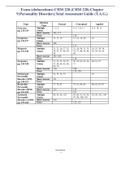
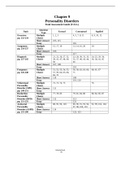
Exam (elaborations) CHM 228 (CHM 228) Chapter 9:Personality Disorders;Total Assessment Guide (T.A.G.)
Chapter 9:Personality Disorders;Total Assessment Guide (T.A.G.) Chapter 9: Personality Disorders Multiple Choice 9.1.1. To meet the definition of a personality disorder in DSM-5, one must meet the criteria of a. personality traits never seen in normal people. b. an enduring pattern of behavior that differs considerably from one's culture. c. the presence of emotional symptoms that make one aggressive. d. the presence of psychotic symptoms. Answer: b. Difficulty: 2 Question ID: 9.1.1 Page Refere...
 oassignment
Exam (elaborations)
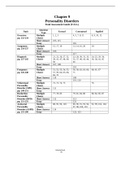
Exam (elaborations) CHM 228 (CHM 228) Chapter 9:Personality Disorders;Total Assessment Guide (T.A.G.)
Chapter 9:Personality Disorders;Total Assessment Guide (T.A.G.) Chapter 9: Personality Disorders Multiple Choice 9.1.1. To meet the definition of a personality disorder in DSM-5, one must meet the criteria of a. personality traits never seen in normal people. b. an enduring pattern of behavior that differs considerably from one's culture. c. the presence of emotional symptoms that make one aggressive. d. the presence of psychotic symptoms. Answer: b. Difficulty: 2 Question ID: 9.1.1 Page Refere...
 academicexcellence
Exam (elaborations)
Exam (elaborations) CHM 228 (CHM 228) Chapter 9:Personality Disorders;Total Assessment Guide (T.A.G.)
Chapter 9:Personality Disorders;Total Assessment Guide (T.A.G.) Chapter 9: Personality Disorders Multiple Choice 9.1.1. To meet the definition of a personality disorder in DSM-5, one must meet the criteria of a. personality traits never seen in normal people. b. an enduring pattern of behavior that differs considerably from one's culture. c. the presence of emotional symptoms that make one aggressive. d. the presence of psychotic symptoms. Answer: b. Difficulty: 2 Question ID: 9.1.1 Page Refere...
 Rubricguru
Exam (elaborations)
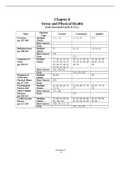
Chapter 8:Stress and Physical Health;Total Assessment Guide (T.A.G.)
Chapter 8:Stress and Physical Health;Total Assessment Guide (T.A.G.) Chapter 8: Stress and Physical Health Multiple Choice 8.1.1. What broad definition of stress has been offered by scientists? a. a subtype of mental disorder that emphasizes physiological symptoms b. a challenging event that requires behavioral, cognitive, and physiological adaptation c. a set of specific symptoms that are associated with increased risk for mental disorders d. an evolutionary development that has enabled ...
Smartsolutions
Exam (elaborations)
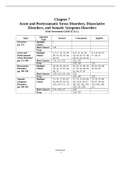
Chapter 7:Acute and Posttraumatic Stress Disorders, Dissociative Disorders, and Somatic Symptom Disorders;Total Assessment Guide (T.A.G.)
Chapter 7:Acute and Posttraumatic Stress Disorders, Dissociative Disorders, and Somatic Symptom Disorders;Total Assessment Guide (T.A.G.)
Smartsolutions
Exam (elaborations)
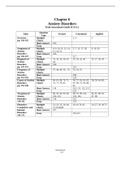
Chapter 6:Anxiety Disorders;Total Assessment Guide (T.A.G.)
Chapter 6:Anxiety Disorders;Total Assessment Guide (T.A.G.) Chapter 6: Anxiety Disorders Multiple Choice 6.1.1. According to the National Comorbidity Survey Replication (NCS-R), in any given year, what percent of adults suffer from at least one type of anxiety disorder? a. 6 percent b. 18 percent c. 24 percent d. 36 percent Answer: b. Difficulty: 1 Question ID: 6.1.1 Page Reference: 144 Topic: Overview Skill: Factual LO 6.2: What is the expected long-term outcome for people with a...
Smartsolutions
Exam (elaborations)
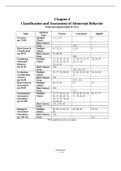
Chapter 4:Classification and Assessment of Abnormal Behavior;Total Assessment Guide (T.A.G.)
Chapter 4:Classification and Assessment of Abnormal Behavior;Total Assessment Guide (T.A.G.)
Smartsolutions
Exam (elaborations)
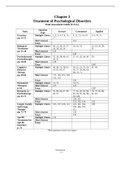
Chapter 3 :Treatment of Psychological Disorders;Total Assessment Guide (T.A.G.)
Chapter 3 :Treatment of Psychological Disorders;Total Assessment Guide (T.A.G.) Chapter 3: Treatment of Psychological Disorders Multiple Choice 3.1.1. Most mental health professionals today identify themselves with a. the psychodynamic paradigm. b. the cognitive-behavioral paradigm. c. the humanistic paradigm. d. no single paradigm. Answer: d. Difficulty: 1 Question ID: 3.1.1 Page Reference: 53 Topic: Overview Skill: Factual LO 3.1: What do treatments for psychological problems loo...
Smartsolutions
Exam (elaborations)
Chapter 2:Causes of Abnormal Behavior;Total Assessment Guide (T.A.G.)
Chapter 2:Causes of Abnormal Behavior;Total Assessment Guide (T.A.G.) Chapter 2: Causes of Abnormal Behavior Multiple Choice 2.1.1. The etiology of a problem behavior is its a. cause. b. paradigm. c. treatment. d. classification. Answer: a. Difficulty: 1 Question ID: 2.1.1 Page Reference: 25 Topic: Overview Skill: Factual LO 2.1: What is the biopsychosocial model and why do we need it? 2.1.2. Which term is used for a set of shared assumptions that includes both the substance of a ...
Smartsolutions