
NSG 5003 (NSG5003)
South University
Here are the best resources to pass NSG 5003 (NSG5003). Find NSG 5003 (NSG5003) study guides, notes, assignments, and much more.
Exam (elaborations)
Chapter 9 NSG 5003 questions & answers
Chapter 9 NSG 5003
 maxiscore
Exam (elaborations)
NSG 5003 Wk 8: Urological GU System questions n answers
NSG 5003 Wk 8: Urological GU System
maxiscore
Exam (elaborations)
Patho NSG 5003 week 9 correctly answered to pass
Patho NSG 5003 week 9Cheyne-Stokes respirations are described as a - correct answer Crescendo-decrescendo pattern of breathing, followed by a period of apnea Vomiting is associated with central nervous system (CNS) injuries that compress which of the brain's anatomic locations - correct answer Vestibular nuclei in the lower brainstem Status epilepticus is considered a medical emergency because of the - correct answer Development of cerebral hypoxia What type of seizure starts in the fi...
maxiscore
Exam (elaborations)
NSG5003 Chapter 1 correctly answered graded A+
NSG5003 Chapter 1
maxiscore
Exam (elaborations)
NSG 5003 Cardiovascular (Ch31-33) fully solved
NSG 5003 Cardiovascular (Ch31-33)What is the effect of oxidized low-density lipoproteins (LDLs) in atherosclerosis? A) LDLs cause smooth muscle proliferation B) LDLs cause regression of atherosclerotic plaques C) LDLs increase levels of inflammatory cytokines D) LDLs direct microphages to the site in the endothelium - correct answer Ans: A- LDLs cause smooth muscle proliferation Which inflammatory cytokines are released when endothelial cells are injured? A) granulocyte-macrophage co...
maxiscore
Exam (elaborations)
NSG 5003- Advanced Pathophysiology-Wk 1 (Ch 1-3) with complete solutions
NSG 5003- Advanced Pathophysiology-Wk 1 (Ch 1-3)
maxiscore
Exam (elaborations)
NSG 5003 Advanced Pathophysiology (South University)correctly answered to pass
NSG 5003 Advanced Pathophysiology (South University)Differentiation - correct answer (maturation) process in which cells become specialized in structure and function The eight specialized cellular functions are - correct answer movement, conductivity, metabolic absorption, secretion, excretion, respiration, reproduction, communication Eukaryotic cells - correct answer Contain a nucleus and other organelles that are bound by membranes. The eukaryotic cell consists of three general compon...
maxiscore
Exam (elaborations)
NSG5003 FINAL EXAM PREP correctly answered to pass
NSG5003 FINAL EXAM PREPWhat is the purpose of administering ibuprofen to individuals being treated for frostbite? - correct answer Inhibiting prostaglandins Which statement is incorrect regarding gallbladder function? - correct answer Within thirty minutes of eating, the gallbladder forces bile What is the cause of functional dysphagia? - correct answer Neural or muscular disorders Which clinical manifestations of a urinary tract infection may be demonstrated in an eighty-five-year-old ...
maxiscore
Exam (elaborations)
Nsg 5003 Questions With 100&Percnt; Correct Answers
nsg 50031. It is important to not dilate the eye if ____ is suspected. Cataract Macular degeneration Acute closed-angle glaucoma Chronic open-angle glaucoma Acute closed-angle glaucoma Question 2. 2. An 18-year-old female patient presents with repeated urinary tract infections. She has no risk factors in her history, and her physical examination is unremarkable. She also has a normal pelvic exam. Which of the following should be obtained if anatomic abnormalities are suspected? Ultras...
maxiscore
Exam (elaborations)
NSG5003 Week 2 Quiz well answered
NSG5003 Week 2 QuizHypersensitivity is best defined as a(an) - correct answer c. Altered immunologic response to an antigen that results in disease A hypersensitivity reaction that produces an allergic response is called: - correct answer Anaphylaxis The common hay fever allergy is expressed through a reaction that is mediated by which class of immunoglobulins? - correct answer IgE Which type of antibody is involved in type I hypersensitivity reaction? - correct answer IgE Blood tra...
maxiscore
Exam (elaborations)
NSG 5003 Final week 10 questions well answered
NSG 5003 Final week 10Understanding the various steps of proteolytic cascades, such as caspase-mediated apoptosis and complement cascades, may be useful in designing drug therapy for which human diseases? - correct answer Autoimmune and malignant disorders Why is it possible for potassium to diffuse easily into and out of cells? - correct answer The resting plasma membrane is more permeable to potassium The loss of the adenosine triphosphate (ATP) during ischemia causes cells to - correct ...
maxiscore
Exam (elaborations)
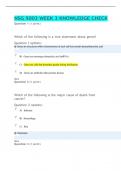
Nsg 5003 Week 3 Knowledge Check
NSG 5003 WEEK 3 KNOWLEDGE CHECK Question 1 (1 point) Which of the following is a true statement about genes? Question 1 options: B) Genes are messenger ribonucleic acid (mRNA) C) Genes are cells that determine gender during fertilization D) Genes are antibodies that promote disease Save Question 2 (1 point) Which of the following is the major cause of death from cancer? Question 2 options: A) Infection B) Hemorrhage C) Pain Save Question 3 (1 point...
 MYSOLUTIONS
Exam (elaborations)
Nsg 5003 Week 6 Knowledge Check
NSG 5003 WEEK 6 KNOWLEDGE CHECK Question 1 (1 point) Both iron and folate are vital to meet both the woman’s needs and those of the developing baby. They play an active role in the development of: Question 1 options: B) Leukocytes C) Neutrophils D) Platelets Save Question 2 (1 point) Within the first year of life, it is normal for a childs: Question 2 options: A) Reticulocyte count to rise
MYSOLUTIONS
Exam (elaborations)
NSG 5003 WEEK 7 KNOWLOGE CHECK Question 1 (1 point)
NSG 5003 WEEK 7 KNOWLOGE CHECK Question 1 (1 point) In the digestive system, the stomach is stimulated by eating to produce large volumes of gastric secretions. The secretion that is responsible for converting pepsinogen to pepsin and acts as a bactericide against swallowed organisms is: Question 1 options: A) Gastroferrin C) Intrinsic factor D) Chymotrypsin Save Question 2 (1 point) The enteric nervous system regulates intestinal motility. Of the two movements...
MYSOLUTIONS
Exam (elaborations)
NSG 5003 Chapter 41: Alterations of Digestive Function Questions with Complete Solutions
NSG 5003 Chapter 41: Alterations of Digestive Function Questions with Complete Solutions
 Classroom
Exam (elaborations)
NSG 5003 Questions with Complete Solutions
NSG 5003 Questions with Complete Solutions
Classroom
Exam (elaborations)
NSG5003 Week 2 Questions with Complete Solutions.
NSG5003 Week 2 Questions with Complete Solutions.
Classroom

Exam (elaborations)
NSG 5003 Cardiovascular questions with complete solutions.
NSG 5003 Cardiovascular questions with complete solutions.
Classroom
Exam (elaborations)
Patho NSG 5003 week 5 questions with correct answers.
Patho NSG 5003 week 5 questions with correct answers.
Classroom
Exam (elaborations)
Patho NSG 5003 week 8 Questions with Correct Answers.
Patho NSG 5003 week 8 Questions with Correct Answers.
Classroom