
NCC (NCC)
Atlanta Fire Academy
Here are the best resources to pass NCC (NCC). Find NCC (NCC) study guides, notes, assignments, and much more.

Exam (elaborations)
NCC EFM practice EXAM
Which of the following factors can have a negative effect on uterine blood flow? a. Hypertension b. Epidural c. Hemorrhage d. Diabetes e. All of the above - CORRECT ANSWER e. All of the above Stimulating the vagus nerve typically produces: a. A decrease in the heart rate b. An increase in the heart rate c. An increase in stroke volume d. No change - CORRECT ANSWER a. A decrease in the heart rate The vagus nerve begins maturation 26 to 28 weeks. Its dominance results in what effect to...
 josephkibirit31
Exam (elaborations)
Ncc Efm
PopularLate Decelerations Are Mediated Primarily By - Correct Answer &Newline;Chemoreceptors &Newline;Baseline - Correct Answer Fhr In A 10 Min Segment &Newline;Tachycardia - Correct Answer Fhr ≫160 &Newline;Bradycardia - Correct Answer Fhr ≪110 &Newline;Variability - Correct Answer Variations In Baseline Absent-0 &Newline;Min ≪&Equals;5 &Newline;Mod 6-25 &Newline;Marked ≫25 &Newline;No Distinction Is Made Between Short Term &Amp; Long Term Variability &Newline;Because - Correct Answer They Are Visualized As A Unit &Newline;Acceleration - Correct Answer
josephkibirit31

Exam (elaborations)
Ncc Efm Exam Flashcards
What entity standardized the term "Electronic Fetal Monitoring (EFM)" ? - CORRECT ANSWER Eunice Kennedy Shriver National Institute of Child Health & Human Development (NICHD) Primary reason for continuous EFM - CORRECT ANSWER Legal reasons. No real benefit of continuous EFM according to studies. Correlation found between continuous EFM and Deliveries. - CORRECT ANSWER continuous EFM found to have increase rates of assisted vaginal deliveries or cesarean deliveries. VBAC vs TOLAC - CORR...
josephkibirit31
Exam (elaborations)
Ncc Efm Certification With Complete Solution
1. Which of the following factors can have a negative effect on uterine blood flow? a. Hypertension b. Epidural c. Hemorrhage d. Diabetes e. All of the above: e. All of the above 2. How does the fetus compensate for decreased maternal circulating volume? a. Increases cardiac output by increasing stroke volume. b. Increases cardiac output by increasing it's heart rate. c. Increases cardiac output by increasing fetal movement.: b. Increases cardiac output by increasing it's heart rate....
josephkibirit31
Exam (elaborations)
NCC EFM Cert. Exam With Verified Answers
Ductus venosus connects ______ to ______? - ANSWER Umb. vein to IVC Foramen ovale connects _______to______? - ANSWER R. atrium to L. atrium Ductus arteriosus connects _______ to _______? - ANSWER Pulm. artery to aorta Normal rate - ANSWER 110 to 160 BPM Average baseline rate at 15wks gestation - ANSWER 160 BPM Average rate in fetus with heart block - ANSWER 60 BPM (intrinsic ventricular or nodal rate) Sympathetic effects - ANSWER Incr. HR, constricted peripheral and visceral blood vessel...
josephkibirit31
Exam (elaborations)
Ncc Efm With Complete Solution
Causes of uteroplacental perfusion decrease: - CORRECT ANSWER • HTN • Pregnancy • DM • Hypotension • Excessive uterine contractions (hypertonus) • Decreased surface area, edema, degenerative calcifications, infarcts, infection FHR reflects fetal oxygenation from which extrinsic factors: - CORRECT ANSWER • Maternal oxygenation • Uterine blood flow • Placental change • Umbilical blood flow FHR reflects oxygenation from which intrinsic factors: - CORRECT ANSWER • Fe...
josephkibirit31

Exam (elaborations)
NCC EFM case study
Carla Hernandez is a 32-year-old Hispanic female, G2P1 (L1), at 39 5/7 weeks of gestation. She was admitted to labor and delivery in active labor at 0600 hours today, accompanied by her husband Earl. To progress the delivery, artificial rupture of membranes was performed by the provider a few minutes ago. The provider has just left the room to make rounds. Suddenly, the fetal heart rate drops dramatically, and you discover that the umbilical cord is prolapsed. You are ready to handle this s...
josephkibirit31

Exam (elaborations)
NCC EFM practice Test 2022 With Complete Solution
Which of the following factors can have a negative effect on uterine blood flow? a. Hypertension b. Epidural c. Hemorrhage d. Diabetes e. All of the above - answere. All of the above Stimulating the vagus nerve typically produces: a. A decrease in the heart rate b. An increase in the heart rate c. An increase in stroke volume d. No change - answera. A decrease in the heart rate The vagus nerve begins maturation 26 to 28 weeks. Its dominance results in what effect to the FHR baseline?...
josephkibirit31

Exam (elaborations)
NCC EFM Practice Questions and Answers Already Passed
Which of the following factors can have a negative effect on uterine blood flow? a. Hypertension b. Epidural c. Hemorrhage d. Diabetes e. All of the above Correct Answer-e. All of the above Stimulating the vagus nerve typically produces: a. A decrease in the heart rate b. An increase in the heart rate c. An increase in stroke volume d. No change Correct Answer-a. A decrease in the heart rate The vagus nerve begins maturation 26 to 28 weeks. Its dominance results in what effect to the ...
josephkibirit31
Exam (elaborations)
NCC Electronic Fetal Monitoring Certification Exam 2022(100% Verified)
Which of the following factors can have a negative effect on uterine blood flow? a. Hypertension b. Epidural c. Hemorrhage d. Diabetes e. All of the above - CORRECT ANSWERS e. All of the above How does the fetus compensate for decreased maternal circulating volume? a. Increases cardiac output by increasing stroke volume. b. Increases cardiac output by increasing it's heart rate. c. Increases cardiac output by increasing fetal movement. - CORRECT ANSWERS b. Increases cardiac output by ...
josephkibirit31
Exam (elaborations)
NCC Electronic Fetal Monitoring Certification Exam 2022(100% Verified)
Which of the following factors can have a negative effect on uterine blood flow? a. Hypertension b. Epidural c. Hemorrhage d. Diabetes e. All of the above - CORRECT ANSWERS e. All of the above How does the fetus compensate for decreased maternal circulating volume? a. Increases cardiac output by increasing stroke volume. b. Increases cardiac output by increasing it's heart rate. c. Increases cardiac output by increasing fetal movement. - CORRECT ANSWERS b. Increases cardiac output by ...
josephkibirit31

Exam (elaborations)
NCC EFM practice 2022/2023 questions and answers
Which of the following factors can have a negative effect on uterine blood flow? a. Hypertension b. Epidural c. Hemorrhage d. Diabetes e. All of the above -Answer- e. All of the above Stimulating the vagus nerve typically produces: a. A decrease in the heart rate b. An increase in the heart rate c. An increase in stroke volume d. No change -Answer- a. A decrease in the heart rate The vagus nerve begins maturation 26 to 28 weeks. Its dominance results in what effect to the FHR baselin...
josephkibirit31

Exam (elaborations)
NCC EFM Practice Questions test 2022 2023
Which of the following factors can have a negative effect on uterine blood flow? a. Hypertension b. Epidural c. Hemorrhage d. Diabetes e. All of the above - e. All of the above Stimulating the vagus nerve typically produces: a. A decrease in the heart rate b. An increase in the heart rate c. An increase in stroke volume d. No change - a. A decrease in the heart rate The vagus nerve begins maturation 26 to 28 weeks. Its dominance results in what effect to the FHR baseline? a. Increas...
josephkibirit31

Exam (elaborations)
NCC EFM Exam, 2022 Test With Solution
Acceleration - ANSWER -Onset to peak <30 seconds - >15 bpm above baseline by >15 seconds but <2 minutes -(Before 32 weeks gestation: peak >10 bpm and lasting >10 seconds) Prolonged Acceleration - ANSWER >2 minutes but <10 minutes Early Deceleration - ANSWER -Gradual decrease and return of FHR associated with a contraction -Onset to nadir of >30 seconds -Nadir occurs at the same time as the peak of the contraction Late Deceleration - ANSWER -Gradual decrease and...
josephkibirit31
Exam (elaborations)
Ncc Efm Certification With Complete Solution
1. Which of the following factors can have a negative effect on uterine blood flow? a. Hypertension b. Epidural c. Hemorrhage d. Diabetes e. All of the above: e. All of the above 2. How does the fetus compensate for decreased maternal circulating volume? a. Increases cardiac output by increasing stroke volume. b. Increases cardiac output by increasing it's heart rate. c. Increases cardiac output by increasing fetal movement.: b. Increases cardiac output by increasing it's heart rate....
josephkibirit31
Exam (elaborations)
NCC EFM Exam Practice Questions AND ANSWERS 2022
Oxygen is transferred from mom to fetus via the placenta through? - correct answersPassive (Simple) Diffusion Intervillous space perfusion is dependent on? - correct answersAdequate Uterine Blood Flow Maternal Fetal Exchange is best promoted by which maternal position? - correct answersEither Rt or Lt Lateral What is transfer down the concentration gradient from higher to lower called? - correct answersDiffusion The most likely physical rationale for recurrent late decels after epidu...
josephkibirit31
Exam (elaborations)
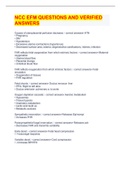
Ncc Efm Questions And Verified Answers
Causes of uteroplacental perfusion decrease: - correct answers• HTN • Pregnancy • DM • Hypotension • Excessive uterine contractions (hypertonus) • Decreased surface area, edema, degenerative calcifications, infarcts, infection FHR reflects fetal oxygenation from which extrinsic factors: - correct answers• Maternal oxygenation • Uterine blood flow • Placental change • Umbilical blood flow FHR reflects oxygenation from which intrinsic factors: - correct answers•...
josephkibirit31

Exam (elaborations)
Ncc Efm Exam Flashcards
What entity standardized the term "Electronic Fetal Monitoring (EFM)" ? - CORRECT ANSWER Eunice Kennedy Shriver National Institute of Child Health & Human Development (NICHD) Primary reason for continuous EFM - CORRECT ANSWER Legal reasons. No real benefit of continuous EFM according to studies. Correlation found between continuous EFM and Deliveries. - CORRECT ANSWER continuous EFM found to have increase rates of assisted vaginal deliveries or cesarean deliveries. VBAC vs TOLAC - CORR...
josephkibirit31

Exam (elaborations)
Ncc Efm With Complete Solution
Causes of uteroplacental perfusion decrease: - CORRECT ANSWER • HTN • Pregnancy • DM • Hypotension • Excessive uterine contractions (hypertonus) • Decreased surface area, edema, degenerative calcifications, infarcts, infection FHR reflects fetal oxygenation from which extrinsic factors: - CORRECT ANSWER • Maternal oxygenation • Uterine blood flow • Placental change • Umbilical blood flow FHR reflects oxygenation from which intrinsic factors: - CORRECT ANSWER • Fe...
josephkibirit31

Exam (elaborations)
NCC EFM practice 2022/2023 questions and answers
Which of the following factors can have a negative effect on uterine blood flow? a. Hypertension b. Epidural c. Hemorrhage d. Diabetes e. All of the above -Answer- e. All of the above Stimulating the vagus nerve typically produces: a. A decrease in the heart rate b. An increase in the heart rate c. An increase in stroke volume d. No change -Answer- a. A decrease in the heart rate The vagus nerve begins maturation 26 to 28 weeks. Its dominance results in what effect to the FHR baselin...
josephkibirit31