INFO 1010 (INFO1010)

University Of Denver

Here are the best resources to pass INFO 1010 (INFO1010). Find INFO 1010 (INFO1010) study guides, notes, assignments, and much more.

All 8 results

Sort by:
Lecture #8 - Linear Programming Lecture #8 - Linear Programming
  • Class notes

    Lecture #8 - Linear Programming

  • Identify the objective, decision cells, and constraints in an optimization problem. Set up an optimization problem in Excel. Set up Solver to solve an optimization problem in Excel.
  • alexperez
    $8.89 More Info
Lecture #7 - The Normal Distribution Lecture #7 - The Normal Distribution
  • Class notes

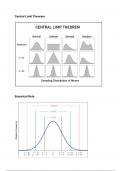
    Lecture #7 - The Normal Distribution

  • Explain the central limit theorem. Apply the empirical rule to a normal data set. Apply Chebychev's theorem to a non-normal data set. Calculate z-scores for values in a data set. Identify outliers in a data set using z-scores.
  • alexperez
    $6.09 More Info
Lecture #6 - Measures of Dispersion
  • Class notes

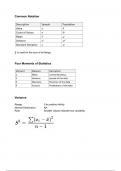
    Lecture #6 - Measures of Dispersion

  • Explain how measures of dispersion describe variability in a data set. Identify skewness and kurtosis in a data set. Calculate the variance and standard deviation of a data set.
  • alexperez
    $8.79 More Info
Lecture #5 - Descriptive Statistics Part #2 Lecture #5 - Descriptive Statistics Part #2
  • Class notes

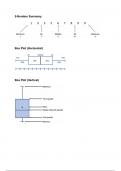
    Lecture #5 - Descriptive Statistics Part #2

  • Construct a box plot to visualize the 5-number of summary of a data set. Match a frequency distribution to a corresponding box plot. Calculate the upper and lower fences for outliers using the interquartile range. Identify outliers using the interquartile range method.
  • alexperez
    $8.09 More Info
Lecture #4 - Descriptive Statistics Part #1 Lecture #4 - Descriptive Statistics Part #1
  • Class notes

    Lecture #4 - Descriptive Statistics Part #1

  • Explain the measures of central tendency. Calculate the mean, median, and mode of a data set. Calculate the range, quartiles, and interquartile range of a data set. Construct a 5-number summary of a data set.
  • alexperez
    $8.59 More Info
Lecture #3 - Data Analysis Lecture #3 - Data Analysis
  • Class notes

    Lecture #3 - Data Analysis

  • Explain the difference between descriptive and inferential statistics. Identify the types of data and levels of measurement. Calculate relative and cumulative frequencies frequencies. Use pivot tables to explore a new data set.
  • alexperez
    $4.09 More Info
Lecture #1 - Introduction to Data Analysis Lecture #1 - Introduction to Data Analysis
  • Class notes

    Lecture #1 - Introduction to Data Analysis

  • Distinguish between quantitative and qualitative data. Understand the distinction between different types of statistics and analytics. Explain how data analysis is used to inform business decision-making. Identify the primary steps in the data analysis lifecyle.
  • alexperez
    $3.49 More Info
Want to regain your expenses?
How much did you already spend on Stuvia? Imagine there are plenty more of you out there paying for study notes, but this time YOU are the seller. Ka-ching!