San Diego City College
Latest uploads at San Diego City College. Looking for notes at San Diego City College? We have lots of notes, study guides and study notes available for your school.
-
17
- 0
- 0
All courses for San Diego City College
Latest content San Diego City College
Salem’s Bewitching History" by Anahi Deloya is a brief yet powerful overview of the Salem Witch Trials (1692–1693). It explores how fear, superstition, and false accusations, sparked by a group of young girls and fueled by community tensions, led to the imprisonment and execution of innocent people. The essay highlights key figures like Tituba, Sarah Good, and John Proctor, and explains how unreliable “spectral evidence” drove the trials. Eventually, public outcry and legal reform end...
NREMT Advanced-EMT GRADED A.
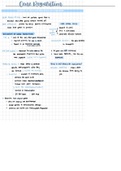
Biological populations evolve through genetic changes that correspond to changes in the organisms' observable traits.
Evolution is the process of change in all forms of life over generations, and evolutionary biology is the study of how evolution occurs. Biological populations evolve through genetic changes that correspond to changes in the organisms' observable traits.
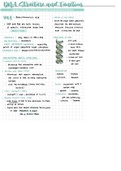
Gene regulation is the process of controlling which genes in a cell's DNA are expressed (used to make a functional product such as a protein)
The DNA molecule consists of 4 nitrogen bases, namely adenine (A), thymine (T), cytosine (C) and Guanine (G), which ultimately form the structure of a nucleotide. The A and G are purines, and the C and T are pyrimidines. The two strands of DNA run in opposite directions.
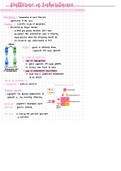
Patterns of inheritance in humans include autosomal dominance and recessiveness, X-linked dominance and recessiveness, incomplete dominance, codominance, and lethality. A change in the nucleotide sequence of DNA, which may or may not manifest in a phenotype, is called a mutation
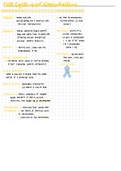
The cell cycle (cell-division cycle), is a series of events that take place in a cell leading to its division and duplication. The main phases of the cell cycle are interphase, nuclear division, and cytokinesis. Cell division produces two daughter cells.
Photosynthesis converts carbon dioxide and water into oxygen and glucose. Glucose is used as food by the plant and oxygen is a by-product. Cellular respiration converts oxygen and glucose into water and carbon dioxide. Water and carbon dioxide are by- products and ATP is energy that is transformed from the process.
This chapter addresses how working cells use membranes, energy, and enzymes