Behavioural Neurosciences

Rijksuniversiteit Groningen (RuG)

Here are the best resources to pass Behavioural Neurosciences. Find Behavioural Neurosciences study guides, notes, assignments, and much more.
21 results

Behavioural neurosciences, Biology RUG, 1st year, 2022/2023, summary
  • Summary

    Behavioural neurosciences, Biology RUG, 1st year, 2022/2023, summary

  • A summary of all the lectures from Behavioural Neurosciences
  • fleurbenneker
    $6.60 More Info
Summary Material Behavioral Neuroscience 1st year course Biology RUG
  • Summary

    Summary Material Behavioral Neuroscience 1st year course Biology RUG

  • This summary contains all the material for the MC exam of behavioral neuroscience. The exam is a lot about the lectures, so all the important information together with important pictures is put in this document. Together with a nice lay-out :)
  • lunakraaijenzank
    $7.20 More Info
Behavioral neurosciences RUG (Biology; year 1): notities colleges
  • Class notes

    Behavioral neurosciences RUG (Biology; year 1): notities colleges

  • Notes taken during the lectures of the course behavioral neuroscience; all lessons are in this.
  • gfnoorman
    $4.20 More Info
Behavioural Neurosciences
  • Summary

    Behavioural Neurosciences

  • This summary contains all the information from the lectures, I had a 7 last year.
  • mjdikken
    $8.29 More Info
Reading 7&8 Van der Zee
  • Class notes

    Reading 7&8 Van der Zee

  • Learning objectives - location of place and grid cells - function and features of place and grid cells (see last slide) - one place cell gets input from circa 100 grid cells - the meaning of a “cognitive map” - aging in relation to place cells - 3D place fields and place cells - functional link between place and grid cells - the hexagonal shape (EUREKA moment) - size of modules of grid cells - episodic memory and place cells - link between grid and place cells and Alzheimer’s ...
  • stijnvantrijp
    $4.20 More Info
Reading 1&2 Van der Zee
  • Class notes

    Reading 1&2 Van der Zee

  • Learning objectives - misconceptions - 4 brain lobes + gyrus, sulcus, fissure - phrenology (what is it) - ventricular system - brain scanning methods - terminology anatomy - white matter / grey matter + general structure neurons - different types of brain cells + function - how CSF flows through the brain - neurophilosophy (what is it) - Nissl and Golgi stainings (what is the difference) - How to optimize your L&M performance (4 tips)
  • stijnvantrijp
    $4.20 More Info
Reading 5&6 Van der Zee
  • Class notes

    Reading 5&6 Van der Zee

  • Learning objectives - Why knowledge of signal transduction is important - principles of the resting membrane potential - principles of action potentials - action potentials in aged neurons - mode of action of lidocaine and cocaine - gap junctions: shape and function - the chemical synapse - classic neurotransmitters and neuropeptides - transmitter release mechanism - the neuromuscular synapse - freeze-etching method and transmitter release mechanism - role of clathrine - classific...
  • stijnvantrijp
    $4.20 More Info
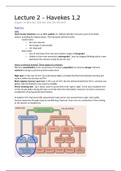
Lecture Havekes 1&2
  • Class notes

    Lecture Havekes 1&2

  • Learning objectives - Reproduce the impact of the medial temporal lobe lesion in patient H.M. on various cognitive aspects (i.e. What forms of learning were affected and which were unaffected? - Reproduce how the delayed-nonmatching to sample task works and what brain regions it requires. - Reproduce the difference between declarative and nondeclarative memories (e.g. explicit and implicit memories) - Reproduce what priming is used for in terms of assessing memory aspects - Reproduce what t...
  • stijnvantrijp
    $4.20 More Info
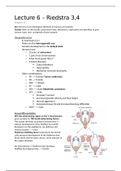
Lecture 3&4 Riedstra
  • Class notes

    Lecture 3&4 Riedstra

  • Learning objectives - What is known about sex and the brain? - Neural machinery that makes reproduction possible - How different are the brains of the two sexes - Is by genetics, brain or behaviour - Anatomy & physiology of the nervous system - Activations and organisational effects of steroid hormone
  • stijnvantrijp
    $4.20 More Info
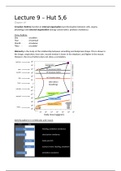
Lecture 5&6 Hut
Lecture 1&2 Riedstra
  • Class notes

    Lecture 1&2 Riedstra

  • Learning objectives - Difference between strength and direction of lateralisation - Differences between individual and population biases - Pro’s and cons of lateralisation - Define lateralisation - Negative frequency dependent selection of lateralisation - Chimera’s
  • stijnvantrijp
    $4.20 More Info
Lecture 3&4 Havekes
  • Class notes

    Lecture 3&4 Havekes

  • Learning objectives - Reproduce the importance of the X, Y chromosome and SRY gene in sex differences - Describe how estradial and testosterone are made - Reproduce the anatomical differences between the male and female brain at the level of the hypothalamus o Differences at the level of nuclei size o Differences at the level of receptor or neurotransmitter expression - Describe how testosterone/ estradiol plays an essential role in sex differences during early development and later stage...
  • stijnvantrijp
    $4.20 More Info
Lecture 5&6 Havekes
  • Class notes

    Lecture 5&6 Havekes

  • Learning objectives - Reproduce the role of hippocampus in specific learning tasks - Reproduce the differences between Pavlovian Conditioning and Operant Conditioning - Reproduce the role of the hippocampus and amygdala in tone-cued fear and contextual fear conditioning - Reproduce how the role of protein synthesis in the consolidation of contextual fear conditioning was studied - Reproduce the difference between the fear conditioning and active shock avoidance - Reproduce how the object...
  • stijnvantrijp
    $4.20 More Info
Lecture 1&2 Hut
Lecture 3&4 Hut
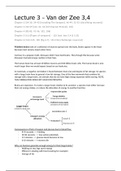
Lecture 3&4 Van der Zee
  • Class notes

    Lecture 3&4 Van der Zee

  • Learning objectives - Organization of primitive brains - evolution of “large brains” - relationship between the brain and energy - storage of fat and the brain - our brain is shrinking, but PFC and cerebellum increase - relationship white matter / grey matter - features of neuronal networks - spine density and functionality - spines and mental health - complexity of the brain - most common cause of stroke - 4 central brain systems (ascending systems; modulatory systems) - h...
  • stijnvantrijp
    $4.20 More Info
Summary Behavioural Neuroscience
  • Summary

    Summary Behavioural Neuroscience

  • Complete summary with pictures of the lectures given by Havekes, Hut, van der Zee, and Riedstra.
  • myrthe01
    $10.21 More Info
Behavioural neuroscience summary lectures
  • Summary

    Behavioural neuroscience summary lectures

  • Summary of the lectures of the first year course of behavioural neuroscience from the study of biology on the back. In it all slides of the lectures are summarized in 1 document the information that was told in the lectures.
  • noorbijvang
    $6.00 More Info
Make study stress less painful
Study stress? For sellers on Stuvia, these are actually golden times. KA-CHING! Earn from your study resources too and start uploading now.