Lecture 8 – Hut 3,4
Chapter 11
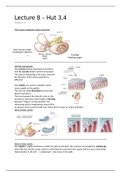
The human vestibular system overview
Utricula and saccula
The utricula detects horizontal movement.
And the saccula detects vertical movement.
The way of functioning is the same, however
the direction of the action potential is
different.
The otolyth are calcium cristalites which
cause weight on the gelatin
The cilia are called kinochilia because they
detect movement.
The functioning of the haircell is due to the
increase or decrease of the length of tip links
between “fingers” on the kinocilia. The
shortening and/or lengthening causes influx
of calcium which is paired with Ca2+ influx which causes an action potential.
Semi-circular canals
Semi-circular canals
The capula is a gelly substance in which the cilia are housed. The cupula is surrounded by endolymph
which fills the circular canals, which is a thin fluid (in contrast to the cupula which is also a thick fluid).
Head rotation to the left —> endolymph + cilia move to the right.
, Eye movement and the vestibular system
Ipsi-lateral projection means that neuronal connections go to the same side. (from left horizontal
semicircular canal to left eye)
Contra-lateral projection means that neuronal connections go to the other side. (from left horizontal
semicircular canal to right eye)
The cranial nerve VIII projects to both medial vestibular nucleus (extraocular motor neurons —> eye
movement & neck motor neurons —> head movement) and lateral vestibular nucleus (limb motor
neurons and cerebellum —> limb movement).
Chapter 11
The human vestibular system overview
Utricula and saccula
The utricula detects horizontal movement.
And the saccula detects vertical movement.
The way of functioning is the same, however
the direction of the action potential is
different.
The otolyth are calcium cristalites which
cause weight on the gelatin
The cilia are called kinochilia because they
detect movement.
The functioning of the haircell is due to the
increase or decrease of the length of tip links
between “fingers” on the kinocilia. The
shortening and/or lengthening causes influx
of calcium which is paired with Ca2+ influx which causes an action potential.
Semi-circular canals
Semi-circular canals
The capula is a gelly substance in which the cilia are housed. The cupula is surrounded by endolymph
which fills the circular canals, which is a thin fluid (in contrast to the cupula which is also a thick fluid).
Head rotation to the left —> endolymph + cilia move to the right.
, Eye movement and the vestibular system
Ipsi-lateral projection means that neuronal connections go to the same side. (from left horizontal
semicircular canal to left eye)
Contra-lateral projection means that neuronal connections go to the other side. (from left horizontal
semicircular canal to right eye)
The cranial nerve VIII projects to both medial vestibular nucleus (extraocular motor neurons —> eye
movement & neck motor neurons —> head movement) and lateral vestibular nucleus (limb motor
neurons and cerebellum —> limb movement).