Criticisms to Augustinian type theodicies
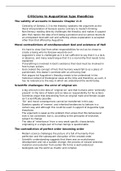
The validity of accounts in Genesis: Chapter 2+3
- Centrality of Genesis 1-3 to the theodicy weakens the argument as the
literal interpretation of Genesis seems contrary to modern thinking
- Non-literacy reading directly challenges the theodicy and makes it suspect
- John Hick rejects the idea of evil being a privation and so cannot reconcile
an omnipotent God with evil and suffering unless explanation is accepted
other than that offered by Augustine
Moral contradictions of omnibenevolent God and existence of Hell
- It’s hard to clear God from other responsibilities for evil as he chose to
create a being who he foresaw would do evil
- Augustine’s view is challenged as it is not sufficient to say that it is a lack,
or absence, and many would argue that it is a real entity that needs to be
explained
- If everything is involved in God’s existence then God must be involved in
free human actions
- God created the concept of hell, that humans would fall to as a place of
punishment, this doesn’t correlate with an all-loving God
- Hick argues tat Augustine’s theodicy needs to be understood in the
historical context of theological views at the time and therefore, as such, it
has no relevance to the way in which we understand the world today
Scientific challenges: the error of original sin
- A big criticism is the idea of ‘original sin’ and that humans were ‘seminally
present’ in the loins of Adam and so take on responsibility for his actions
- Scientists argue that descending from an original male and female couple
isn’t scientifically possible
- ‘Sin’ and moral consequences cannot be transferred in this way
- Dawkins speaks of ‘memes’ and inherited tendencies to behave in a
certain way and although this could be used in support of Augustine type
theodicies
- The argument is weak as the problem then arises that this behavioural
trait is not consistent, but is, according to the principles of evolution,
subject to change
- The idea of ‘inheritance’ from a very weak specific characteristic
originating in a single pair of human beings is questionable
The contradiction of perfect order becoming order
- Modern science challenges the picture of a fall of humanity from
perfection and the subsequent disruption of the created order
- Scientific understanding suggests that there was an evolutionary
development and not a sudden change; the process of natural selection,
mutation and evolution from earlier life forms is well evidenced
- Geologists see the world as chaotic and complex
The validity of accounts in Genesis: Chapter 2+3
- Centrality of Genesis 1-3 to the theodicy weakens the argument as the
literal interpretation of Genesis seems contrary to modern thinking
- Non-literacy reading directly challenges the theodicy and makes it suspect
- John Hick rejects the idea of evil being a privation and so cannot reconcile
an omnipotent God with evil and suffering unless explanation is accepted
other than that offered by Augustine
Moral contradictions of omnibenevolent God and existence of Hell
- It’s hard to clear God from other responsibilities for evil as he chose to
create a being who he foresaw would do evil
- Augustine’s view is challenged as it is not sufficient to say that it is a lack,
or absence, and many would argue that it is a real entity that needs to be
explained
- If everything is involved in God’s existence then God must be involved in
free human actions
- God created the concept of hell, that humans would fall to as a place of
punishment, this doesn’t correlate with an all-loving God
- Hick argues tat Augustine’s theodicy needs to be understood in the
historical context of theological views at the time and therefore, as such, it
has no relevance to the way in which we understand the world today
Scientific challenges: the error of original sin
- A big criticism is the idea of ‘original sin’ and that humans were ‘seminally
present’ in the loins of Adam and so take on responsibility for his actions
- Scientists argue that descending from an original male and female couple
isn’t scientifically possible
- ‘Sin’ and moral consequences cannot be transferred in this way
- Dawkins speaks of ‘memes’ and inherited tendencies to behave in a
certain way and although this could be used in support of Augustine type
theodicies
- The argument is weak as the problem then arises that this behavioural
trait is not consistent, but is, according to the principles of evolution,
subject to change
- The idea of ‘inheritance’ from a very weak specific characteristic
originating in a single pair of human beings is questionable
The contradiction of perfect order becoming order
- Modern science challenges the picture of a fall of humanity from
perfection and the subsequent disruption of the created order
- Scientific understanding suggests that there was an evolutionary
development and not a sudden change; the process of natural selection,
mutation and evolution from earlier life forms is well evidenced
- Geologists see the world as chaotic and complex