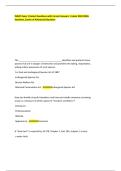
Emergency Management: Key Questions and Answers for Certification,
Exams of Advanced Education
What are the phases of emergency management? - ANSWERMitigation,
Preparation, Recovery, and Response
Hazard - ANSWERA source of danger that may or may not lead to an
emergency disaster
Risk - ANSWERThe likelihood of a hazard leading to a disaster and the actual
associated consequences. Risk may be measured and expressed
quantitatively or qualitatively (often both)
Disaster - ANSWERWhen response requirements exceed local and regional
capacity
Catastrophe - ANSWERWhen response requirements exceed state and
national capacity
Vulnerability - ANSWERA deficiency or other internal characteristics that
creates exposure to a hazard/threat. Vulnerability may be measured and
expresses in physical, environmental, social, or economic terms; simplified--
physical vulnerability (built or natural environment) and social vulnerability
(economic and other demographic factors)
, **Know what is not a vulnerability**
Stafford Act - ANSWERA lot of acts led up to it; revised the previous DRAs and
established public assistance, individual assistance, and the hazard mitigation
grant program
Constitutes the statutory authority for most Federal disaster response
activities especially as they pertain to FEMA and FEMA programs.
Most common forms of emergency management planning -
ANSWERMitigation plans
Preparedness - ANSWERState of readiness to response to a disaster, crisis, or
any other type of event
Preparedness Cycle - ANSWERPlanning
Organization and Equipment
Training
Exercise
Evaluation and Improvement
Base Plan - ANSWERContains a comprehensive set of general information
regarding the community (or facility), risks, legal responsibilities and
authority, and a framework for emergency operations
Local officials - ANSWERAlways the first to respond to any event and typically
remain in control except an act of terror or where the national security is at
risk
Exams of Advanced Education
What are the phases of emergency management? - ANSWERMitigation,
Preparation, Recovery, and Response
Hazard - ANSWERA source of danger that may or may not lead to an
emergency disaster
Risk - ANSWERThe likelihood of a hazard leading to a disaster and the actual
associated consequences. Risk may be measured and expressed
quantitatively or qualitatively (often both)
Disaster - ANSWERWhen response requirements exceed local and regional
capacity
Catastrophe - ANSWERWhen response requirements exceed state and
national capacity
Vulnerability - ANSWERA deficiency or other internal characteristics that
creates exposure to a hazard/threat. Vulnerability may be measured and
expresses in physical, environmental, social, or economic terms; simplified--
physical vulnerability (built or natural environment) and social vulnerability
(economic and other demographic factors)
, **Know what is not a vulnerability**
Stafford Act - ANSWERA lot of acts led up to it; revised the previous DRAs and
established public assistance, individual assistance, and the hazard mitigation
grant program
Constitutes the statutory authority for most Federal disaster response
activities especially as they pertain to FEMA and FEMA programs.
Most common forms of emergency management planning -
ANSWERMitigation plans
Preparedness - ANSWERState of readiness to response to a disaster, crisis, or
any other type of event
Preparedness Cycle - ANSWERPlanning
Organization and Equipment
Training
Exercise
Evaluation and Improvement
Base Plan - ANSWERContains a comprehensive set of general information
regarding the community (or facility), risks, legal responsibilities and
authority, and a framework for emergency operations
Local officials - ANSWERAlways the first to respond to any event and typically
remain in control except an act of terror or where the national security is at
risk