

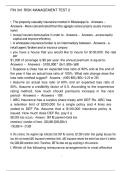
FIN 341 RISK MANAGEMENT TEST 2
1. The property-casualty insurance market in Mississippi is- Answers --
Answers - More concentrated than the aggregate national property-casualty insurance
market
2. mutual insurers demutualize in order to- Answers -- Answers - access equity
capital and improve eflciency
3. A wholesale insurance broker is an intermediary between- Answers - a
retail agent/broker and an insurance company
4. you have a house that you would like to insure for $100,000. the rate
per
$1,000 of coverage is $6 per year. the annual premium is equal to-
Answers -- Answers - $100,000 * ($6/1,000)= $600
5. Suppose a class has an expected loss ratio of 80% and at the end of
the year it has an actual loss ratio of 100%. What rate change does the
loss ratio method suggest?- Answers - (100%-80%)/80%= 0.25 or 25%
6. Assume an actual loss ratio of 60% and an expected loss ratio of
50%. Assume a credibility factor of 0.5. According to the experience
rating method, how much should premiums increase in the next
period- Answers -- Answers - 10%
7. ABC Insurance has a surplus share treaty with DEF Re. ABC has
a retention limit of $200,000 for a single policy and 4 lines are
ceded to DEF Re. Assume that a $100,000 insurance policy is
issued. How much does DEF Re. pay if a
$50,000 loss occurs.- Answers - DEF RE payment=(total loss-
retention)/ (number of lines) ($50,000-$200,000)/4
-150,000/4= -37,500
In this context, the negative sign indicates that DEF Re receives $37,500 (rather than paying) because the
loss did not exceed ABC Insurance's retention limit. ABC Insurance retains the entire loss since it is below
the $200,000 retention limit. Therefore, DEF Re does not pay anything in this scenario.
8. Which of the following reinsurance arrangements is most effective
1/
11
, at protect- ing against high loss ratios following large losses?- Answers
- excess of loss
9. The U.S. P/C industry has the following data for 2017. Net Premiums
Written
= 552.6; Premiums Earned = 540.6; Losses and LAE Incurred = 410.2;
Net Investment Income = 49; Underwriting Expenses = 151.1. The
combined ratio (expressed as a %) is- Answers -- Answers - loss ratio= (incurred losses+
loss adjustment expense)/premiums earned
410.2/540.6= 0.7588
2/
11
1. The property-casualty insurance market in Mississippi is- Answers --
Answers - More concentrated than the aggregate national property-casualty insurance
market
2. mutual insurers demutualize in order to- Answers -- Answers - access equity
capital and improve eflciency
3. A wholesale insurance broker is an intermediary between- Answers - a
retail agent/broker and an insurance company
4. you have a house that you would like to insure for $100,000. the rate
per
$1,000 of coverage is $6 per year. the annual premium is equal to-
Answers -- Answers - $100,000 * ($6/1,000)= $600
5. Suppose a class has an expected loss ratio of 80% and at the end of
the year it has an actual loss ratio of 100%. What rate change does the
loss ratio method suggest?- Answers - (100%-80%)/80%= 0.25 or 25%
6. Assume an actual loss ratio of 60% and an expected loss ratio of
50%. Assume a credibility factor of 0.5. According to the experience
rating method, how much should premiums increase in the next
period- Answers -- Answers - 10%
7. ABC Insurance has a surplus share treaty with DEF Re. ABC has
a retention limit of $200,000 for a single policy and 4 lines are
ceded to DEF Re. Assume that a $100,000 insurance policy is
issued. How much does DEF Re. pay if a
$50,000 loss occurs.- Answers - DEF RE payment=(total loss-
retention)/ (number of lines) ($50,000-$200,000)/4
-150,000/4= -37,500
In this context, the negative sign indicates that DEF Re receives $37,500 (rather than paying) because the
loss did not exceed ABC Insurance's retention limit. ABC Insurance retains the entire loss since it is below
the $200,000 retention limit. Therefore, DEF Re does not pay anything in this scenario.
8. Which of the following reinsurance arrangements is most effective
1/
11
, at protect- ing against high loss ratios following large losses?- Answers
- excess of loss
9. The U.S. P/C industry has the following data for 2017. Net Premiums
Written
= 552.6; Premiums Earned = 540.6; Losses and LAE Incurred = 410.2;
Net Investment Income = 49; Underwriting Expenses = 151.1. The
combined ratio (expressed as a %) is- Answers -- Answers - loss ratio= (incurred losses+
loss adjustment expense)/premiums earned
410.2/540.6= 0.7588
2/
11


