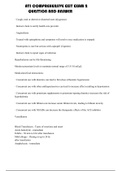
ATI COMPREHENSIVE EXIT EXAM 2
QUESTION AND ANSWER
· Cough, rash or altered or distorted taste (dysgeusia)
· Instruct client to notify health care provider
· Angioedema
· Treated with epinephrine and symptoms will resolve once medication is stopped
· Neutropenia is rare but serious with captopril (Capoten)
· Instruct client to report signs of infection
Hyperkalemia can be life-threatening
Monitor potassium levels to maintain normal range of 3.5-5.0 mEq/L
Medication/food interactions:
· Concurrent use with diuretics can lead to first-dose orthostatic hypotension
· Concurrent use with other antihypertensives can lead to increase effect resulting in hypotension
· Concurrent use with potassium supplements or potassium-sparing diuretics increases the risk of
hyperkalemia
· Concurrent use with lithium can increase serum lithium levels, leading to lithium toxicity
· Concurrent use with NSAIDs can decrease the therapeutic effects of the ACE inhibitor
Vasodilators
Blood Transfusion - Types of reactions and onset
Acute hemolytic - immediate
Febrile - 30 min to 6 hr after transfusion
Mild allergic - During or up to 24 hr
after transfusion
Anaphylactic - immediate
,Blood Transfusion Reaction - Medications
Antipyretics (acetaminophen [Tylenol])
- febrile
Antihistamines (diphenhydramine
[Benadryl]) - mild allergic
Antihistamines, corticosteroids,
vasopressors - anaphylactic
Blood Transfusion - Potential Complications
Circulatory overload:
Administer oxygen.
Monitor vital signs.
Slow the infusion rate.
Administer diuretics as prescribed.
Notify the provider immediately
Blood Transfusion - Sepsis and septic shock
Maintain patent airway.
Administer oxygen.
Administer antibiotics as prescribed.
Obtain blood samples for culture.
Administer vasopressors in late phase.
Elevate client's feet.
Assess for disseminated
intravascular coagulation.
Digoxin - Take apical pulse for 1 min, and monitor laboratory levels for signs of toxicity.
Digoxin - Instruct the client not to take medication within 2 hr of eating, and teach client how
to take an apical pulse for 1 min.
Sodium polystyrene - Instruct the client to take a mild laxative if constipated, and teach how to
take blood pressure
Sodium polystyrene - Monitor for hypokalemia, and restrict sodium intake.
Epoetin alfa - Instruct the client about having blood tests twice a week and how to take
blood pressure.
,Epoetin alfa - Administer by subcutaneous route, and monitor for hypertension.
Ferrous sulfate - Instruct the client to take medication with food and that stools will be dark
in color.
Ferrous sulfate - Administer following dialysis and with a stool softener
Aluminum hydroxide gel - Avoid administering if client has gastrointestinal disorders;
administer a stool softener with this medication
Aluminum hydroxide gel - Instruct the client to report constipation to the provider and to take
2 hr before or after receiving digoxin.
Furosemide - Monitor intake and output and blood pressure.
Furosemide - Instruct the client to weigh self each morning and to notify provider of
light
-
headedness, excess thirst, and unusual coughing
Asthma - Combination agents (bronchodilator and anti-inflammatory)
Ipratropium and albuterol (Combivent)
Fluticasone and salmeterol (Advair)
If prescribed separately for inhalation administration at the same time, administer the
bronchodilator first in order to increase the absorption of the anti-inflammatory agent
ASTHMA- Encourage the client to drink plenty of fluids to promote hydration.
Encourage the client to take prednisone with food.
Advise client to use this medication to prevent asthma, not for the onset of an attack.
Encourage client to avoid persons with respiratory infections.
Use good mouth care.
Do not stop the use of this type of medication suddenly.
Short-acting beta2
agonists, such as albuterol (Proventil, Ventolin)
Provide rapid relief of acute
, symptoms and prevent exercise-induced asthma.
Anticholinergic medications, such as ipratropium (Atrovent), block the parasympathetic nervous
system.
This allows for the sympathetic nervous system effects of increased bronchodilation
and decreased pulmonary secretions.
These medications are long-acting and used to
prevent bronchospasms
Ipratropium - Advise the client to suck on hard candies to help relieve dry mouth; increase
fluid intake; and report headache, blurred vision, or palpitations, which may indicate toxicity
of ipratropium.
Ipratropium - Observe the client for dry mouth.
Monitor the client's heart rate
Methylxanthines, such as theophylline (Theo-24), require close monitoring of serum medication
levels due to a narrow therapeutic range.
Use only when other treatments are ineffective.
Theophylline - Monitor the client's serum levels for toxicity. Side effects will include
tachycardia, nausea, and diarrhea
Short-acting beta2 agonists, such as albuterol (Proventil, Ventolin), provide rapid relief of acute
symptoms and prevent exercise-induced asthma.
Albuterol - Watch the client for tremors and tachycardia.
Salmeterol - Asthma
Salmeterol - Advise client to use to prevent an asthma attack and not at the onset of an attack
Combination agents (bronchodilator and anti-inflammatory)
Ipratropium and albuterol (Combivent)
Fluticasone and salmeterol (Advair)
If prescribed separately for inhalation administration at the same time, administer the
bronchodilator first in order to increase the absorption of the anti-inflammatory agent
QUESTION AND ANSWER
· Cough, rash or altered or distorted taste (dysgeusia)
· Instruct client to notify health care provider
· Angioedema
· Treated with epinephrine and symptoms will resolve once medication is stopped
· Neutropenia is rare but serious with captopril (Capoten)
· Instruct client to report signs of infection
Hyperkalemia can be life-threatening
Monitor potassium levels to maintain normal range of 3.5-5.0 mEq/L
Medication/food interactions:
· Concurrent use with diuretics can lead to first-dose orthostatic hypotension
· Concurrent use with other antihypertensives can lead to increase effect resulting in hypotension
· Concurrent use with potassium supplements or potassium-sparing diuretics increases the risk of
hyperkalemia
· Concurrent use with lithium can increase serum lithium levels, leading to lithium toxicity
· Concurrent use with NSAIDs can decrease the therapeutic effects of the ACE inhibitor
Vasodilators
Blood Transfusion - Types of reactions and onset
Acute hemolytic - immediate
Febrile - 30 min to 6 hr after transfusion
Mild allergic - During or up to 24 hr
after transfusion
Anaphylactic - immediate
,Blood Transfusion Reaction - Medications
Antipyretics (acetaminophen [Tylenol])
- febrile
Antihistamines (diphenhydramine
[Benadryl]) - mild allergic
Antihistamines, corticosteroids,
vasopressors - anaphylactic
Blood Transfusion - Potential Complications
Circulatory overload:
Administer oxygen.
Monitor vital signs.
Slow the infusion rate.
Administer diuretics as prescribed.
Notify the provider immediately
Blood Transfusion - Sepsis and septic shock
Maintain patent airway.
Administer oxygen.
Administer antibiotics as prescribed.
Obtain blood samples for culture.
Administer vasopressors in late phase.
Elevate client's feet.
Assess for disseminated
intravascular coagulation.
Digoxin - Take apical pulse for 1 min, and monitor laboratory levels for signs of toxicity.
Digoxin - Instruct the client not to take medication within 2 hr of eating, and teach client how
to take an apical pulse for 1 min.
Sodium polystyrene - Instruct the client to take a mild laxative if constipated, and teach how to
take blood pressure
Sodium polystyrene - Monitor for hypokalemia, and restrict sodium intake.
Epoetin alfa - Instruct the client about having blood tests twice a week and how to take
blood pressure.
,Epoetin alfa - Administer by subcutaneous route, and monitor for hypertension.
Ferrous sulfate - Instruct the client to take medication with food and that stools will be dark
in color.
Ferrous sulfate - Administer following dialysis and with a stool softener
Aluminum hydroxide gel - Avoid administering if client has gastrointestinal disorders;
administer a stool softener with this medication
Aluminum hydroxide gel - Instruct the client to report constipation to the provider and to take
2 hr before or after receiving digoxin.
Furosemide - Monitor intake and output and blood pressure.
Furosemide - Instruct the client to weigh self each morning and to notify provider of
light
-
headedness, excess thirst, and unusual coughing
Asthma - Combination agents (bronchodilator and anti-inflammatory)
Ipratropium and albuterol (Combivent)
Fluticasone and salmeterol (Advair)
If prescribed separately for inhalation administration at the same time, administer the
bronchodilator first in order to increase the absorption of the anti-inflammatory agent
ASTHMA- Encourage the client to drink plenty of fluids to promote hydration.
Encourage the client to take prednisone with food.
Advise client to use this medication to prevent asthma, not for the onset of an attack.
Encourage client to avoid persons with respiratory infections.
Use good mouth care.
Do not stop the use of this type of medication suddenly.
Short-acting beta2
agonists, such as albuterol (Proventil, Ventolin)
Provide rapid relief of acute
, symptoms and prevent exercise-induced asthma.
Anticholinergic medications, such as ipratropium (Atrovent), block the parasympathetic nervous
system.
This allows for the sympathetic nervous system effects of increased bronchodilation
and decreased pulmonary secretions.
These medications are long-acting and used to
prevent bronchospasms
Ipratropium - Advise the client to suck on hard candies to help relieve dry mouth; increase
fluid intake; and report headache, blurred vision, or palpitations, which may indicate toxicity
of ipratropium.
Ipratropium - Observe the client for dry mouth.
Monitor the client's heart rate
Methylxanthines, such as theophylline (Theo-24), require close monitoring of serum medication
levels due to a narrow therapeutic range.
Use only when other treatments are ineffective.
Theophylline - Monitor the client's serum levels for toxicity. Side effects will include
tachycardia, nausea, and diarrhea
Short-acting beta2 agonists, such as albuterol (Proventil, Ventolin), provide rapid relief of acute
symptoms and prevent exercise-induced asthma.
Albuterol - Watch the client for tremors and tachycardia.
Salmeterol - Asthma
Salmeterol - Advise client to use to prevent an asthma attack and not at the onset of an attack
Combination agents (bronchodilator and anti-inflammatory)
Ipratropium and albuterol (Combivent)
Fluticasone and salmeterol (Advair)
If prescribed separately for inhalation administration at the same time, administer the
bronchodilator first in order to increase the absorption of the anti-inflammatory agent