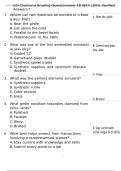
GIA Diamond Grading Questionnaire 18 With 100% Verified
Answers!!
1. Where can two materials be bonded to create
A. Near the girdle
a dou- blet?
A. Near the girdle
B. Just above the culet
C. Parallel to the bezel facets
D. Perpendicular to the table
2. What was one of the first assembled simulants B. Garnet-and-glass
in jew- elry? dou- blet
A. Coated CZ
B. Garnet-and-glass doublet
C. Synthetic spinel triplet
D. Synthetic sapphire and strontium titanate
doublet
D. Glass
3. What was the earliest diamond simulant?
A. Synthetic sapphire
B. Synthetic rutile
C. Cubic zirconia
D. Glass
D. Bruted
4. What girdle condition separates diamond from
simu- lants?
A. Polished
B. Faceted
C. Wavy
D. Bruted
A. Stay current with
5. What best helps protect from transactions knowl- edge and skills
involving misrepresented stones?
A. Stay current with knowledge and skills
B. Submit every stone to a lab
1/
5
, GIA Diamond Grading Questionnaire 18 With 100% Verified
Answers!!
C. Buy directly from mines
D. Sell only colored stones
6. What diamond simulant shows noticeable A. Synthetic rutile
doubling and strong fire?
A. Synthetic rutile
B. CZ
C. GGG
D. Strontium titanate
7. Why do some diamond simulants D. Large critical angles
display "read-through"?
A. High RI
B. Low hardness
C. Poor polish
D. Large critical angles
8. What simulant is a natural gemstone? D. Zircon
A. GGG
B. YAG
C. Strontium titanate
D. Zircon
C. Doubly refractive
9. What causes doubling in a simulant?
crystal system
A. High refractive index
B. Low dispersion value
C. Doubly refractive crystal system
D. Exceptional toughness
D. Same appearance as
10. What best describes a diamond simulant? di- amond
A. Always natural
B. Always synthetic
2/
5
Answers!!
1. Where can two materials be bonded to create
A. Near the girdle
a dou- blet?
A. Near the girdle
B. Just above the culet
C. Parallel to the bezel facets
D. Perpendicular to the table
2. What was one of the first assembled simulants B. Garnet-and-glass
in jew- elry? dou- blet
A. Coated CZ
B. Garnet-and-glass doublet
C. Synthetic spinel triplet
D. Synthetic sapphire and strontium titanate
doublet
D. Glass
3. What was the earliest diamond simulant?
A. Synthetic sapphire
B. Synthetic rutile
C. Cubic zirconia
D. Glass
D. Bruted
4. What girdle condition separates diamond from
simu- lants?
A. Polished
B. Faceted
C. Wavy
D. Bruted
A. Stay current with
5. What best helps protect from transactions knowl- edge and skills
involving misrepresented stones?
A. Stay current with knowledge and skills
B. Submit every stone to a lab
1/
5
, GIA Diamond Grading Questionnaire 18 With 100% Verified
Answers!!
C. Buy directly from mines
D. Sell only colored stones
6. What diamond simulant shows noticeable A. Synthetic rutile
doubling and strong fire?
A. Synthetic rutile
B. CZ
C. GGG
D. Strontium titanate
7. Why do some diamond simulants D. Large critical angles
display "read-through"?
A. High RI
B. Low hardness
C. Poor polish
D. Large critical angles
8. What simulant is a natural gemstone? D. Zircon
A. GGG
B. YAG
C. Strontium titanate
D. Zircon
C. Doubly refractive
9. What causes doubling in a simulant?
crystal system
A. High refractive index
B. Low dispersion value
C. Doubly refractive crystal system
D. Exceptional toughness
D. Same appearance as
10. What best describes a diamond simulant? di- amond
A. Always natural
B. Always synthetic
2/
5