

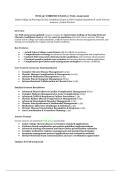
NUR 257 CHRONIC EXAM 3 | FALL 2025/2026
Galen College of Nursing Chronic Conditions Exam 3 with Complete Questions & 100% Correct
Answers | Latest Version
Overview
This Fall 2025/2026 updated resource contains the latest Galen College of Nursing NUR 257
Chronic Conditions Exam 3 with the exact 50 questions and 100% correct answers, following
current Galen College curriculum standards, evidence-based chronic disease management protocols, and
nursing care principles for complex chronic health conditions.
Key Features
● ✓ Actual Galen College exam format with the official 50 questions
● ✓ Comprehensive coverage of advanced chronic disease management and complications
● ✓ Updated Fall 2025/2026 clinical practice guidelines and treatment advancements
● ✓ Practical complex patient care scenarios and nursing decision-making applications
● ✓ Complication prevention and management strategies for chronic conditions
Core Content Areas (50 Total Questions)
● Complex Chronic Disease Management (15 Qs)
● Chronic Disease Complications & Emergencies (12 Qs)
● Advanced Medication Management (10 Qs)
● Chronic Pain & Symptom Management (8 Qs)
● Interprofessional Collaboration in Chronic Care (5 Qs)
Detailed Content Breakdown
● Advanced Heart Failure & Cardiac Complication Management (8 Qs)
● Complex Diabetes Management & Acute Complications (8 Qs)
● Advanced COPD & Respiratory Failure Prevention (7 Qs)
● Chronic Kidney Disease Progression & Management (6 Qs)
● Advanced Neurological Disorder Management (6 Qs)
● Chronic Pain Syndromes & Multimodal Management (5 Qs)
● Medication Adherence Challenges & Solutions (4 Qs)
● Chronic Disease Exacerbation Recognition & Response (4 Qs)
● Care Coordination & Transition Planning (2 Qs)
Answer Format
Correct answers are marked in bold green and include:
● Galen College chronic disease curriculum standard applications
● Evidence-based complication prevention guideline implementations
● Advanced nursing assessment and intervention prioritization rationales
● Complex medication regimen management and monitoring strategies
● Symptom management protocol applications and evaluation methods
● Interprofessional team communication and care coordination approaches
Updates for Fall 2025/2026
, ● 🔹 Reflects Fall 2025/2026 Galen College NUR 257 chronic care curriculum
● 🔹
revisions
🔹 Updated advanced diabetes technology integration (closed-loop systems, AI)
●
● 🔹
🔹
Enhanced heart failure management and remote monitoring protocols
New chronic pain management and opioid stewardship guidelines
●
● 🔹
🔹
Revised chronic kidney disease progression slowing strategies
Updated respiratory failure prevention and home ventilation care
●
● 🔹 New digital health tools for complication prediction and prevention
Revised interprofessional chronic care team models and communication
NUR 257 CHRONIC EXAM 3 QUESTIONS (1–50)
1. A patient with heart failure with reduced ejection fraction (HFrEF) is on a new
closed-loop insulin pump for comorbid type 1 diabetes. The nurse recognizes that fluid
retention from HF may affect:
A. Insulin absorption only
B. Continuous glucose monitor (CGM) accuracy due to interstitial fluid changes
C. Pump battery life
D. Carbohydrate counting
Rationale: Edema alters interstitial fluid composition, potentially causing CGM lag or inaccuracy.
Nurses must correlate CGM trends with clinical status and capillary glucose if HF exacerbation
occurs (ADA Diabetes Tech, 2025).
2. A patient with advanced COPD on home oxygen develops morning headaches and
confusion. The nurse suspects:
A. Hypoglycemia
B. Oxygen-induced hypercapnia (CO₂ retention)
C. Stroke
D. Anxiety
Rationale: In severe COPD, high-flow oxygen can suppress hypoxic drive, leading to
hypoventilation, CO₂ retention, and respiratory acidosis—manifesting as headache, confusion, and
somnolence (GOLD Guidelines, 2025).
, 3. A patient with diabetic ketoacidosis (DKA) has a serum potassium of 5.8 mEq/L. The
nurse anticipates:
A. Immediate potassium replacement
B. Holding potassium and monitoring for hypokalemia during insulin therapy
C. Administering sodium polystyrene sulfonate
D. Increasing insulin dose
Rationale: Total body potassium is depleted in DKA, but acidosis shifts K⁺ extracellularly, causing
pseudohyperkalemia. Insulin drives K⁺ into cells, causing rapid hypokalemia—requiring careful
replacement once K⁺ <5.3 (ADA DKA, 2025).
4. A patient with stage 4 chronic kidney disease (CKD) is prescribed
trimethoprim-sulfamethoxazole for a UTI. The nurse should question this order due to risk
of:
A. Hepatotoxicity
B. Hyperkalemia and acute kidney injury
C. Hypoglycemia
D. QT prolongation
Rationale: Trimethoprim blocks renal potassium excretion and can cause life-threatening
hyperkalemia in CKD. It also crystallizes in renal tubules, risking AKI (KDIGO CKD, 2025; Beers
Criteria).
5. A patient with Parkinson’s disease experiences “wearing-off” motor fluctuations. The
nurse expects the provider to consider:
A. Discontinuing levodopa
B. Adding a COMT inhibitor (e.g., entacapone) to prolong levodopa effect
C. Starting an anticholinergic
D. Increasing carbidopa dose only
Rationale: COMT inhibitors extend levodopa half-life, reducing “off” time. Anticholinergics are for
tremor only and avoided in older adults (MDS Parkinson’s Guidelines, 2025).
Galen College of Nursing Chronic Conditions Exam 3 with Complete Questions & 100% Correct
Answers | Latest Version
Overview
This Fall 2025/2026 updated resource contains the latest Galen College of Nursing NUR 257
Chronic Conditions Exam 3 with the exact 50 questions and 100% correct answers, following
current Galen College curriculum standards, evidence-based chronic disease management protocols, and
nursing care principles for complex chronic health conditions.
Key Features
● ✓ Actual Galen College exam format with the official 50 questions
● ✓ Comprehensive coverage of advanced chronic disease management and complications
● ✓ Updated Fall 2025/2026 clinical practice guidelines and treatment advancements
● ✓ Practical complex patient care scenarios and nursing decision-making applications
● ✓ Complication prevention and management strategies for chronic conditions
Core Content Areas (50 Total Questions)
● Complex Chronic Disease Management (15 Qs)
● Chronic Disease Complications & Emergencies (12 Qs)
● Advanced Medication Management (10 Qs)
● Chronic Pain & Symptom Management (8 Qs)
● Interprofessional Collaboration in Chronic Care (5 Qs)
Detailed Content Breakdown
● Advanced Heart Failure & Cardiac Complication Management (8 Qs)
● Complex Diabetes Management & Acute Complications (8 Qs)
● Advanced COPD & Respiratory Failure Prevention (7 Qs)
● Chronic Kidney Disease Progression & Management (6 Qs)
● Advanced Neurological Disorder Management (6 Qs)
● Chronic Pain Syndromes & Multimodal Management (5 Qs)
● Medication Adherence Challenges & Solutions (4 Qs)
● Chronic Disease Exacerbation Recognition & Response (4 Qs)
● Care Coordination & Transition Planning (2 Qs)
Answer Format
Correct answers are marked in bold green and include:
● Galen College chronic disease curriculum standard applications
● Evidence-based complication prevention guideline implementations
● Advanced nursing assessment and intervention prioritization rationales
● Complex medication regimen management and monitoring strategies
● Symptom management protocol applications and evaluation methods
● Interprofessional team communication and care coordination approaches
Updates for Fall 2025/2026
, ● 🔹 Reflects Fall 2025/2026 Galen College NUR 257 chronic care curriculum
● 🔹
revisions
🔹 Updated advanced diabetes technology integration (closed-loop systems, AI)
●
● 🔹
🔹
Enhanced heart failure management and remote monitoring protocols
New chronic pain management and opioid stewardship guidelines
●
● 🔹
🔹
Revised chronic kidney disease progression slowing strategies
Updated respiratory failure prevention and home ventilation care
●
● 🔹 New digital health tools for complication prediction and prevention
Revised interprofessional chronic care team models and communication
NUR 257 CHRONIC EXAM 3 QUESTIONS (1–50)
1. A patient with heart failure with reduced ejection fraction (HFrEF) is on a new
closed-loop insulin pump for comorbid type 1 diabetes. The nurse recognizes that fluid
retention from HF may affect:
A. Insulin absorption only
B. Continuous glucose monitor (CGM) accuracy due to interstitial fluid changes
C. Pump battery life
D. Carbohydrate counting
Rationale: Edema alters interstitial fluid composition, potentially causing CGM lag or inaccuracy.
Nurses must correlate CGM trends with clinical status and capillary glucose if HF exacerbation
occurs (ADA Diabetes Tech, 2025).
2. A patient with advanced COPD on home oxygen develops morning headaches and
confusion. The nurse suspects:
A. Hypoglycemia
B. Oxygen-induced hypercapnia (CO₂ retention)
C. Stroke
D. Anxiety
Rationale: In severe COPD, high-flow oxygen can suppress hypoxic drive, leading to
hypoventilation, CO₂ retention, and respiratory acidosis—manifesting as headache, confusion, and
somnolence (GOLD Guidelines, 2025).
, 3. A patient with diabetic ketoacidosis (DKA) has a serum potassium of 5.8 mEq/L. The
nurse anticipates:
A. Immediate potassium replacement
B. Holding potassium and monitoring for hypokalemia during insulin therapy
C. Administering sodium polystyrene sulfonate
D. Increasing insulin dose
Rationale: Total body potassium is depleted in DKA, but acidosis shifts K⁺ extracellularly, causing
pseudohyperkalemia. Insulin drives K⁺ into cells, causing rapid hypokalemia—requiring careful
replacement once K⁺ <5.3 (ADA DKA, 2025).
4. A patient with stage 4 chronic kidney disease (CKD) is prescribed
trimethoprim-sulfamethoxazole for a UTI. The nurse should question this order due to risk
of:
A. Hepatotoxicity
B. Hyperkalemia and acute kidney injury
C. Hypoglycemia
D. QT prolongation
Rationale: Trimethoprim blocks renal potassium excretion and can cause life-threatening
hyperkalemia in CKD. It also crystallizes in renal tubules, risking AKI (KDIGO CKD, 2025; Beers
Criteria).
5. A patient with Parkinson’s disease experiences “wearing-off” motor fluctuations. The
nurse expects the provider to consider:
A. Discontinuing levodopa
B. Adding a COMT inhibitor (e.g., entacapone) to prolong levodopa effect
C. Starting an anticholinergic
D. Increasing carbidopa dose only
Rationale: COMT inhibitors extend levodopa half-life, reducing “off” time. Anticholinergics are for
tremor only and avoided in older adults (MDS Parkinson’s Guidelines, 2025).



