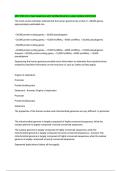
HLTH 331 Exam 2 Questions with Verified Solutions Latest Update 2025/2026
Young children living in poverty are more likely to have - Answers cognitive, behavioral, and
Socio-emotional difficulties.
health equity - Answers Attainment of the highest level of health for all people
What is not an essential element in the pathways to health equity developed by NASEM leaders
and partners? - Answers Government institutions
Data from 2015 documented that 46% of ____ youth have considered suicide. - Answers LGBTQ
For which age group are unintentional injuries among the top three causes of death? - Answers
Adults 25-64 years
health disparity - Answers A particular type of health difference that is closely linked with social,
economic, and/or environmental disadvantage
In 2014, 34% of ___ children lived with two married parents. - Answers Black-alone
Which of the following is considered by Healthy People 2020 leaders to be an important health
issue for U.S. adolescents? - Answers Homicide
Survey results have shown that more than ___ have experienced rape, physical violence, and/or
stalking by an intimate partner. - Answers 1 in 3 women and 1 in 4 men
Exposure to hazardous materials or chemicals, physically taxing labor, or jobs requiring more
sedentary behaviors provide a confounding effect on biological factors in which disease or
condition? - Answers Diabetes
epidemiology - Answers study of disease, determinants of health and behaviors that
prevent/cause disease or injury
purpose of epidemiology - Answers study past or current trends, identify causes of deaths,
define risk factors, determine need for health services, feasible prevention/promotion strategies
morbidity - Answers rate of illness
incidences- # of NEW cases (how fast is it spreading)
prevalences: total # of cases (how common)
mortality - Answers rate of deaths
primary prevention - Answers efforts to prevent individuals in becoming sick
, education is easiest/cheapest in long run
secondary prevention - Answers efforts to prevent the progression of a disease once it occurs
-already have it but try to catch it early on
-screenings/blood test
tertiary prevention - Answers efforts to prevent situations in becoming worse
-rehab, therapy
Americans tend to spend more time on - Answers secondary/tertiary prevention
harder to get people to listen at primary
cross-sectional study - Answers one-time data collection set
-prevalence (nothing to compare to)
-determines correlation NOT causation
-oftentimes we overestimate the impacts of a correlation
cohort studies - Answers a cohort of people is followed and studied through time
-first one is prevalence, rest of data collected are incidences
case-controlled studies - Answers cases are compared to controls to determine how/why a
disease occurs
-cases: people presenting w/ a disease
-controls: people without disease but similiar
sampling - Answers using a representative portion of a population in a study
-sample because impossible to study whole population
-represent the pop.
-convenience sample: convenient and does not always represent the population
Most to least impactful on health - Answers social & economic factors, health behaviors, clinical
care, physical environment
Quantitative methods - Answers purpose: measure, explain/predict & generalize
measure/quantify: measure and compare variables
Young children living in poverty are more likely to have - Answers cognitive, behavioral, and
Socio-emotional difficulties.
health equity - Answers Attainment of the highest level of health for all people
What is not an essential element in the pathways to health equity developed by NASEM leaders
and partners? - Answers Government institutions
Data from 2015 documented that 46% of ____ youth have considered suicide. - Answers LGBTQ
For which age group are unintentional injuries among the top three causes of death? - Answers
Adults 25-64 years
health disparity - Answers A particular type of health difference that is closely linked with social,
economic, and/or environmental disadvantage
In 2014, 34% of ___ children lived with two married parents. - Answers Black-alone
Which of the following is considered by Healthy People 2020 leaders to be an important health
issue for U.S. adolescents? - Answers Homicide
Survey results have shown that more than ___ have experienced rape, physical violence, and/or
stalking by an intimate partner. - Answers 1 in 3 women and 1 in 4 men
Exposure to hazardous materials or chemicals, physically taxing labor, or jobs requiring more
sedentary behaviors provide a confounding effect on biological factors in which disease or
condition? - Answers Diabetes
epidemiology - Answers study of disease, determinants of health and behaviors that
prevent/cause disease or injury
purpose of epidemiology - Answers study past or current trends, identify causes of deaths,
define risk factors, determine need for health services, feasible prevention/promotion strategies
morbidity - Answers rate of illness
incidences- # of NEW cases (how fast is it spreading)
prevalences: total # of cases (how common)
mortality - Answers rate of deaths
primary prevention - Answers efforts to prevent individuals in becoming sick
, education is easiest/cheapest in long run
secondary prevention - Answers efforts to prevent the progression of a disease once it occurs
-already have it but try to catch it early on
-screenings/blood test
tertiary prevention - Answers efforts to prevent situations in becoming worse
-rehab, therapy
Americans tend to spend more time on - Answers secondary/tertiary prevention
harder to get people to listen at primary
cross-sectional study - Answers one-time data collection set
-prevalence (nothing to compare to)
-determines correlation NOT causation
-oftentimes we overestimate the impacts of a correlation
cohort studies - Answers a cohort of people is followed and studied through time
-first one is prevalence, rest of data collected are incidences
case-controlled studies - Answers cases are compared to controls to determine how/why a
disease occurs
-cases: people presenting w/ a disease
-controls: people without disease but similiar
sampling - Answers using a representative portion of a population in a study
-sample because impossible to study whole population
-represent the pop.
-convenience sample: convenient and does not always represent the population
Most to least impactful on health - Answers social & economic factors, health behaviors, clinical
care, physical environment
Quantitative methods - Answers purpose: measure, explain/predict & generalize
measure/quantify: measure and compare variables